One Mom Monopolized the Courtyard Swing for Her Daughter Daily – Her Response Made Us Regret Judging Her
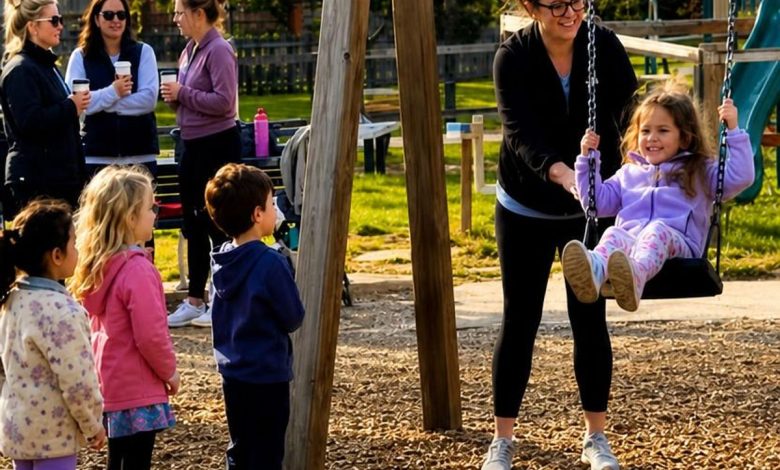
We all thought one mother was being selfish by letting her daughter monopolize the swing every day. Then she told me the reason, and the gossip suddenly felt cruel.
The woman started crying before I had even finished my sentence.
Not loudly.
Her face just folded, and she turned away so quickly that for one awful second I thought I had scared her.
“No,” she said, wiping both cheeks. “No, you’re right.”
I stood there wishing I could pull the last 30 seconds back into my mouth.
Behind me, I knew the other mothers were listening.
They had been very subtle about following me across the courtyard.
By “subtle,” I mean six grown women had all somehow decided they needed to stand 20 feet closer to the swing at exactly the same time.
The little girl kept swinging.
Forward. Back.
Forward. Back.
Her mother took a shaky breath.
“It’s just… our situation isn’t a normal one.”
That’s when the gossip behind me stopped.
Completely.
My name is Alice. I’m married to Tom, and we have a six-year-old son named Mike.
We moved into our apartment complex three months ago.
It’s built around a shared courtyard with benches, grass, and a small playground in the middle.
The playground was the first thing people told me about.
“Parents built it themselves,” my neighbor Jenna said the week we moved in.
Apparently, management had promised new equipment and then never followed through.
So the residents raised money.
A few parents knew construction.
Someone found discounted materials.
Others spent weekends helping.
They built a climbing frame, slide, monkey bars, and one swing.
Just one.
I remember saying, “Only one?”
Jenna laughed. “Budget ran out.”
At first, I thought the whole thing was lovely.
Neighbors building something for their kids.
A real community.
Then I started hearing about the swing.
There was a little girl who used it almost every afternoon.
Four or five years old.
Tiny. Dark hair. Pink headphones most days.
She would sit there for what felt like forever while her mother stood beside her.
Her name was Sophie. Her mother was Rachel.
And according to the parents near the bench, Rachel and Sophie were becoming a Problem.
“She’s been on it 40 minutes,” Jenna said one afternoon.
Another mother, Paige, checked her phone.
“Forty-seven.”
“You timed her?”
“I’m waiting for Olivia to get a turn.”
Olivia, apparently suffering terribly, was hanging upside down from the monkey bars, yelling that she was a bat.
I sipped my coffee. “Has Olivia asked?”
Paige frowned. “She shouldn’t have to.”
That was my introduction to the politics of the courtyard swing.
Over the next few weeks, I heard the same complaints.
Rachel never told Sophie to get off.
Rachel didn’t make her take turns.
Rachel barely spoke to anyone.
Then the complaints became personal.
“She didn’t contribute when we built this,” Melissa said one day.
I asked, “Maybe she moved in later?”
“No. She was here.”
Then Jenna lowered her voice. “And there’s no dad.”
I looked at her. “What does that have to do with the swing?”
She shrugged. “Nothing. I’m just saying.”
People are always “just saying” right before saying something they know they shouldn’t.
Apparently Rachel worked part-time.
Apparently Sophie didn’t attend the same preschool as the other children.
Apparently Rachel sometimes left the courtyard suddenly.
Apparently she had once ignored someone who said hello.
The strange thing was that nobody actually talked to her.
For all the outrage, nobody walked across the playground and said, “Would Sophie mind letting someone else have a turn?”
They preferred discussing Rachel from a distance.
I didn’t join in much. But I listened.
That’s not as innocent as I’d like it to sound.
Because after enough afternoons hearing the complaints, I started noticing the swing too.
I’d arrive at four. Sophie was on it.
Twenty minutes later, still there.
Sometimes Rachel pushed her. Sometimes Sophie moved herself.
Mostly Rachel stood nearby and watched.
She never sat down.
Never chatted. Never looked at her phone for long.
One afternoon, the swing slowed, and Sophie made a sharp sound.
Not quite a scream. More like panic.
Rachel immediately pushed her again.
The sound stopped.
I remember thinking: Well, that’s not helping.
I hate admitting that now.
But I thought it.
Then came the afternoon when I finally said something.
Mike and I had been downstairs for maybe half an hour.
Sophie was swinging.
Again.
Paige and Melissa were complaining.
“It’s every day,” Paige said.
“She acts like she owns it.”
Melissa folded her arms. “My husband helped build that frame.”
Something about that annoyed me.
Not because other children didn’t deserve access.
They did.
But because we were standing close enough for Rachel to see us talking about her.
So I said, “Can’t somebody just talk to her?”
They both looked at me.
“If it’s a problem, ask her. Like a normal person.”
Jenna smiled. “You know what, Alice? You’re right.”
I should have recognized the smile.
“You go.”
“Me?”
“You’re new.”
“Exactly.”
“It’ll be less awkward coming from you.”
I stared at her. “Wouldn’t that make it more awkward?”
She laughed. “What have you got to lose?”
I remember thinking that was a strange way to put it.
But I went.
Halfway across the courtyard, I noticed the others drifting closer.
A step here.
A step there.
Suddenly, everyone wanted a better view of the slide.
That was when I realized they wanted to hear the conversation.
I nearly turned around.
Instead, I walked up to Rachel. “Hi.”
She looked at me.
Up close, she seemed younger than I’d thought.
Early 30s, maybe. Tired eyes. Hair pulled into a loose knot.
“Hi.”
“I’m Alice. We moved into Building B recently.”
“I know. Mike’s your son.”
That surprised me.
“Yes.”
She smiled faintly. “Sophie likes watching him run.”
I looked at the swing.
Sophie stared straight ahead, headphones over her ears.
Forward. Back.
Forward. Back.
I almost abandoned the whole thing.
Then I said, “Sorry to bother you. I just wanted to ask something.”
Rachel’s shoulders tightened.
That should have told me she already knew. “Sophie seems to spend quite a lot of time on the swing.”
Rachel looked at her daughter. “She does.”
“And some of the other kids would probably like turns sometimes.”
I pointed unnecessarily toward Mike.
Mike was currently banging a plastic dinosaur against the ground and had shown no interest in the swing all day.
I felt ridiculous.
Rachel looked at me. Then she started crying.
“No. You’re right.”
I immediately said, “I’m sorry. I wasn’t trying to upset you.”
“It’s okay.”
“It really isn’t a huge deal.”
“It is.”
She wiped her face. “Our situation just isn’t a normal one.”
I waited.
Rachel looked toward Sophie. “She’s autistic.”
I nodded.
That explained the headphones. Not the tears.
Rachel continued.
“She doesn’t speak much. She has sensory issues. Repetitive movement helps her regulate when she’s overwhelmed.”
“The swing?”
“The swing.”
She swallowed. “Especially this one.”
Apparently Sophie had always loved repetitive movement.
At home, she rocked.
At occupational therapy, she used a platform swing.
But after moving into the apartment, this swing became part of her daily routine.
Same time. Same motion. Same number of pushes at the beginning.
When Sophie became overwhelmed, swinging could help her settle enough to eat, sleep, or transition upstairs.
“She doesn’t understand taking turns the same way the other kids do yet,” Rachel said. “We’re working on it.”
My face burned.
“I didn’t know.”
“Why would you?”
Then she looked past me. Toward the mothers.
Her expression changed. So she had noticed them too.
Of course she had.
“They’ve been talking about us for months,” she said quietly.
Nobody behind me moved.
I said, “I’m sorry.”
Rachel shook her head. “You’re the first one who’s asked.”
That felt worse.
Then she said, “I know we stay too long.”
“Rachel—”
“No. We do.”
Her voice wasn’t defensive.
Just tired.
“Some days I can get her off after 15 minutes. Some days it takes 40. If I pull her off suddenly, she panics.”
She showed me faint scratches on her forearm.
“She’s not trying to hurt me. She just loses control.”
That changed how I remembered the sound I’d heard days earlier.
I had thought Rachel was giving in.
She had been trying to keep Sophie from becoming overwhelmed.
Still, Rachel said she knew the playground belonged to everyone.
She had started coming at quieter times.
She used countdowns.
Five more minutes. Three more. Last swing.
Then a picture card showing “finished.”
Some days it worked. Some days it didn’t.
I asked, “Why didn’t you tell anyone?”
Rachel stared at me. “Tell them what?”
“I don’t know. About Sophie.”
Her expression wasn’t angry.
But it made me hear how stupid my question sounded.
“I shouldn’t have to explain her diagnosis to everyone in the courtyard before people speak to me like a person.”
“No.”
“And I don’t want every parent telling their child there’s something wrong with her.”
“There’s nothing wrong with her.”
“I know.”
She said it firmly.
That was when I realized she had probably heard the opposite too many times.
Behind us, there was silence.
Then Melissa walked over. “Rachel?”
Her face was red. “I didn’t know.”
Rachel nodded. “I know.”
Melissa looked down. “I said some things I shouldn’t have.”
That surprised me.
A direct apology is rarer than gossip.
Rachel didn’t rescue her from the discomfort.
She simply said, “Okay.”
Then Paige approached.
Then Jenna.
Suddenly the little group that had spent weeks dissecting Rachel’s life was standing there with nothing clever to say.
Jenna finally asked, “Was that why you didn’t contribute when we built the playground?”
I nearly shoved her into a bush.
The timing was unbelievable.
But Rachel gave a tired laugh.
“Actually, no.”
Then came the second thing none of us knew.
When the playground fund was being collected, Rachel had been living with Sophie’s father.
He controlled all their money.
Her paycheck went into an account he managed.
She had no card in her own name.
She had wanted to contribute $20.
He refused.
A few months later, she left him.
“There is a dad,” Rachel said quietly. “He’s just not allowed to come here.”
Nobody spoke.
I remembered Jenna whispering, “There’s no dad.”
Suddenly the phrase sounded uglier.
Rachel didn’t give us details.
She didn’t owe us any.
She only said there had been enough incidents that she had a protective order and building management knew not to let him inside.
When she left, she had Sophie, two bags, and $83.
“So no,” she said. “I didn’t pay for the playground.”
Melissa’s eyes filled.
Rachel looked at her. “But Sophie loves what you all built.”
That sentence destroyed whatever pride was left in the group.
Then Mike ran over holding a dead beetle.
“Mom, can I keep this?”
“No.”
“But he’s already dead.”
“Especially no.”
Rachel laughed. A real laugh.
Even Sophie glanced toward us.
Then the swing slowed.
Rachel stepped closer. “Five more.”
She held up a card with the number five.
Sophie made an unhappy sound.
“Five,” Rachel repeated gently.
Then she counted down.
Five. Four. Three. Two. One.
“Finished.”
Sophie gripped the chains.
For a second, I expected panic. Instead, she breathed hard, kicked once, then let Rachel help her down.
Rachel handed her another card.
“Home.”
Sophie looked at it. Then took her mother’s hand.
Before they left, she turned back toward the swing.
Paige’s daughter had already climbed on.
Sophie watched her. Then walked away.
It was a tiny victory.
Rachel looked like she’d won a marathon.
Things changed after that.
Not perfectly.
This isn’t one of those stories where everyone learns a lesson on Tuesday and becomes a better person by Wednesday.
There were still days when children wanted the swing while Sophie was using it.
There were still days she struggled to leave.
But people started talking to Rachel instead of about her.
That helped.
We came up with something simple.
During busy afternoons, parents used a timer if another child was waiting.
Rachel practiced it with Sophie.
Nobody demanded she get off immediately if she was already distressed.
In return, Rachel watched for other children waiting.
It wasn’t complicated.
Most community problems become less mysterious once people actually speak.
About a month later, Tom and two other dads added a second swing.
Not “for Sophie.”
Rachel was clear about that.
For everyone.
There had always been room on the frame, but the first time around, the money had run out.
This time, people collected again.
Rachel was the first person to contribute. Twenty dollars.
Melissa tried to refuse it.
Rachel said, “Don’t you dare.”
So Melissa took it.
Now there are two swings. Sophie still prefers the original one.
Apparently, the second makes a slightly different squeaking sound.
I cannot hear the difference. Sophie absolutely can.
Rachel and I have become friends.
Not best friends. Just real friends.
Coffee sometimes. Texts.
I’ve also learned Sophie is funny.
The first time she used my name, she looked at my mug and said, “Coffee Alice.”
Rachel nearly choked laughing.
Apparently I had been categorized by beverage.
Could be worse.
A few weeks ago, a new family moved into Building D.
Their daughter ran toward the swings.
Sophie was on one. Mike was on the other.
The girl stood waiting.
Before I could say anything, Sophie noticed her.
She kept swinging for another minute.
Then Rachel held up the countdown card.
“Three more.”
Three. Two. One.
Sophie stopped. She climbed off.
Then she touched the empty swing and looked at the new girl.
The girl climbed on.
Rachel covered her mouth.
I pretended not to notice her crying.
Happy tears this time.
I think about that first afternoon more often than I’d like.
Six women standing around with coffee, forming opinions about a mother none of us had bothered to know.
We thought Rachel was selfish.
We thought Sophie was spoiled.
We thought the missing playground contribution told us what kind of person Rachel was.
We thought the absence of a father was information we had a right to interpret.
Almost everything we “knew” was wrong.
The embarrassing part is that Rachel never demanded special treatment.
She didn’t say Sophie should own the swing because she was autistic.
She knew other children needed turns.
She was already trying to teach her daughter how to manage them.
What she needed was patience.
And maybe for someone to speak to her before building an entire personality out of things we’d observed from a bench.
The other day, Jenna and I were watching the kids when she said, “Do you remember making you go over there?”
“I remember.”
“I feel terrible.”
“You should.”
She looked at me.
I smiled. “Don’t worry. I feel terrible too.”
Because I wasn’t innocent.
I may not have started the gossip, but I stood there and listened.
Eventually, listening long enough starts to look a lot like participating.
Across the courtyard, Rachel was counting.
“Three.”
Sophie swung forward.
“Two.”
Back.
“One.”
The swing slowed. Sophie climbed off.
Another child climbed on.
No argument. No crisis.
Just a little girl learning something difficult at her own pace.
And a group of adults who had needed much longer to learn something that should have been easy.
Do you think the other parents were wrong for being frustrated about the swing, or was the real problem that they judged Rachel without ever speaking to her?
Read more stories
- Usha Vance Nearly Loses Her Footing Exiting Helicopter While Carrying 9-Week-Old Alec — Video
- Chocolate Chip Cookie Pie
- My SIL Asked to Borrow My Wedding Dress ‘Just for Photos’ – A Week Later, I Saw Her Wearing It at a Wedding I Wasn’t Invited To
- ‘Days of Our Lives’ Star Robert Kelker-Kelly Dies — and a Former Co-Star’s Bombshell Words About Him Have Resurfaced