Released in the early 1970s, this quiet prayer rose above the noise of its time to ask for something fame could never guarantee.
Released in the early 1970s, this quiet prayer rose above the noise of its time to ask for something fame could never guarantee. Decades later, its plea for love and inner peace feels even more urgent — and strangely timeless.
In the early 1970s, George Harrison found himself at a crossroads that fame alone could not resolve.
The Beatles were gone, the world was changing rapidly, and the spiritual questions he had long carried were no longer abstract ideas — they were deeply personal needs.
Out of that quiet inner struggle came “Give Me Love (Give Me Peace on Earth),” released in 1973, not as a grand statement, but as a gentle plea.
Unlike protest songs that shouted for attention, this one spoke softly.
It didn’t demand change.
It asked for relief.
Written during a period of emotional exhaustion, “Give Me Love” reflected Harrison’s growing sense that external success meant very little without inner balance.
He had already tasted superstardom, wealth, and creative validation.
What he was searching for now was something far less tangible.
Peace.
Grace.
A sense of spiritual alignment in a world that felt increasingly chaotic.
Musically, the song is deceptively simple.
A flowing slide guitar line opens the track, warm and restrained, setting a tone of humility rather than grandeur.
The melody moves gently, almost prayer-like, never forcing emotion but allowing it to surface naturally.
There is no excess here — no dramatic climax, no showy instrumentation.
Everything serves the song’s central emotion: quiet longing.
Lyrically, Harrison avoids metaphor-heavy imagery.
Instead, he speaks plainly, almost conversationally.
“Give me love.”
“Give me peace on earth.”
The repetition feels intentional, mirroring the way real prayers are often formed — not clever, but sincere.
It’s the voice of someone who knows exactly what he needs and isn’t pretending otherwise.
What makes the song powerful is its vulnerability.
Harrison does not present himself as enlightened or resolved.
He presents himself as human.
Someone asking for help rather than offering answers.
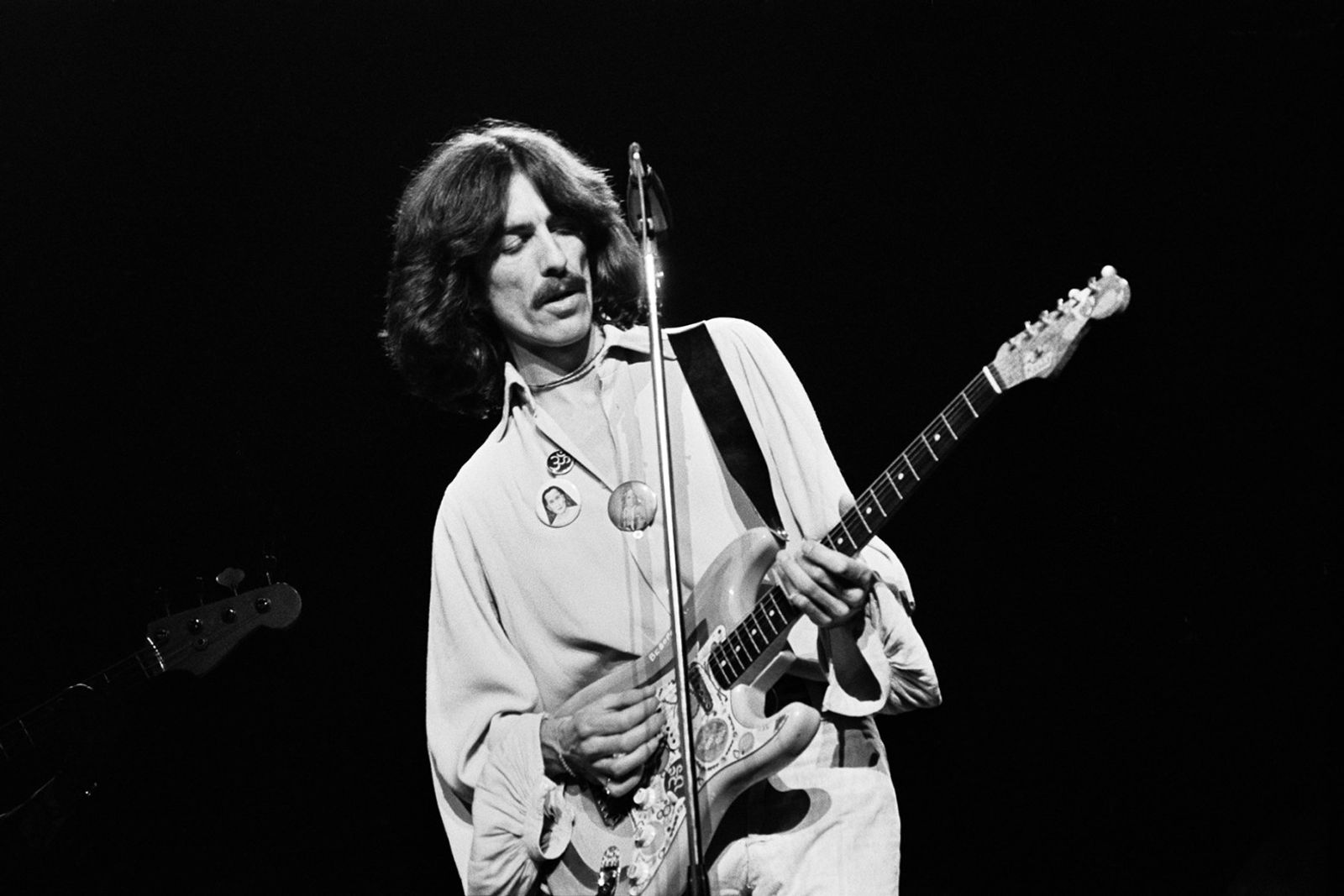
In an era where rock stars were often positioned as prophets or rebels, this humility felt strikingly honest.
When “Give Me Love” was released, it resonated immediately.
The song reached No. 1 on the Billboard Hot 100, briefly replacing Paul McCartney and Wings at the top of the chart.
Yet its success never felt like a victory lap.
It felt incidental — almost beside the point.
The song’s real impact was emotional, not commercial.
Listeners recognized themselves in its simplicity.

The desire for peace, clarity, and compassion was universal, especially in the aftermath of the turbulent 1960s and early 1970s.
This was not a song about escaping the world.
It was a song about surviving it with one’s spirit intact.
George Harrison’s slide guitar deserves special attention.
Unlike the aggressive solos common at the time, his playing here is melodic and voice-like.
It doesn’t interrupt the song.
It converses with it.
Each note feels placed rather than performed, reinforcing the sense that this music was meant to soothe rather than impress.
Over time, “Give Me Love” has aged with remarkable grace.
It hasn’t been overused or drained of meaning.
If anything, its relevance has deepened as the world has grown louder, faster, and more fractured.
The song doesn’t belong to a specific decade.
It belongs to moments of quiet reflection — early mornings, long drives, private thoughts.
For Harrison, the song represented more than a hit single.

It was confirmation that his artistic identity no longer depended on legacy or comparison.
He had found a voice that was unmistakably his own — introspective, spiritual, and grounded.
Not preachy.
Not distant.
Just honest.
Today, “Give Me Love” stands as one of George Harrison’s most enduring solo works.
It reminds us that music doesn’t always need to challenge or provoke.
Sometimes, its greatest power lies in offering comfort.
In acknowledging uncertainty rather than conquering it.
In asking for peace instead of claiming it.
In the end, “Give Me Love” is not a song that tells you what to believe.
It simply sits beside you and whispers a hope you already carry.
And that quiet sincerity is precisely why it continues to resonate, decades after it was first released.
Read more stories
- Released in 1971, this cheerful pop hit sounded bright and carefree on the surface… But hidden inside the lyrics was a surprisingly sad story most listeners never noticed.
- Shelley Winters: A Voice That Refused to Be Silenced
- Ed Harris’s Journey from Frustration to Acceptance in Dutton Ranch
- The Last Ride: John Wayne’s Moving Farewell in The Shootist