I Fell in Love Again After Losing My Husband, but My New Boyfriend Wouldn’t Let Me Visit His Home, So I Decided to Find Out Why
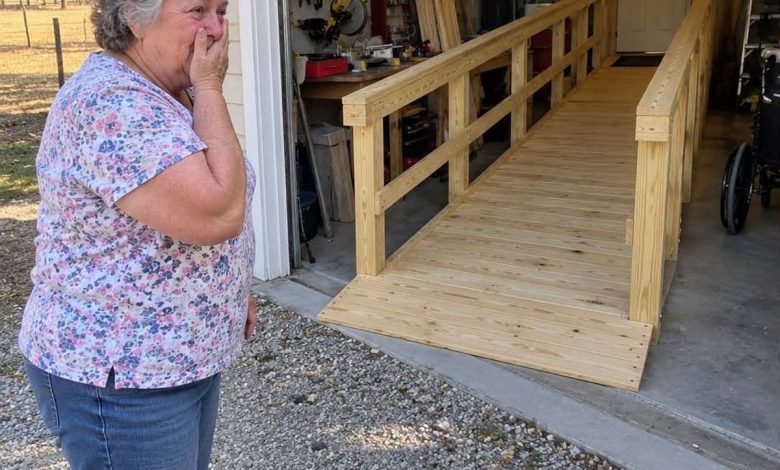
The garage door was standing wide open.
A radio was playing somewhere inside. George Strait, low and scratchy. The whole place smelled like fresh cut pine and paint.
I stood at the edge of the gravel drive in my good shoes and my good blouse, the one with the little blue buttons, and I couldn’t make my feet go any farther.
My son had told me what I would find out here. A wife, maybe. A girlfriend. A man with something to hide, who wanted his hands on my dead husband’s insurance money.
I’d driven forty minutes on back roads to prove him wrong. Or to prove him right. By then I honestly didn’t know which one I was more afraid of.
Then I looked into that garage, and I saw the ramp.
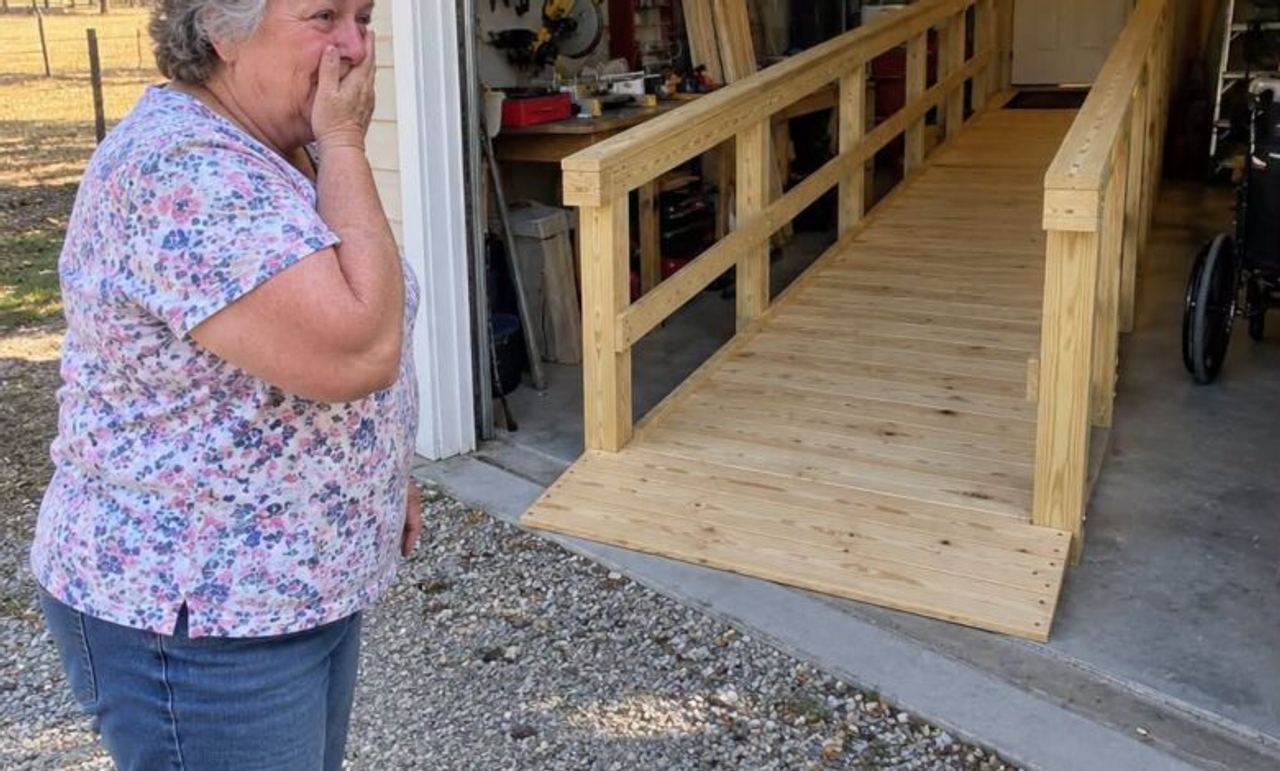
Long and wide, built of brand new lumber, so new the wood was still pale and sticky with sap. It ran from the concrete floor of the garage all the way up to the door that led into the house. There were rails on both sides. Smooth, sanded rails.
I walked over to it before I could stop myself. I put my hand on the rail.
It was exactly the right height for my hand.
Not his hand. Wendell was six foot two.
Mine.
My name is Winona Pruitt. I was an ER nurse for thirty four years at Baylor in Dallas.
I still check people’s color when they walk into a room. I can’t help it. Gray around the mouth, that’s the heart. Yellow in the whites of the eyes, that’s the liver. Too pink and too sweaty, that’s somebody whose sugar is off. Thirty four years of triage doesn’t wash out of you just because you hand in your badge.
My husband Dwight used to say I couldn’t even enjoy a church picnic without diagnosing half the congregation.
“Brother Lyle’s color is bad,” I’d whisper to him over the potato salad.
“Winnie, eat your chicken.”
“I’m just saying. Somebody ought to check his pressure.”
Brother Lyle had a heart attack six weeks later. Dwight never teased me about it again.
But I didn’t catch it with Dwight.
That’s the thing I’ve carried for two years. I could spot a heart attack across a fellowship hall, and I didn’t catch it in my own husband. He came in from mowing on a hot Saturday in November, said his arm felt funny, sat down in his brown recliner by the window and said he’d be fine after a glass of tea.
By the time I came back from the kitchen with the tea, he wasn’t fine.
I did CPR on my own living room carpet until the ambulance came. I knew. I knew before they got there. I’d seen that color a thousand times.
Dwight’s recliner still sits by the window of our house in Seagoville. It’s brown corduroy, worn smooth on the arms where his hands went. Nobody sits in it. I dust around it. Every week, I dust the end table and the lamp and the windowsill and I run the cloth all the way around that chair like it’s a little island.
My daughter Megan said once that I ought to get rid of it.
“I will,” I said. “When I’m ready.”
That was two years ago.
For a long time after Dwight died, I didn’t go anywhere except the grocery store and church and the cemetery out on Highway 175. My knees made sure of that. Thirty four years on hospital floors will grind your knees down to gravel. By sixty four, I couldn’t kneel in the garden anymore. Some mornings I had to go down the porch steps sideways, like a crab.
My neighbor Carla finally lost patience with me last June.
Carla is seventy one and lives across the street. She’s been widowed eleven years, and she wears bright pink lipstick to the mailbox, and she does not believe in sitting around.
“There’s a grief group at the senior center,” she said, standing on my porch with her purse already on her arm. “Tuesdays at ten. Coffee’s terrible but the people are nice. You’re coming.”
“I’m not much for groups.”
“You’re not much for anything these days, Winona. Get your shoes.”
So I got my shoes.
There were about a dozen of us in a little room with folding chairs and a big coffee urn and a box of Kleenex on every table. A cheerful young woman named Brooke ran it. She had Carla write my name tag in big black marker.
WINONA, in letters about two inches high.
“Lord, Carla,” I said, peeling the backing off. “I look like a kindergartner.”
“You act like one, too,” she said, and slapped it on my chest.
That’s where I met Wendell.
He was sitting across the circle from me. Big man, quiet, wearing a pressed plaid shirt buttoned all the way to the top. His name tag said WENDELL in neat block letters that he must have written himself, because they were straight as a ruler.
He had the biggest hands I’d ever seen on a man. Careful hands. When he held his little styrofoam cup of terrible coffee, he held it like it might break.
When it was his turn to talk, he said his name was Wendell Haskins. He was sixty six. He’d retired from the electric co op after thirty eight years as a lineman. His wife, Ruth, had passed fourteen months before.
“ALS,” he said. Then he stopped. He looked at his coffee cup for a long time. “That’s all I got today. Sorry.”
Brooke said that was fine. That was more than fine.
I watched him while the others talked. I couldn’t help it. His color was fine, but he had the look I used to see on family members in the ER waiting room at three in the morning. Like somebody who’s been holding his breath so long he’s forgotten how to let it out.
The second week, I came in late. My knees had been bad that morning and the porch steps took me a while. By the time I got there, everybody was already sitting down.
Wendell stood up when he saw me. He walked over to the coffee urn and came back with a cup and handed it to me.
“Two creams,” he said. “Right?”
I stared at him. “How’d you know that?”
He shrugged and sat back down. “You took two creams last week. I was paying attention.”
I didn’t know what to say. Dwight drank coffee with me every morning for thirty nine years, and to this day I’m not sure he could have told you how I took it.
The third week, after group, Wendell walked me to my car.
“Your porch light’s out,” he said.
“How do you know about my porch light?”
“You said it last week. When Brooke asked what’s hardest. You said it was little things. You said the porch light’s been out since your husband passed and you keep forgetting to get a new bulb, and every time you come home at night, it’s dark.”
I’d forgotten I said that. He hadn’t.
“It’s not the bulb,” I said. “I tried the bulb. Dwight always said it was the wiring. He kept meaning to look at it.”
“I was a lineman for thirty eight years,” Wendell said. “I can look at it.”
He came that Saturday. He spent two hours on a ladder on my front porch with his toolbox, and I stood at the bottom handing him things and trying not to fuss. He replaced the switch and a whole length of wire inside the wall. When he flipped it on, the porch light came on, bright and yellow, the first time in almost two years.
I stood in my front yard looking at it, and I had to put my hand over my mouth.
“Winona?” he said from the ladder. “You okay?”
“I’m fine,” I said. “Get down from there before you fall. I’m making you supper.”
I made chicken fried steak and mashed potatoes and green beans with bacon. He ate two helpings and said it was the best meal he’d had in a year and a half. Then he washed the dishes without asking, and dried them, and asked where everything went.
The next Sunday, he came back for supper. Then the Sunday after that.
By August, it was every Sunday.
I want to be honest about something. I didn’t think I’d ever want another man in my life after Dwight. I didn’t want one now, exactly. I wasn’t looking for a husband. I’d had one. A good one.
But it was nice to cook for two again. It was nice to have somebody to talk to while I peeled potatoes. It was nice to hear a man’s voice in the house, a deep, slow voice laughing at something on the TV.
Wendell didn’t talk much. But he listened like no man I’d ever known.
One Sunday in July, I was standing at the stove and my knees were bad. I had to hold onto the counter to get the cornbread out of the oven.
“You all right?” he asked.
“Just my knees. Thirty four years on hospital tile.” I laughed. “I’ll end up in a wheelchair like Mama did. You watch. Then you’ll have to push me around.”
I meant it as a joke. Wendell didn’t laugh.
He looked at me for a long moment across the kitchen. Then he looked down at his plate.
“Your mama was in a wheelchair?”
“The last eight years of her life. Arthritis. Her hips and knees both.”
“Where’d she live?”
“Out in Kaufman. The house I grew up in.” I set the cornbread on the table. “Little old farmhouse. She wouldn’t move. My brother and I begged her, but she said she’d been in that house fifty years and she’d die in it.” I smiled. “She painted the kitchen buttercup yellow when I was six. I remember sitting on the counter while she did it. She said yellow was the color of a happy kitchen. Every time I walked in, it was like the sun was coming up.”
“Buttercup yellow,” Wendell repeated.
“That’s what the can said. Buttercup.”
Two Sundays later, out of nowhere, he asked me about it again.
“That kitchen. Your mama’s. Was it a pale yellow, or a bright yellow?”
“Pale,” I said, surprised. “Like butter. Why?”
“Just wondering.”
And then a month after that, when I was washing up, he asked a third time. “Did the cabinets match? In your mama’s yellow kitchen? Or were they white?”
“White,” I said. “With little glass knobs. Wendell, why do you keep asking me about my mama’s kitchen?”
He just smiled and dried a plate.
“I like hearing you talk about it,” he said. “You look different when you talk about it.”
I didn’t know what that meant. I didn’t ask.
But there was one thing that started to bother me.
He never once asked me over to his place.
Not once, in four months. He came to my house every Sunday for supper. He fixed my porch light and my garbage disposal and the leaky faucet in the guest bathroom. He took me to the Mexican place in Mesquite on my birthday. He drove me to the cemetery on Dwight’s birthday and waited in the truck for a whole hour without complaining.
But whenever I said, “Next Sunday, why don’t I come to you for a change?” he’d shake his head.
“It’s not fit for company yet, Winnie.”
That was what he called me by then. Winnie. Only Dwight had ever called me that.
“I don’t care what it looks like. I was a nurse. I’ve seen worse than a messy house.”
“Give me till Christmas,” he said. “It’ll be ready by Christmas.”
I’m sixty four years old. I’ve heard every excuse a man can make. Dwight’s brother Earl kept a whole second family in Tyler for eight years and told his wife he was driving a truck route. I was the one who had to sit with her in the ER when she found out and tried to swallow a bottle of her sleeping pills.
So that one bothered me. It’s not fit for company. Give me till Christmas.
And I noticed things. I can’t turn that off.
Sawdust in the cuffs of his jeans. Little curls of it, pale, the kind that comes from a power saw.
A splinter in his palm that he hadn’t bothered to take out. I took it out myself with my tweezers at the kitchen table and he winced and said, “Mean nurse,” and I said, “You’d better believe it.”
Paint on his knuckles. A pale yellow. Scrubbed, but not all the way, the kind of paint that gets in the creases and won’t come out with soap.
When I asked about the paint, he just smiled.
“Puttering,” he said.
“Puttering at what?”
“This and that.”
And one Sunday in September, he came in and sat down in Dwight’s recliner.
Nobody had sat in that chair in two years. I stopped in the kitchen doorway with a dish of macaroni and cheese in my hands. I opened my mouth to say something.
Wendell’s head went back against the corduroy, and his eyes closed, and he was out cold. Asleep in about ten seconds. His big careful hands went loose on the worn arms of the chair, right where Dwight’s used to go.
I stood there and looked at him for a long time.
I checked his color out of habit. A little gray under the eyes. Tired. Not sick, I didn’t think. Just a man who’d been working too hard at something.
I didn’t wake him up. I let him sleep for forty five minutes while the macaroni got cold. It was nice to see somebody in that chair. I hadn’t known how much I wanted to see somebody in that chair until he was in it.
When he woke up, he was embarrassed.
“I’m sorry, Winnie. I don’t know what happened. I was up late last night.”
“Doing what?”
He hesitated.
“Puttering,” he said.
My son Zach did not like Wendell. Not from the first minute.
Zach is thirty eight. He runs a body shop in Balch Springs called Pruitt Collision. Dwight helped him start it eleven years ago with money we’d saved, and Zach has worked himself half to death keeping it going. He’s a good boy. He was always a good boy. When he was eight, he gave his whole allowance to a kid at school whose dog got hit by a car, so the kid could buy a new puppy.
But since Dwight died, Zach had changed.
Right after the funeral, while I was still in a fog, he sat me down at the kitchen table.
“Mama, I’m going to handle your bank stuff for a while,” he said. “Just till you get your feet under you. Daddy’s insurance came through, and that’s a lot of money. Old people get scammed. I see it on the news every day.”
“I’m not old, Zachary.”
“You know what I mean.” He took my hand. “Just so you don’t get scammed, Mama. Please. Let me do this for you.”
So I let him. He set up my online banking. He kept the password. When I needed to know something, I called him and he’d look it up on his phone. I didn’t mind. Honestly, I was glad not to think about it. I’d been doing paperwork for thirty four years in the hospital. I’d had enough of it.
The first time Zach met Wendell was at the end of August. He came by unexpectedly on a Sunday and found Wendell in my kitchen, drying dishes.
Zach stood in the doorway with his arms crossed. He’s built like his daddy, thick through the chest, and when he crosses his arms, he takes up the whole doorway.
“Who’s this?”
“Zach, this is Wendell Haskins. From my grief group. Wendell, this is my son.”
Wendell put down the dish towel and held out his big hand. “Pleasure to meet you, Zach. Your mama talks about you all the time.”
Zach looked at the hand for a second too long before he shook it.
“Does she,” he said.
After that, Zach started coming to Sunday supper. Every single week.
He’d never come every week before. Not even when Dwight was alive. Once a month, maybe. On holidays. He was always so busy at the shop.
Now he showed up every Sunday at five o’clock sharp with his wife Jordyn and the grandkids, Kaylee and Brody. Kaylee is seven and Brody is four. I loved having them. I’d have loved it more if I didn’t understand exactly why they were there.
Zach watched Wendell eat. That’s the only way I know how to put it. He sat across the table and watched him eat like he was counting the bites.
He asked questions. Lots of them.
“So where’d you say you worked, Wendell?”
“Trinity Valley Electric Co op. Thirty eight years.”
“And you’re retired now?”
“Two years.”
“Pension pretty good?”
“Zachary,” I said.
“What? I’m just making conversation.”
“It’s fine,” Wendell said. He wiped his mouth with his napkin. “It’s a decent pension. Enough for me.”
“Huh.” Zach cut his pork chop into small pieces. “And where do you live?”
“Out past Ferris.”
“Big place?”
“Little place.”
“Never seen it, though,” Zach said, and looked at me. “Have you, Mama?”
I didn’t answer. Wendell looked at his plate.
Across the table, Jordyn was looking at hers too. Jordyn is a quiet girl, a dental hygienist, sweet with the kids. All through supper, she hardly looked up. When I went to the kitchen to get the pie, she followed me in to help, and she stood next to me at the counter cutting slices without saying anything.
Then she said, very quietly, “He seems really nice, Miss Winona.”
“He is.”
She nodded. She kept cutting. Her hands were shaking a little. I noticed that. I thought she was nervous about Zach making a scene. I didn’t think about it again.
I should have. Thirty four years in an ER, and I didn’t think about it again.
It went on like that for three weeks. Then, on the last Sunday in September, it came apart.
Wendell had gone home early. He said he had something he needed to finish. The grandbabies were in the living room watching cartoons. Jordyn was helping me clear plates.
Zach leaned back in his chair. He had his daddy’s way of leaning back, with one arm hooked over the back of the chair.
“Where does he live, Mama? Really?”
“Out past Ferris, I think.”
“You think.” He laughed. “You think. You’ve been seeing this man for four months, and you’ve never been to his house?”
“He says it isn’t fit for company.”
“Mama.” He leaned forward. “For all you know, he’s got a wife out there.”
“He’s a widower. Ruth. She died of ALS. He talked about it in group.”
“He told you that. Anybody can say anything in a grief group.” Zach shook his head. “Mama, wake up. A man who won’t show you his house wants one thing, and it’s Daddy’s insurance.”
Jordyn set down the stack of plates on the counter. She didn’t turn around.
“He’s never asked me for a dime,” I said.
“Not yet.” Zach pulled his phone out of his pocket. He tapped on it. I saw the green logo come up on the screen. My bank. “I’m just making sure he’s not in your accounts.”
“Zachary, put that away.”
He didn’t look up. He was scrolling.
“I’m serious, Mama. Has he asked to borrow your card? Has he asked about your Social Security number? Has he asked you to sign anything?”
My face went hot. I could feel it climbing up my neck, all the way into my ears.
I was being talked about like a child. In my own kitchen. In front of my grandbabies, who’d gone quiet in the living room and were peeking around the door.
“Put that phone away, Zachary,” I said. “Right now.”
He didn’t.
He kept scrolling. And then he stopped, and he looked at something on the screen for a long second. His jaw got tight.
Then he put the phone face down on the table.
“Everything looks fine,” he said. “For now.”
That Tuesday, my daughter Megan called from Longview.
Megan is thirty five. She’s a school counselor. She has two little girls and a husband who sells insurance. She calls me on Tuesdays and Fridays, regular as a clock.
“Mama,” she said. “Zach called me. He’s real upset.”
I was standing in the kitchen. I sat down hard on the kitchen stool.
“About Wendell.”
“He says this man’s got you wrapped around his finger. He says he’s at your house every Sunday, sitting in Daddy’s chair.”
“He fell asleep in it one time.”
“Mama.” She sighed. “Zach says if you keep seeing him, he’s done bringing the kids.”
The kitchen was very quiet. I could hear the refrigerator hum. I could hear the clock over the stove.
“He said that?”
“He’s just scared. He doesn’t want you to get hurt.”
“Is that what you think too, honey?”
She took too long to answer.
“I think,” Megan said slowly, “that you’re lonely, Mama. And lonely people get taken. I see it all the time. Not just old people. Everybody. When you’re lonely, you see what you want to see.”
I didn’t say anything for a long time. I looked at Dwight’s recliner through the kitchen doorway, in its little dusted island by the window.
“Mama? Are you there?”
“I’m here,” I said. “I’ve got to go, baby. I’ve got something on the stove.”
I didn’t have anything on the stove.
I didn’t sleep much that week.
At two in the morning, I’d lie there in the big bed Dwight and I bought in 1991 and listen to the house tick. The air conditioner cycling on and off. The ice maker dropping cubes. The porch light buzzing a little, the one Wendell fixed.
Maybe they were right.
I’d go over it and over it. Maybe I was just a lonely old woman getting fooled by a nice man with a coffee cup. Maybe he’d watched me in that grief group and seen exactly what I was. A widow with a paid off house and a life insurance check. Maybe the porch light was just the first step. Maybe the two creams were just the first step.
I’d seen it happen. Lord knows I’d seen it happen. Old women coming into the ER with broken hips, and the “boyfriend” nowhere to be found when the bills came. Earl’s poor wife with her bottle of pills.
Then I’d think about those yellow knuckles.
The sawdust. The splinter. The way he’d fallen asleep in Dwight’s chair, out cold in ten seconds, like a man who’d been working twelve hours a day.
A man running a con doesn’t come to supper too tired to eat. A man running a con doesn’t wash your dishes and ask where they go. A man running a con doesn’t ask three separate times what color your dead mother’s kitchen cabinets were.
Thirty four years in the ER taught me one thing above everything else. When the story doesn’t match the body, you trust the body.
The story everybody was telling me said Wendell was a liar.
The body said he was exhausted, and covered in sawdust, and paint.
I’m a nurse. When something’s off, I go see for myself.
Wendell had written his address on a paper napkin once, back in July. “In case of emergency,” he’d said, and tucked it under the sugar bowl. I’d put it in my junk drawer and forgotten about it.
On Thursday morning, I went through that drawer. Rubber bands and twist ties and dead batteries and coupons for things I’d never buy. Under the old phone book, folded in half, I found it.
1412 County Road 664. Ferris, TX.
His handwriting. Straight block letters, like a ruler.
I put on my good blouse, the one with the little blue buttons. I put on my good shoes. I looked at myself in the hall mirror and thought, Winona, what in the world are you doing?
Then I got in my car.
It took me forty minutes. The back roads out past Ferris wind through cotton fields and cattle and long stretches of nothing. I had my phone on the seat beside me with the map on it, and twice I took a wrong turn and had to back up on a gravel road.
I almost turned around three times.
The first time was at the gas station in Wilmer. I sat at the pump and thought, this is crazy. This is exactly the kind of thing a lonely, foolish old woman does.
The second time was when I passed the sign for Ferris. I thought about Zach’s face at the table. You think. You’ve never been to his house.
The third time was when I turned onto County Road 664, and I saw it.
A little white frame house with green shutters and a chain link fence. A big pecan tree in the front yard, so big its branches hung down over the roof. A tire swing on one of the low branches, old and faded, the rope gone gray.
His truck was parked out back by a metal shed.
But the garage door was standing wide open. And a radio was playing country music inside.
I pulled over at the edge of the road and sat in my car with the engine running.
What if Zach was right? What if a woman came to that door? What if I got out and walked up that drive, and some lady in a housecoat came out on the porch and said, “Can I help you?”
My hands were shaking on the steering wheel. Not my knees this time. My hands.
I turned off the engine.
I got out anyway.
I walked up that gravel drive in my good shoes. The gravel crunched loud as gunshots. My knees complained with every step.
Nobody came out on the porch.
The garage smelled like fresh cut pine and paint and something else, something like turpentine. The radio was on a workbench in the back, playing George Strait. There were sawhorses and a table saw and a stack of lumber against one wall. A shop vac. Paint cans, a lot of them, lined up neatly on a shelf.
And there was the ramp.
Long and wide, built of new lumber, running from the garage floor up to the door into the house. Gently sloped, the way you build them when you want somebody to be able to roll up them easy. Raw wood, sanded smooth. Not a splinter on it.
Rails on both sides. Nice and wide. At just the right height for a hand.
I put my hand on the rail. It fit my hand perfectly. I’m five foot three. My hand sat on that rail like it was made for it.
Because it was. I knew that, standing there. I knew it before I knew anything else.
I looked at the paint cans on the shelf. I walked over to them. Most were primer. White semi gloss. A can of deck stain.
And four gallons of interior latex, with a color swatch taped to the lid. A little square of pale yellow.
The name printed under the swatch said: Buttercup.
I walked up the ramp.
I don’t remember deciding to. My feet just did it. I put my hand on that rail and walked up that gentle slope in my good shoes, and my knees didn’t hurt at all. Not once. It was the easiest walk I’d taken in a year.
At the top, the door into the house was open a crack. I pushed it.
It swung in onto a kitchen.
I stood in the doorway, and I couldn’t breathe.
The walls …