My Stepson Tried to Sell My Husband’s Tractor While He Was in the ICU, but 300 Farmers Refused to Bid
Lot Forty
I drove up to buy a stock tank.
That is all I went for. A three-hundred-gallon Rubbermaid stock tank for the heifer lot, because the old galvanized one had rusted through on the bottom, and Earl had been saying since August that he’d get to it.
He wasn’t going to get to it now. So I put on my church shoes, because they were the only clean ones by the back door, and I drove forty minutes north to the Hanson Brothers fall consignment sale outside Cannon Falls.
I figured I’d be in and out in an hour. Find the tank. Bid on it. Load it in the pickup. Drive back to the hospital before dark.
Then I saw the wheels.
The Hanson sale is the biggest one in our part of southern Minnesota. Twice a year, spring and fall, farmers from four counties bring everything they want to get rid of. Tractors, combines, hay rakes, grain wagons, gates, fence posts, anvils, rusty milk cans. It all gets lined up in long rows across a forty-acre hayfield, with a lot number wired to every item.
I was walking down the third row, looking for the stock tanks, when I saw a red tractor at the end of the line.
An old one. A Farmall. You can tell a Farmall from a quarter mile away. Tall and narrow, with the big rear wheels and the little front ones set close together, so it looks like it’s standing on tiptoe.
There are thousands of old Farmalls in Minnesota. I didn’t think anything of it at first.
Then I got closer. And I saw the wheels.
Earl ground those lug weights himself.
The big cast-iron weights bolted to the inside of the rear wheels. Every old tractor has them. But the right-hand one on Earl’s tractor had a crack in the casting, and the winter he restored it, he’d ground the crack smooth with an angle grinder so it wouldn’t spread.
When he painted the wheel afterward, the grinder had left a little smooth spot that the paint wouldn’t stick to right. About the size of a thumb. A silver thumbprint in the red paint.
Nineteen years I knew that mark.
Nineteen years I watched Earl wipe it with a rag every Labor Day morning before the parade. “That’s my signature,” he’d say. “Leonardo da Vinci didn’t sign his best one either.”
I don’t think that’s true about da Vinci. But Earl always said it.
There was a lot tag wired to the wheel. A square of white cardboard with a black number on it.
It was wired on with a twist of baling wire. Rusty and bright at the same time, the way baling wire gets after a couple of years in a barn.
Our baling wire. From the spool hanging on the nail inside our barn door. I know that because Earl buys it from the co-op in Zumbrota, and it’s a heavier gauge than the stuff they sell in town. I’d wound enough of it around enough gates to know the feel of it under my fingers.
I reached out and touched it. My hand was shaking.
I stood there in my church shoes in that hayfield and shook.
People were walking past me. Men in feed caps and Carhartt coats, holding Styrofoam cups of coffee from the church ladies’ food stand. Kids running between the tractors. Somebody’s dog.
A boy walked by. Maybe sixteen. Skinny, in a camouflage hoodie, with a bidder’s card stuck in his back pocket. He stopped beside me and looked at the tractor.
“Nice old M,” he said. “You bidding?”
I didn’t look at him. I looked at the silver thumbprint.
“She is not for sale,” I said.
He gave me a look. The look teenage boys give old women who say strange things. Then he kept going.
Chapter Two: Doyle
The sale office was in a white trailer at the edge of the field, up on cinder blocks, with an extension cord running to it from a generator.
There was a girl behind the counter. Maybe twenty. Blonde ponytail, a Hanson Brothers Auction sweatshirt, a stack of bidder cards in front of her.
“I need to know who brought lot forty,” I said. “The Farmall M. Third row.”
She looked at me. Then at her computer.
“I’m sorry, ma’am,” she said. “We can’t give out consignor information. It’s company policy.”
“It’s my husband’s tractor.”
“I’m sorry.”
“It was taken without his permission.”
She looked uncomfortable. She glanced at the door behind her.
“You’d have to talk to Doyle,” she said. “He’s the yard man. He handles the lots.”
Doyle Pettersen was out by the loading chute, directing a man backing a flatbed trailer.
I’d known Doyle for twenty-five years. Not well. He came to our place once, years ago, to haul off an old chisel plow Earl sold. He’d stood in our yard and drunk two cups of my coffee and told Earl a long story about a goat.
He was in his sixties now. Heavy, slow-moving, with a gray mustache and a John Deere cap so old the green had faded nearly white.
When he saw me, his face changed.
“Darlene,” he said. “I heard about Earl. I’m real sorry. How’s he doing?”
“Not good, Doyle,” I said.
I told him about the tractor.
He listened without saying anything. When I was done, he reached into his coat pocket and pulled out a folded sheet of paper. A long list. Every lot in the sale, with the consignor’s name next to it.
He ran his finger down the list. Thirty-six. Thirty-seven. Thirty-eight. Thirty-nine.
He stopped.
His mouth went flat. Like somebody had pulled a string at both corners.
“Consigned by Kevin,” he said quietly. “Kevin Lindgren. Thursday.”
Thursday.
Two days after they wheeled his father in.
I stood there by the loading chute with the wind blowing chaff across the field, and I did the arithmetic in my head because I couldn’t stop myself.
Earl had his stroke on Tuesday morning. In the machine shed, around seven-thirty. He’d gone out to grease the baler. I found him on the floor by the workbench when he didn’t come in for breakfast. He was trying to talk and only half his mouth was moving.
The ambulance from Kenyon took him to the hospital in Rochester. Sixty miles south. On the way there, his heart quit on top of it. The paramedics brought him back in the back of the ambulance on Highway 52.
By Tuesday night he was in the ICU on a ventilator. Tubes in his arms. A machine breathing for him.
Kevin came. He sat in that waiting room on Tuesday night and cried. Big, ugly crying, with his face in his hands. I sat next to him and rubbed his back. The first time in nineteen years I’d ever touched my stepson like that.
Then on Wednesday he drove home.
And on Thursday he loaded the tractor.
He had a key to the shed. Of course he did. Because he is family.
Earl gave it to him the day Kevin moved back to the area eight years ago. “Anytime you need anything,” Earl told him. “Tools, equipment, anything. What’s mine is yours.”
“Doyle,” I said. “I need you to pull it. Take it out of the sale.”
He looked at me with real sorrow.
“I can’t, Darlene.”
“It’s not his. It’s Earl’s.”
“I know it.” He rubbed his mustache. “But there’s no title on a tractor that old. A 1948 M? There’s never been a title. Whoever brings it in with a key and signs the consignment form, that’s the owner far as we know. Unless somebody shows us otherwise.”
“Then I’m showing you otherwise.”
“With what?”
I didn’t have anything. No title. No bill of sale. Earl’s daddy bought that tractor new in 1948 from the International Harvester dealer in Kenyon, for $2,100 cash, and if there was ever a receipt, it burned up in the house fire in 1961.
All I had was a silver thumbprint and a length of baling wire.
“And there’s more,” Doyle said, looking at the consignment form. “Kevin signed as owner and agent. He wrote down that he holds his dad’s power of attorney.”
I closed my eyes.
It was true. Earl signed a power of attorney after Kevin’s mother died in 2004, back before he ever met me. It named Kevin. For the farm. In case anything happened. Earl never changed it. He never thought he’d need to.
“Earl can’t sign anything,” Doyle said gently. “Kevin can.”
I called the sheriff’s office from my cell phone, standing right there by the loading chute.
A deputy came out in about twenty minutes. A young man named Strand with a crew cut and a brown uniform. He listened to me. He listened to Doyle. He looked at the consignment form.
Then he took off his hat and rubbed his head.
“Ma’am, I’m sorry,” he said. “This is a family matter. Your stepson’s got a power of attorney. He’s got a key. There’s no title. I can’t call it theft on the spot.”
“So what do I do?”
“You can get a lawyer and go to court. Ask a judge to stop the sale. Get the power of attorney looked at.”
“How long would that take?”
He hesitated. “A court? Weeks. Maybe longer.”
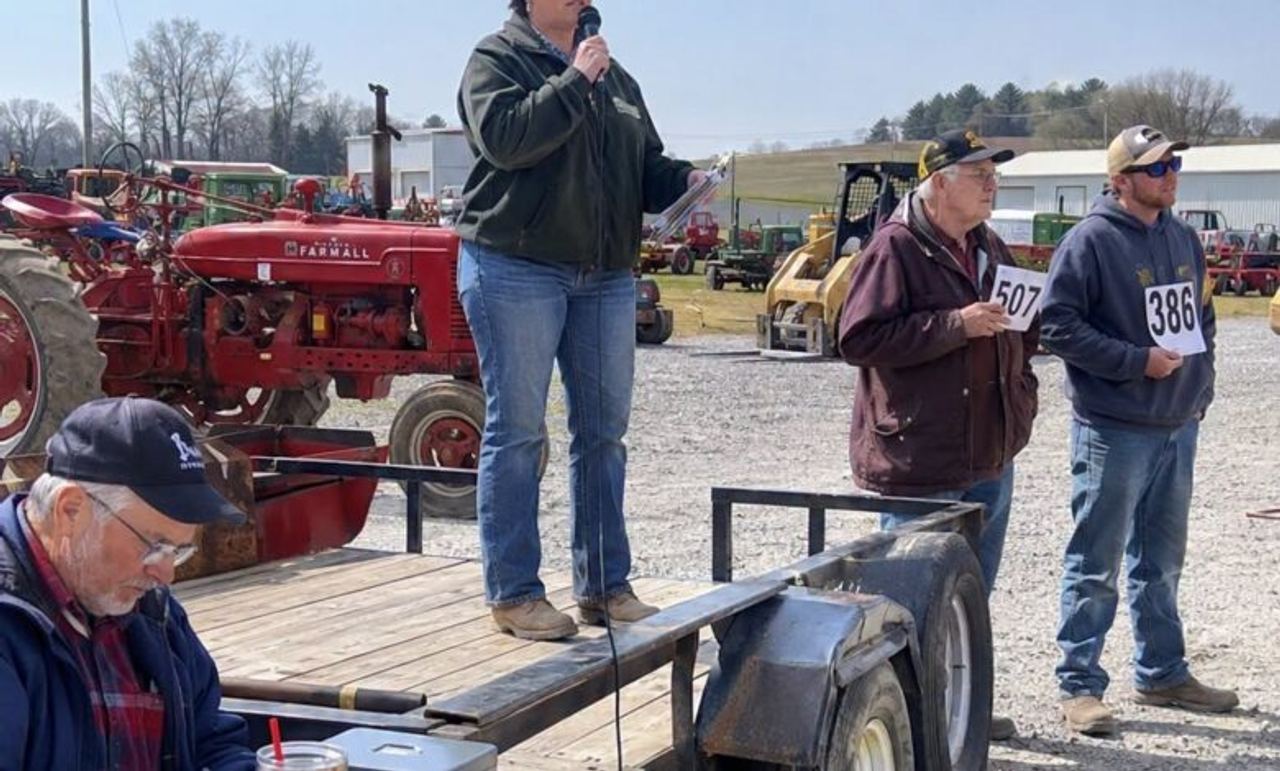
I looked across the hayfield at the auctioneer’s stand. A flatbed trailer with a little canopy on top and a loudspeaker on a pole. The sale was going to start at nine tomorrow morning. Lot forty would come up by ten-thirty.
“The sale’s tomorrow,” I said.
Deputy Strand put his hat back on. He didn’t say anything. There wasn’t anything to say.
Chapter Three: The Waiting Room
I married Earl Lindgren nineteen years ago this October.
I was forty-four. A widow myself. My first husband, Glenn, died of pancreatic cancer when I was forty-one. We didn’t have any children. I was working as a bookkeeper at the grain elevator in Kenyon, living alone in a little house in town, eating supper standing up at the kitchen counter.
Earl came in to settle his corn check one January. He was fifty-one. Tall, quiet, with big hands and a sunburned neck even in winter. His wife, Ruth, had died two years earlier. Breast cancer. He wore his wedding ring on a chain around his neck.
He asked me if I knew anybody who could do his books, because Ruth always did them and he was making a mess of it. I said I could.
Six months later, he asked me to marry him. In the cab of his pickup, in the elevator parking lot, during a thunderstorm.
“I’m not much for talking,” he said. “But I’m pretty good at showing up.”
He was. Every single day for nineteen years.
Kevin was twenty-one when his father married me.
He hated me. I don’t say that to be dramatic. He told me so himself, at the wedding reception at the VFW in Zumbrota, after six beers.
“You’re not my mother,” he said. “You’ll never be my mother. You’re just some lady who does Dad’s taxes.”
Earl heard him. He took Kevin outside. They were gone a long time. When they came back, Kevin didn’t say anything else that night. But he never said anything kind to me either.
Not for nineteen years.
Kevin moved to Mankato after the wedding. He worked construction. He got married, got divorced, got married again. He had two boys, Tanner and Wyatt. Earl drove to Mankato every other Sunday to see the grandkids. I went sometimes. Kevin was polite to me in front of them. That was about it.
Eight years ago, Kevin moved back. He bought eighty acres on the other side of the township, the old Kowalski place, on a contract for deed. He said he wanted the boys to grow up on a farm, the way he did.
Earl was so happy he could barely stand it. He helped Kevin put in his first crop. Lent him the planter, the sprayer, the combine. Spent every weekend over there fixing fences and rewiring the barn.
He gave Kevin a key to our machine shed the first week.
“What’s mine is yours,” he said.
I didn’t know Kevin was in trouble. Nobody did.
I found out later. The contract for deed on the Kowalski place called for a payment of $14,200 every November first. He’d missed last year’s. The seller, old Stan Kowalski’s daughter in the Cities, had given him until this November first to catch up both payments. $28,400. Or she’d cancel the contract and he’d lose the land and every dollar he’d put in.
Kevin didn’t tell his father. He didn’t tell anyone.
And on Tuesday, his father went down on the floor of the machine shed.
In the ICU waiting room on Tuesday night, Kevin sat beside me on a vinyl couch under a TV that was playing a cooking show with the sound off.
“Is he going to die?” he asked me.
“I don’t know, honey,” I said.
That was the first time I’d ever called him honey. He didn’t seem to notice.
“The doctor said if he makes it, he might not walk again,” Kevin said. His voice was thick. “Might not talk right. Might not ever come home.”
“I know.”
He put his face in his hands and cried. I rubbed his back in slow circles, the way you’d rub the back of a child who’s had a bad dream.
“He was supposed to be fine,” Kevin said through his fingers. “He’s never been sick. Not one day. He was supposed to be fine for twenty more years.”
Then on Wednesday morning, he said he had to go home and check on his cattle.
I didn’t see him again.
Chapter Four: The Parking Ramp
I drove back down to Rochester that afternoon after I left the sale.
I didn’t buy a stock tank. I forgot all about it. I drove sixty miles down Highway 52 without the radio on, past the cornfields with the combines going, past the grain elevators and the dairy barns, and I didn’t remember any of it.
I parked on the fourth level of the hospital parking ramp. Eight dollars a day. I’d been paying it since Tuesday.
I sat in the pickup for a long time with the engine off. Then I took out my phone and called Kevin.
It rang four times. I thought it was going to voicemail.
Then he picked up. I could hear a television in the background. A ball game. The Vikings. Somebody cheering. Somebody else yelling at the screen.
“Hello?”
“Kevin. It’s Darlene.”
A pause. “Is Dad okay? Did something happen?”
“He’s the same,” I said. “Still on the ventilator. They’re going to try to wean him tomorrow afternoon.”
“Okay.” I heard him let out a breath. “Okay.”
“Kevin,” I said. “I was at the Hanson sale today.”
The silence on the line was so long I thought the call had dropped. All I could hear was the ball game. A third down. The crowd groaning.
“Bring your daddy’s tractor home,” I said.
“Darlene…”
“Bring it home, Kevin. Tonight. Doyle will let you take it out of the sale if you’re the one asking. Hook up your trailer and bring it home.”
“Dad is never driving again,” he said.
It came out flat and hard. Like he’d been practicing it.
“You don’t know that.”
“I talked to the neurologist. On Wednesday. You weren’t there.” His voice went up. “He said Dad’s right side is gone. His right arm, his right leg. He said even in the best case, he’ll be in a wheelchair. You know what you need to drive an M? You need two good legs and two good arms. That clutch alone takes your whole body.”
“So you sold it.”
“I didn’t sell it yet.”
“Why, Kevin?” I said. “Why would you do this? Why now?”
There was another long silence. The ball game. A commercial for trucks.
“I’m behind on my note,” he said finally. His voice was very quiet. “On the Kowalski place. Two payments. Twenty-eight thousand. I have until November first or I lose everything. The land. The house. Everything I put in.”
I didn’t say anything. I didn’t know.
“A ’48 M in that condition goes for six, seven thousand at Hanson,” Kevin said. “Restored like that, maybe eight. It’s not enough. But it’s something. And it’s just sitting there, Darlene. He’s never going to drive it again. It’s just going to sit in that shed and rust.”
“It’s your father’s.”
“It’s half mine anyway,” he said.
“Half yours?”
“It was Grandpa’s tractor,” Kevin said. “Grandpa Arvid’s. He bought it new. It came down to Dad. It should come down to me. Not to you. You’re not even blood. Everything Dad has, when he dies, it’s going to go to you. And then to who? Your nephews in Wisconsin?” His voice cracked. “That’s Grandpa’s tractor. It’s a Lindgren tractor. It’s half mine.”
“Kevin…”
“I’m not letting you have it,” he said.
The line went dead.
I sat in the pickup on the fourth level of that parking ramp until the lights came on.
Nobody was left. That’s what I kept thinking. The office girl wouldn’t tell me anything. Doyle couldn’t pull it. The deputy said it was a family matter. A court would take weeks. Kevin hung up on me.
There was nobody left.
Nobody but the farmers.
Chapter Five: Four Winters
Earl built that M over four winters.
When we got married, it was sitting in the back of his grandfather’s old corn crib, under a blue tarp, where it had been since Arvid died in 1983. Rust all over. Flat tires. A mouse nest in the seat. The engine seized up so tight you couldn’t turn the crank with a breaker bar.
“That was my daddy’s first tractor,” Earl told me, the first winter we were married. We were standing in the crib with a flashlight, looking at it. “He bought her new the year he came home from the war. Paid cash. Every dollar he’d saved in the Army.”
“Are you going to fix it?”
“I’m going to try,” he said.
He worked on it every winter, from November to March. Out in the machine shed with the propane heater going and the radio playing the farm report and old country music.
The first winter, he took it apart. Every bolt, every nut, every washer. He laid them out on sheets of cardboard on the shed floor, labeled with a black marker in his blocky handwriting. Carburetor. Magneto. Steering box. It looked like a puzzle a giant had dumped out.
The second winter, he did the engine. New pistons, new sleeves, new bearings. He sent the crankshaft to a machine shop in Owatonna to be ground.
The third winter was the hardest one. He split it in the middle for the clutch.
You’ve got to understand what that means. To get to the clutch on an old Farmall M, you have to split the tractor in half. Literally. You unbolt the front half from the back half, right behind the engine, and roll them apart. It takes chains and jacks and blocks and a chain hoist hanging from the rafters. One wrong move and four thousand pounds of iron falls on you.
Earl did it alone. He wouldn’t let me help. He said it was too dangerous.
I came out to the shed one night in January with a thermos of coffee and found him sitting on an overturned five-gallon bucket between the two halves of that tractor. Just sitting there. Looking at them.
“You okay?” I asked.
“I was thinking about Dad,” he said. “He split her once too. In 1962. I was eleven. I handed him wrenches.” He took the thermos from me. “He let me tighten the last bolt when they went back together. He said, now she’s half yours, boy.”
The fourth winter was paint.
Three coats of International Harvester red. Earl ordered the paint special from a supply house in Iowa. Real IH Red, the exact color from 1948. He sanded every part by hand first, with sandpaper wrapped around a block of wood. It took him two months just to sand.
That was the winter he ground the crack on the lug weight. And when he painted the wheel, the paint wouldn’t stick right on the smooth spot.
He tried twice to fix it. Then he stood back and looked at it.
“Leave it,” I said. “It’s like a fingerprint.”
“A thumbprint,” he said. He smiled. “My signature.”
He drove it in the parade every Labor Day after that.
The Kenyon Labor Day parade. Fifteen years in a row. Down Main Street, past the Legion, past the café, past the grain elevator where I used to work. He’d wear his good jeans and a clean white T-shirt and his daddy’s old IH cap with the sweat stain on the band.
He’d wave to everybody. People would wave back. Old men would stand at the curb and nod at that tractor like it was a person they used to know.
The year Kevin’s boys were little, Earl let them ride on the fenders. One on each side. Tanner and Wyatt, holding on for dear life, grinning so hard their faces nearly split.
Kevin walked beside the tractor the whole way. Down Main Street. Taking pictures on his phone.
I remember thinking, that was the happiest I ever saw him.
I didn’t sleep that night.
I sat beside Earl’s bed in the ICU. The machine breathed for him. In, out. In, out. The nurses came and went in their soft shoes. Monitors beeped. Somewhere down the hall, somebody was crying.
His big right hand lay on top of the blanket. The one that didn’t work anymore. I held it.
I thought about Arvid, coming home from the war and paying cash for a red tractor. I thought about an eleven-year-old boy handing his daddy wrenches. Now she’s half yours, boy.
I thought about four winters on an overturned bucket.
I thought about the silver thumbprint.
Around four in the morning, I let go of his hand and kissed his forehead.
“I’m going to go get her, Earl,” I told him.
The machine breathed. In, out.
I drove north in the dark.
Chapter Six: Three Hundred Caps
I was at the gate before light.
The sale didn’t start until nine. I got there at six-fifteen. The hayfield was gray and wet with dew, and there was frost on the windshields of the trucks already parked along the fence line. The church ladies were setting up their food stand. I could smell coffee and pancakes and sausage.
I bought a cup of coffee I didn’t drink. I walked down the third row and stood next to the M.
The lot tag was still wired on. 40. The silver thumbprint was wet with dew.
I put my hand on it.
By eight-thirty, the field was full.
Three hundred men, maybe more. In caps and Carhartts and insulated flannel shirts. Holding coffee. Standing in little groups between the rows, talking about corn prices and the weather and who’d died since spring. There were a few women. A few kids. But mostly men. Farmers. Their faces all brown and creased and alike, the way faces get when they’ve spent fifty years squinting into the wind.
I knew some of them. Not many. Earl knew all of them. That was the thing about Earl. He didn’t talk much, but he showed up. Every funeral, every barn raising, every benefit supper at the Lutheran church. He helped every man on this road at one time or another.
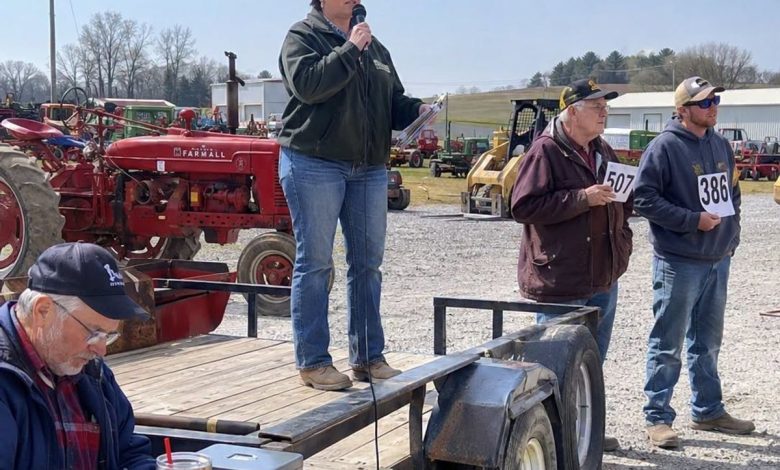
At nine o’clock, the auctioneer started.
His name was Bud Hanson. He was the younger of the two Hanson brothers, maybe sixty, with a big belly and a white cowboy hat and a voice like a gravel truck. He stood on the flatbed under the canopy with a microphone, and his ringman, a skinny young guy in a Hanson sweatshirt, stood below him watching the crowd for bids.
They started at the far end of the first row. Lot one. A pile of steel fence posts.
“Who’ll give me fifty dollars? Fifty dollars, fifty dollars, now forty, forty, do I hear thirty…”
The chant rolled down the rows. It’s a strange sound if you’ve never heard it. Fast and rhythmic, almost like singing, with the numbers tumbling out on top of each other.
Lot five. Lot nine. Lot twelve.
The crowd moved with Bud. Down the first row. Then the second. Three hundred men shuffling across a wet hayfield, following the voice.
Lot thirty. A John Deere grain drill. Sold for eleven hundred.
Lot thirty-four. A gravity wagon. Sold for twenty-two hundred.
Lot thirty-six. An old Ford 8N tractor. Gray and red. Sold for thirty-four hundred to a man from Northfield.
My heart was going like a trip hammer.
I looked around for Kevin. I didn’t see him. I hadn’t seen him all morning. But he could be anywhere in that crowd. Three hundred caps all looked the same from behind.
Lot thirty-eight. A pile of tires.
Lot thirty-nine. A hay rack.
I walked to the hay wagon parked beside the M.
It was lot forty-one. An old flat hay rack on running gear, the kind you pull behind a baler to stack the bales on. It was sitting right next to Earl’s tractor, maybe ten feet away.
I put my hand on the cold wheel of the M. One more time. On the silver thumbprint.
And then I climbed up.
My knees were water under me. I’m sixty-three years old. I’d been up for twenty-six hours. I was wearing my church shoes, and the wood of the hay rack was slick with dew.
I got one foot on the wheel hub. Then the other knee on the deck. Then I pulled myself up and stood.
Chapter Seven: The Truth
From up there, I could see the whole crowd.
Three hundred men coming down the row toward me, following Bud Hanson’s flatbed as the ringman drove it slowly forward. Steam rising off their coffee cups. Their breath making little clouds.
Bud was finishing lot thirty-nine. “Sold, two hundred and fifty, to number eighty-eight.”
The flatbed rolled forward a few feet. It stopped right beside the M.
I cupped my hands around my mouth.
“Excuse me,” I said.
Nobody heard me. My voice was too small. Bud was already lifting his microphone.
I took a breath and called out again. As loud as I could. Louder than I’d ever said anything in my life.
“Excuse me!”
Bud stopped. He turned around and looked at me. The ringman looked. The men nearest the hay wagon looked.
“Before you bid,” I said, “I need to tell you whose this is.”
Three hundred caps turned toward me.
I’ll never forget it. It went across that field like a wave. Every head turning. Every face lifting. The ones in the back stood on their toes. A kid climbed up on the fender of a grain wagon to see.
Bud Hanson lowered his microphone.
He didn’t say anything. He ju…