My Sister Billed Our 79-Year-Old Mom For Everything Until My Son’s Birthday Toast Revealed Her
I had always believed that bad behavior eventually comes with a price. I just never imagined my sister would start sending the bill to our seventy-nine-year-old mother and that this would be the thing that finally made me believe it.
But I need to rewind, because you can’t really grasp what Rachel did unless you understand where we were when she did it.
Six months into chemotherapy, there were days when I could hardly get from my bed to the bathroom.
My absurd little coping mechanism was to narrate the worst moments like I was a sports commentator. It was the only thing that stopped me from crying, so I committed to it completely.
“Dana is off the bed,” I would whisper, holding on to the doorframe. “She has made it to the doorway. Incredible posture. The judges are impressed.”
From the hall, my son Noah would shout, “She’s slowing down!”
“The crowd has turned hostile.”
“The crowd wants breakfast.”
“The crowd is ten years old and capable of pouring its own cereal.”
He would grin every time. He was ten, and at ten there is nothing better than hearing that you can do something yourself. He had been saving every quarter he found in a big glass jar on his dresser, one of those giant jars that used to hold pretzels, and he planned to buy a bike with it. He counted it constantly. He knew exactly how much was in there down to the dollar.
That was basically our whole house that year. A mother who was sick, a boy collecting quarters, and enough jokes to keep fear at arm’s length.
So when Rachel moved in, I was thankful. I need that to be clear. I was truly, deeply thankful.
Her boyfriend Craig had emptied out their joint savings and disappeared, the way some men do, leaving behind nothing except a car payment and a story that made no sense. Rachel arrived at my front door with two suitcases and red-rimmed eyes, and I told her of course, stay as long as you need. Most days I couldn’t handle stairs. I couldn’t drive myself to treatment. And our mother lived three houses down, seventy-nine years old, with arthritis in both hands and the kind of personality that treated asking for help as a moral weakness.
“You focus on getting better,” Rachel told me that first week while unpacking in the spare room. “I’ll take care of Mom. I’ll take care of everything.”
“Are you sure? That’s a lot.”
“Dana, please. She’s three houses away. It’s hardly a commute.”
“She’s seventy-nine, she has arthritis, and she acts like asking for help is unconstitutional.”
Rachel laughed. It was a good laugh, the old laugh, the one from before Craig. “I can handle Mom. Trust me.”
And I did trust her. That’s the part I keep circling back to. My sister had always liked being the one in control. She made lists. She color-coded everything. She solved problems and almost never asked anyone else for help. If you had asked me then to name the most capable, self-sufficient person I knew, I would have said Rachel without even pausing.
So I believed her, and I loosened my grip on the one thing I had been white-knuckling through my entire illness, which was worrying about Mom.
The first sign that something was wrong, I ignored completely.
It was a Sunday. Mom was sitting at my kitchen table, and out of nowhere she looked up from her tea and said, “Nobody manages me, you know.”
Rachel leaned down and kissed her on the cheek. “See? Easy. She manages herself.”
Mom didn’t smile. I realized that only later, when I replayed it in my head. At the time I just thought she was being stubborn in her usual way, and I laughed and went back to my toast.
Then came the afternoon that broke it open.
I was in bed, deep into what I had started calling overtime, that hour after treatment when the nausea peaked and all I could do was lie very still and breathe. Noah appeared next to my bed. I felt him there before I even opened my eyes.
“Mom?”
“Unless the house is on fire,” I muttered, “Dana is currently in overtime and cannot come to the phone.”
“It’s not a fire.” He shifted from foot to foot. “Why does Grandma have to pay Aunt Rachel?”
I opened my eyes.
“Pay her for what?”
“For helping.”
I pushed myself up on one elbow. The room tipped and then settled. “What kind of helping?”
He stared down at his socks. “Grandma asked her to turn off the hallway light. Her arm hurt. And Aunt Rachel said, ‘Ten dollars.’”
“Was she joking?” I asked. Because that was honestly where my mind went first. That had to be a joke. My sister had a dark sense of humor. We all did. “Noah, she was joking.”
“No.”
“How do you know she wasn’t joking?”
“Because Grandma said she only had five dollars in her purse.” Noah’s voice got quieter. “And Aunt Rachel said, ‘Then you can switch it off yourself,’ and went back to her phone. And Grandma turned it off herself. It took a long time because of her hands.”
I lay back for one second. Then I got up, nausea and all, and went downstairs.
I want to be honest about what I was thinking on those stairs, because I’ve gone over it so many times since. I did not think, my sister is stealing from our mother. I thought, there’s been some misunderstanding and I’ll clear it up and everyone will feel ridiculous. That’s how much I trusted her. My first instinct was not to catch her. It was to defend her in my own mind before I had even reached the last step.
Rachel was in the living room, scrolling on her phone. Mom was in the armchair with a blanket over her knees.
“Hey,” I said, trying for casual. “Noah said something weird. He said you charged Mom ten dollars to turn off a light. That was a joke, right?”
Rachel didn’t even look up immediately. “He shouldn’t be listening in.”
“He’s ten. Listening in is basically his favorite pastime. Is it true?”
She set down the phone and gave me that patient expression people use on children. “It’s a system, Dana. It’s not what it sounds like.”
“What does it sound like? Because what it sounds like is you charged our mother money to flip a switch.”
“She asks me for things constantly,” Rachel said. “Constantly. All day. Turn this off, get me that, bring my slippers. She was becoming completely dependent, and I read that the best thing for elderly people is to preserve their independence as long as possible. So I created a system that makes her think before she asks. If it’s something she can do herself, she does it herself. If she truly needs help, she can pay a little, and that makes her stop and think about whether she really needs it.”
Honestly, it almost sounded reasonable. That was the thing about Rachel. She could make the indefensible sound like a TED Talk.
Mom spoke from the armchair, quietly. “Sometimes I don’t have the money on me.”
“I don’t go after every dollar,” Rachel said quickly, waving her hand.
And Mom looked at me and said, in this dry little voice, “That sounded very carefully worded.”
I almost laughed. That was Mom. Even humiliated, even subdued, she could still land one.
I let it go that day. God help me, I let it go. I told myself it was some strange boundary issue, that Rachel was stressed and grieving and maybe overcorrecting, and that as long as it stayed small, it wasn’t worth a fight I didn’t have the energy for. I had chemo. I had a child. I had a body actively fighting itself. I did not have the strength to supervise my competent, capable sister.
But twenty years of working insurance claims does something permanent to your mind. For twenty years my whole job had been to hear a neat explanation and ask, yes, but does the timeline actually hold? And something about Rachel’s neat explanation smelled wrong.
So even though I dropped it out loud, I didn’t really drop it.
The next thing happened on a Tuesday. I came downstairs for water and found Mom in the hallway dragging a full laundry basket across the floor with one hand, her bad hand, her whole body tilting sideways from the effort.
“Mom.”
She froze like I had caught her committing a crime. “What?”
“Why are you dragging that like you’re trying to hide a corpse?”
“It’s only towels.”
“Where’s Rachel?”
“Upstairs.”
“Then why are you doing this? Ask her.”
Mom looked away. “Dana, sit down.”
“No. Noah says Rachel charges you money. You practically confirmed it the other day. How much for laundry, Mom?”
She let out a long, defeated sigh that I hated hearing. “She calls it a system.”
“I’ve heard the sales pitch. How much?”
“Twenty. Ten if the basket is already downstairs.”
I sat down hard on the closed dryer lid. “She has surge pricing.”
“Dana—”
“What about water? If you want a glass of water?”
“Ten.”
“A bath?”
Mom got very quiet. “Thirty.”
I dropped my face into my hands. “Ladies and gentlemen, Dana has officially been defeated by capitalism.”
“Please don’t fight with her,” Mom said. “Please. It’s not worth it. She’s having a hard time.”
“You are paying your own daughter thirty dollars to help you take a bath.”
“She says I ask too often. Maybe I do.”
“You have arthritis in both hands. Asking is not a character defect.”
“I can do more than people think I can,” Mom said, and there was stubbornness in it, but beneath the stubbornness was something that broke my heart, because she was trying to make what Rachel had done sound like it had been her own idea. Like she had chosen it. Like it was some kind of exercise program.
That was when Rachel walked in, phone still in hand.
“Oh, good,” she said when she saw me. “You’re up. How are you feeling?”
I ignored the question. “Are you charging Mom thirty dollars to take a bath?”
Her face changed for exactly half a second. I’ve spent two decades watching faces change when the numbers stop lining up, and I know that flicker. It’s the flicker of someone doing fast recalculations. Then it was gone, replaced by that same patient sigh.
“It’s not like that.”
“You know,” I said, “that sentence remains undefeated as the opening line to a terrible explanation.”
“Dana, she asks me for things all day.”
“Because she has arthritis in both hands.”
“She was becoming dependent. The money makes her think before she asks. It’s for her own good.”
From the armchair, Mom said softly, “Sometimes I really don’t have it.”
“I don’t go after every dollar,” Rachel said again, using the exact same line as before, word for word, which is something liars often do without noticing. They repeat the phrase that worked before.
I looked at her. “You are living here rent-free because you are helping both of us. That was the arrangement.”
“I’m living here rent-free,” Rachel snapped, “because my boyfriend stole everything I had. Don’t twist it into some favor you’re doing for me.”
“I know exactly why you’re living here. I’m the person who opened the door. But that still doesn’t give you the right to charge our mother for hydration.”
“You always do this.”
“Do what?”
“Turn everything into a joke so everybody takes your side. So you look reasonable and I look like the villain. You’ve done it since we were kids.”
I stood up too quickly and had to catch the edge of the counter when the kitchen tilted.
Mom was on her feet in an instant, moving toward me. “Sit. Sit down right now.”
“See?” Rachel said, actually gesturing toward me as if I were exhibit A. “This is exactly why you shouldn’t be involving yourself in this at all. You should be resting. You’re making yourself sick over a misunderstanding.”
I lowered myself back into the chair, furious that my own body had betrayed me in the middle of the argument. “Dana,” I said, “leaves the debate due to a medical technicality.”
From the doorway, Noah announced, “Rachel wins by nausea.”
“Thank you, sports commentator.”
Rachel rolled her eyes and walked out, and that was the end of it. She had won that round, and she knew it, because she had learned the same thing everyone eventually learns about a sick person: we do not have the stamina for prolonged conflict. You can just outlast us.
But here is what she did not understand about me. My body was weak. My attention was not. And I had spent twenty years learning that when someone gives you a reasonable-sounding explanation and then becomes very invested in keeping you from looking too closely, you look closely.
So I began watching. And I began writing things down.
The ten-dollar light switch, as it turned out, was not even the strangest part. The strangest part was who Rachel became depending on who else was in the room.
Aunt Carol came by that weekend. Carol is Mom’s younger sister, warm and a little gullible, the kind of person who assumes the best about everyone right up until it costs her. And the second Carol walked through the door, my sister transformed.
She would not let Mom do a thing. She fussed over her. She fluffed the pillow behind Mom’s back. When Mom reached for her own mug of tea, Rachel swooped in. “Let me get that, you’ll spill it.”
“You’re so good with her,” Carol said, watching all this with shining eyes. “Rachel, honestly, you’re an angel. Not everyone would do this.”
Rachel released a soft, brave sigh. “It’s exhausting, I won’t lie. But what am I supposed to do? She’s my mother. You just do what has to be done.”
I nearly choked on my tea.
Because I had watched this same woman, four days earlier, tell our mother to shut off her own light or pay for the privilege.
I said nothing. I filed it away.
Carol left around four. I heard the front door shut. And I swear, I counted, it was less than a minute later that Mom said, “Rachel, honey, would you mind getting my cardigan? I’m cold.”
Rachel picked up her phone. “You know the rule, Mom.”
I stared at her. Ten seconds after performing as an angel of mercy who wouldn’t even let Mom lift a mug, she was right back to charging by the task.
“Seriously,” I said. “You’re serious right now.”
“Don’t start.”
Mom slowly pushed herself up from the chair, both hands on the armrests, her face tightening from the effort. “Never mind,” she said. “It’s fine. Never mind.”
I got up and got the cardigan myself and draped it over her shoulders, and she patted my hand and would not meet my eyes.
That “never mind” got under my skin worse than any of the rest of it. The invoices made me angry. The “never mind” made me want to cry. Because I knew that voice. It was the voice of someone who had learned, at seventy-nine, that being cold was easier than asking.
That night I dug out an old notebook and started writing down dates.
Noah found me at the kitchen counter a few evenings later, pen in hand.
“What are you doing?”
“Insurance-claims brain,” I said. “It never shuts off.”
“You don’t even work anymore.”
“Twenty years of claims adjusting causes permanent damage, buddy. I’ll be spotting inconsistencies from my deathbed.”
He climbed onto the stool beside me. “What are you writing down?”
“Things that don’t add up.”
“Like Aunt Rachel?”
I looked at him. He was ten, and he had seen the light switch and the cardigan and probably plenty of things I hadn’t. Kids see everything. They just don’t always know how to name it.
“Especially Aunt Rachel,” I admitted.
He nodded very seriously. “She’s bad at math.”
“What do you mean?”
“She charged Grandma twenty for laundry one time and twenty-five another time. Same laundry. And one time she said the doctor ride was fifty but Aunt Carol drove Grandma that day. I remember because Aunt Carol brought me a candy bar.”
I set my pen down and looked at my son.
“Say that again. About the doctor ride.”
He repeated it. And I wrote down the date.
At the time, I thought I was just keeping track so I would feel less insane. I thought maybe if I ever confronted Rachel again, I’d want the details to be correct. I had no idea, none at all, how useful those dates were about to become.
A month later, Mom turned seventy-nine and a half, technically, but we held the party for her seventy-ninth because I had been too sick to manage it on the actual day.
I spent nearly everything I had left that week on it. A roast. Potatoes. A lemon pie, her favorite. And a huge bunch of yellow tulips, because yellow was her color and she had stopped buying flowers for herself years ago, deciding somewhere along the line that flowers were a luxury she no longer deserved.
By six o’clock, the house was full. Aunt Carol brought a basket of rolls. My cousin Ben brought wine. Uncle Mike, my father’s brother, brought nothing except a large appetite and an even larger opinion about everything.
Mom kept touching the tulips. Just brushing the petals with her fingertips again and again, like she couldn’t quite believe they belonged to her.
Carol wrapped Rachel in a hug the moment she came in. “There she is. Our angel. I tell everyone about you, I really do.”
“I’m just doing what family does,” Rachel said.
Ben raised his glass toward her. “Seriously, though. Taking care of your mom and helping Dana through chemo at the same time? I don’t know how you do it. I couldn’t.”
Rachel let out that sigh. The brave one. The exhausted angel sigh. “Some days are really, really hard. But you don’t think about it. You just do it.”
I looked across the table at Noah. Noah looked back at me.
Not tonight, my look told him. It’s her birthday. Let her have her night.
For a solid twenty minutes, nothing blew up. We ate. Uncle Mike told a story about a fish that somehow got longer every time he retold it. Mom laughed, really laughed, and for a little while it was just a family sitting around a table, which was all I had wanted.
Then my son pushed back his chair and stood.
“Excuse me,” he said in his most formal voice. “May I make a toast?”
Everyone smiled. A ten-year-old giving a toast. Adorable.
Rachel lifted her wine glass and cooed, “Aww. Go ahead, sweetheart.”
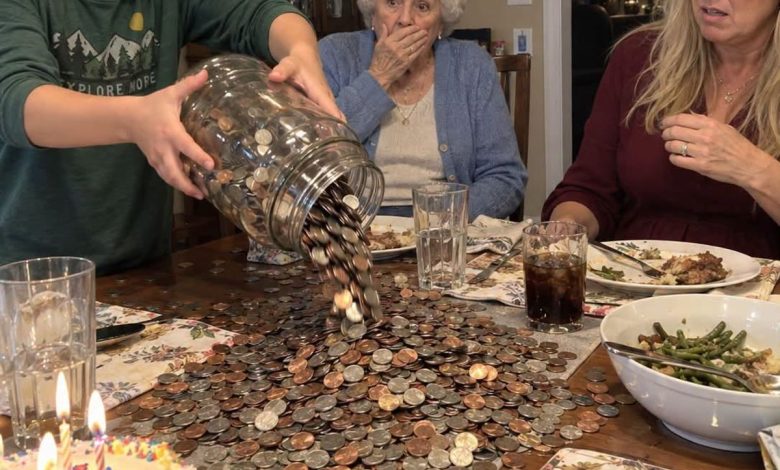
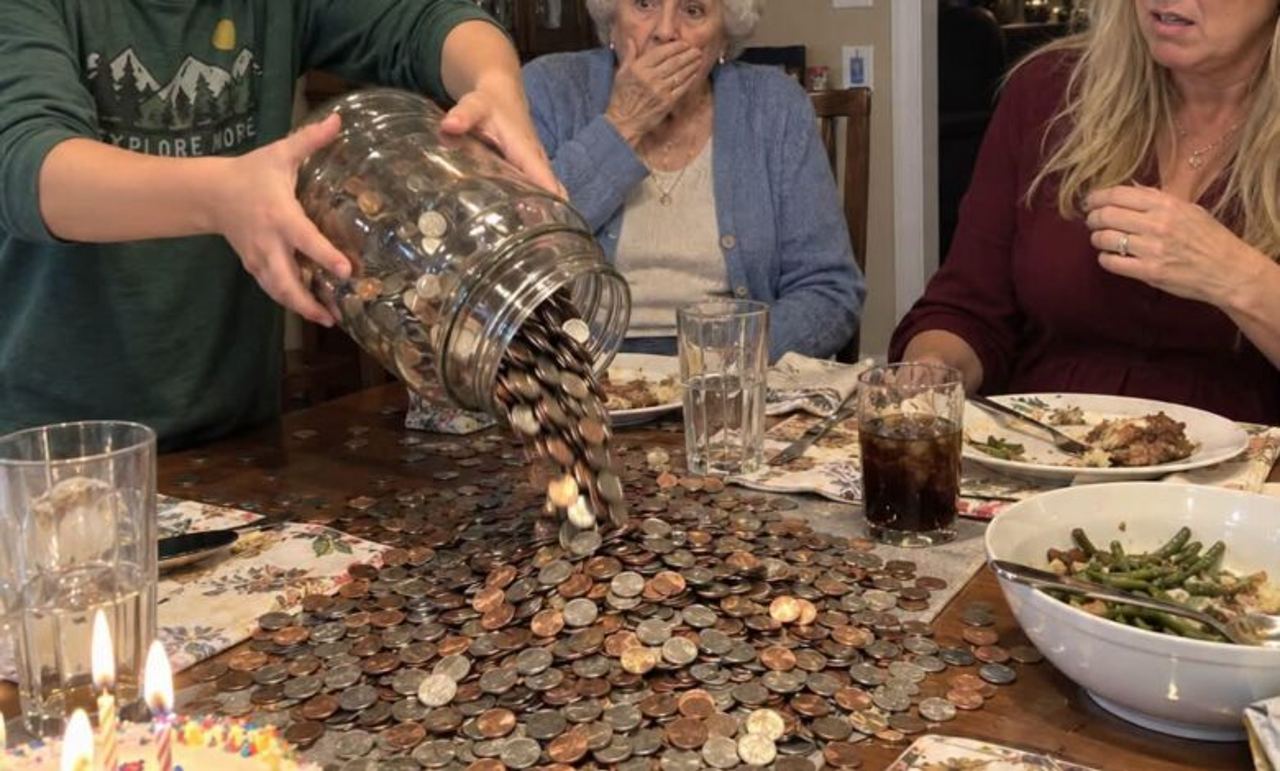
Noah reached under the table and dragged out his bike-savings jar. The huge one. Packed to the top with quarters, months’ worth of them, every coin he had found in couch cushions and parking lots.
“Noah?” I said. There was a warning in it. That was his bike. That jar was months of his life.
“It’s okay, Mom,” he said. “Trust me.”
Rachel’s smile flickered. “What is that?”
“My savings.”
And then, before anyone could stop him, he tipped the entire jar upside down over Rachel’s place setting.
The coins came down like a landslide. They thundered across the table, bounced off plates, rolled onto the floor, spun in bright circles and clattered flat. Rachel jerked backward. “What the hell?”
“It’s for you!” Noah said cheerfully.
“For me?”
“Yes! Because you like getting money for helping. And you helped at the party. So.” He gestured toward the pile of quarters. “Payment.”
There was one full beat of stunned silence. Uncle Mike’s fork froze halfway to his mouth.
Then Noah reached into his back pocket and pulled out a folded piece of paper.
Rachel’s whole face drained white. “Noah.”
He tucked it behind his back.
“Give me that,” she said, rising halfway out of her chair. “Right now.”
Aunt Carol leaned forward, confused. “What is it, honey? What’s the paper?”
“It’s nothing,” Rachel said too quickly. “He went into my room and took something. He’s just being a brat, he doesn’t understand—”
“I didn’t take it from your room,” Noah said. “You gave it to Grandma yesterday. I saw. Grandma put it in the kitchen drawer because she didn’t want Mom to see it and get upset.”
The whole table went quiet in a different way then. A worse way.
I turned to Mom. “Is that true?”
She would not look at me. She looked down at her plate. “You had treatment yesterday,” she said. “You came home so sick. I didn’t want you to see it. I was going to deal with it myself.”
Rachel took a step toward my son, hand out. “Give it to me. Now.”
Noah kept it firmly behind his back and lifted his chin. “Aunt Rachel says Grandma still owes her thousands of dollars.”
No one moved. Even Uncle Mike had stopped chewing, which I would have said was impossible.
I held out my hand across the table. “Noah. Paper. Please.”
“Dana, don’t,” Rachel said. “It’s private, it’s between me and Mom—”
“Excellent argument,” I said. “Very persuasive. Noah.”
He placed it in my hand.
I unfolded it. At the top, in bold letters she had clearly typed and printed, because Rachel never does anything halfway:
CARE SERVICES — BALANCE DUE.
I read it out loud, because I wanted everyone to hear it in her mother’s house, in my voice, at her mother’s birthday table.
“Light switch, ten dollars. Water, ten dollars. Stairs assistance, twenty dollars. Bath, thirty dollars. Laundry, twenty-five dollars.”
Aunt Carol whispered, “Are you kidding me.”
I kept going, item after item, all the way to the bottom.
“Total owed,” I read. “Three thousand, seven hundred and sixty dollars.”
Mom covered her face with both hands.
“It’s not real,” Rachel said. “It’s not an actual invoice. You’re all overreacting.”
Cousin Ben leaned over and pointed at the page. “It has a total, Rachel. Real or not, there’s a running balance at the bottom.”
“It’s motivational.”
Ben stared at her. “You motivationally invoiced your seventy-nine-year-old mother for three thousand dollars?”
“She was becoming too dependent!”
Mom lowered her hands. Her eyes were wet, but when she spoke, her voice was steady. “I paid you, Rachel.”
The room went silent again.
I turned toward her slowly. “How much, Mom?”
“I don’t know exactly.”
“Mom. How much did you actually pay her?”
“A few hundred. Over the months. Whenever I had it. From my pension.”
“She insisted,” Rachel cut in. “I never made her. She insisted on paying.”
Mom looked directly at her daughter, and for the first time all night she did not look embarrassed. She looked furious. “No,” she said. “I did not.”
By then I was fully in claims mode, and once I get there, I don’t stop. I had noticed there were more folded slips of paper tucked beneath Mom’s stack of birthday cards on the sideboard. I stood up and went for them.
“Dana, leave those alone,” Rachel said sharply. “Those are private.”
So naturally I picked them up. Every single one.
I opened the first. “‘Bath, thirty dollars. Tuesday.’” I looked up. “Which Tuesday?”
“Last Tuesday.”
“You weren’t here last Tuesday. You were out all day. I remember because I had to text you twice to bring milk on your way home.”
“I might have written the wrong day.”
I opened another slip. “‘Doctor’s ride, fifty dollars. Wednesday.’” I walked to the counter, picked up my notebook, the one Noah had teased me about, and flipped it open to the date. “Wednesday. According to my notes, you left before noon and didn’t get home until dinner.”
Aunt Carol slowly set down her fork. “I drove her to the doctor on Wednesday. I picked her up at ten. I brought Noah a candy bar.”
Rachel’s face was doing something complicated.
And then Carol reached for her phone, and I watched a new understanding pass over her face like a shadow. “Rachel,” she said. “You told me you were spending hundreds of dollars a week caring for your mother. You told me it was a real financial burden.”
“I was,” Rachel said. “It is.”
Carol looked at me, then back at Rachel. “I sent you three hundred dollars last month. To help.”
“You what?” I said.
“She told me you couldn’t contribute because of your treatment, Dana. She said money was tight and she was paying for everything for Mom herself. So I sent her three hundred dollars.”
Cousin Ben pulled out his own phone and started scrolling, jaw tight. “I sent her two hundred and fifty. Same reason. She said Dana was too sick to help and it was all falling on her.”
Uncle Mike raised one thick hand, almost sheepishly. “One-eighty from me. She got me at Thanksgiving.”
I looked at my sister. The entire table was looking at my sister.
“So let me make sure I have the timeline right,” I said, because that is what I do, I get the timeline right. “Mom was paying you out of her pension. And Carol was paying you. And Ben was paying you. And Mike was paying you. All of you were paying my sister to care for our mother. And half the things you invoiced her for, you weren’t even in the house to do.”
Rachel’s face hardened completely then, every trace of the angel gone. “You think I wanted to end up like this? Thirty-eight years old, no savings, sleeping in my sick sister’s spare room? Craig left me with nothing. Nothing. Do you understand what that does to a person?”
“And that made this okay?”
“I needed money to start over. A deposit somewhere. A car that actually works. Something. Anything.”
“So you took it from Mom.”
“It started small,” she said, and her voice cracked, and I couldn’t tell if it was genuine or another performance and I hated that I couldn’t tell. “Ten dollars here. Twenty dollars there. And I told myself I was helping her stay independent while building a little cushion for myself at the same time. Two birds. It didn’t feel like stealing. It felt like a system.”
“And Carol’s money? Ben’s money? Mike’s?”
She looked away. “Carol offered first. She just offered, out of nowhere. Then Ben. I didn’t ask.”
“You didn’t ask. You just let all of them believe you needed it for Mom’s care.”
“Nobody asked questions,” she said, almost defiantly. “Nobody made me explain anything.”
“Because they trusted you,” I said. “That’s why no one asked questions, Rachel. Because you were the responsible one. Because everyone in this family would have bet their house on you before they’d bet a nickel on almost anybody else.”
She went quiet.
I looked over at Mom, sitting very small in her chair with the tulips in front of her. “…”
Read more stories
- A Country Singer Backed Out of the 60th CMA Awards at the Last Minute — Here’s the Reason
- How One Song Made Luckenbach a Symbol of Country Simplicity
- In 1983, Kris Kristofferson left behind California’s hard-living rhythm, married law student Lisa Meyers in a modest chapel, and relocated to a secluded part of Maui.
- The 1957 TV Song That Introduced Patsy Cline to America