Lisa Lopes was more than the fire that made her famous

In June of 1994, a mansion outside Atlanta burned to the ground, and for years that blaze became the first line in almost every story told about Lisa Nicole Lopes. It flattened her into a headline, a punchline, a cautionary tale. But that version leaves out the child, the artist, the writer, the woman who had already spent years making herself impossible to ignore.
Lisa was born in Philadelphia in 1971, the oldest of three children, often the one left in charge while her parents worked. By the time she was five, she could sit at a piano and pick out a song she had only heard once. Music did not arrive as a lesson for her. It seemed to come from somewhere inside her, fully formed, as if she had always known how to reach it.
At nineteen, she left for Atlanta with almost nothing, carrying the sense that her life was meant to stretch beyond what she had been given. There she found Tionne and Rozonda, and together the three became TLC. What many people missed then, and still miss now, is how much Lisa drove the group’s identity. She wrote her own verses, the kind fans still know by heart. She coined the phrase that became the title of their defining album, three words for the three sides she said every woman carries. Even the condom worn over her glasses was not a joke or a costume. It was a deliberate choice, made in a time when too few people were willing to speak plainly about sex and AIDS.
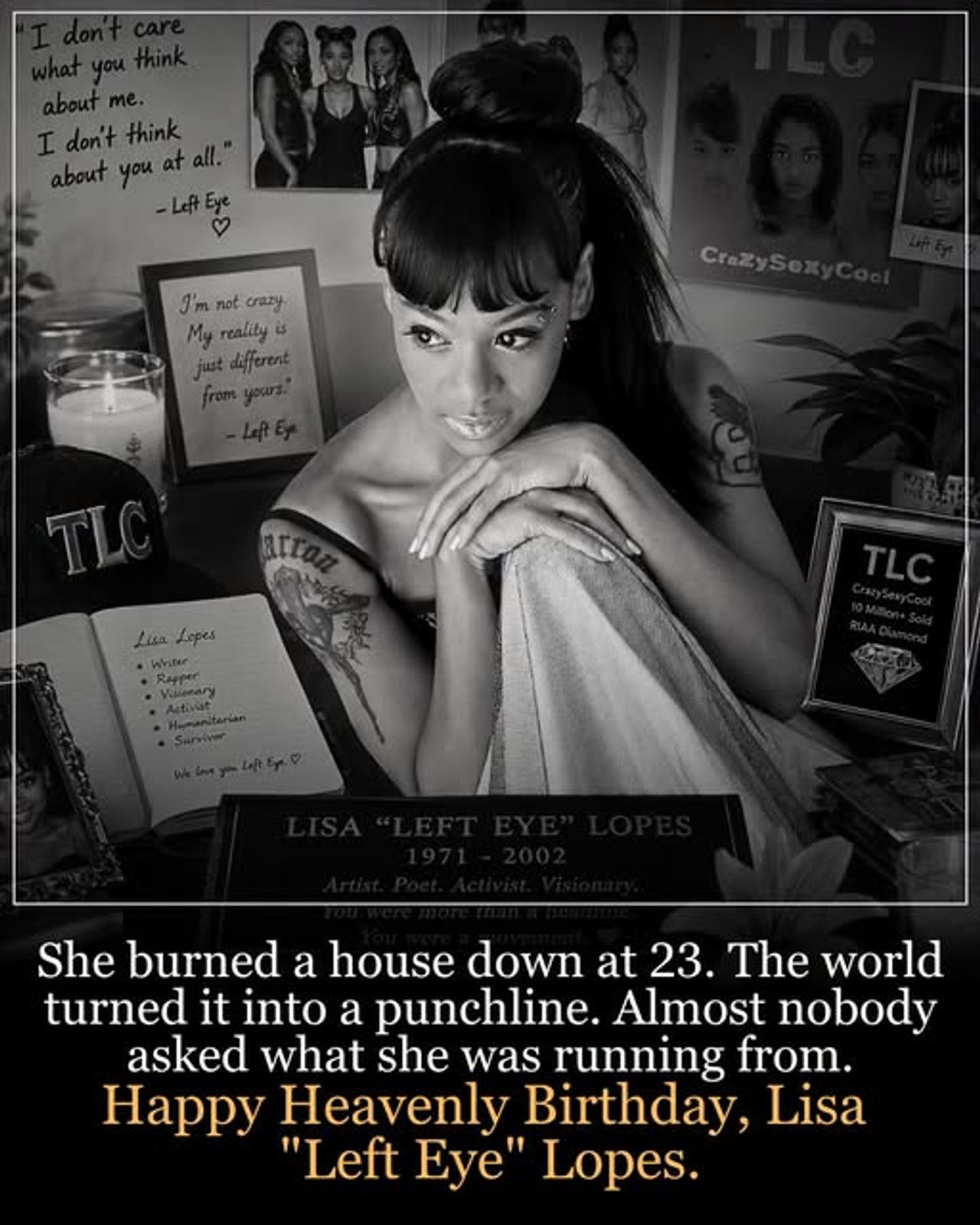
In the early 1990s, when a generation was quietly losing people and mainstream television still avoided saying the word, Lisa used the biggest stage she had to try to protect the fans watching her. She was only 23, but she understood that pop music could do more than entertain. It could warn. It could insist on survival. It could make room for truth.
Then came the fire, and everything after it was swallowed by the story everyone thought they already knew. She had been with football player Andre Rison since she was barely out of her teens, and whatever the cameras captured, home was not gentle. The relationship had already turned physical more than once, and police already knew both their names. On a June night in 1994, after a long fight and too much to drink, Lisa set a pile of his sneakers on fire in a bathtub. The fire spread. By morning, the house was gone.
She pleaded guilty to arson and received five years’ probation, a fine, and mandatory rehab. She never said she intended to burn the whole place down; she said that part got away from her. For months, her name was reduced to a national joke, as if public humiliation could tell the whole story of a 23-year-old visibly falling apart in front of everyone.
What gets lost is that the years around that disaster should have been among the richest of her life. TLC’s 1994 album went on to sell more than ten million copies in the United States alone, making them the best-selling girl group in American history. Lisa had helped build something lasting, something bigger than scandal. And maybe that is the truest way to remember her: not as the fire, but as the force that kept burning underneath it.