The late, great Johnny Cash’s final concert was a triumph of the spirit – Today’s Story!
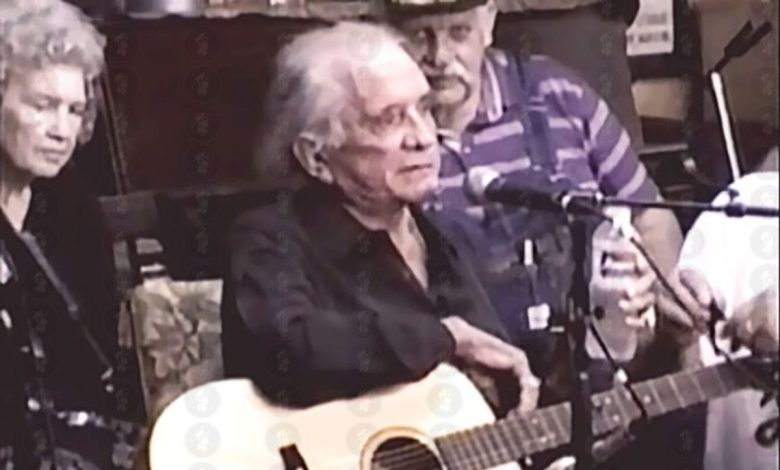
Hello, I’m Johnny Cash. That’s how Johnny Cash started his concerts before firing up his early hit Folsom Prison Blues (1955). His last public performance was no exception. Before we get to the video of that performance we need a little background. First, Johnny Cash had been plagued by debilitating health problems for some time before his final concert on 5 July 2003. By July 2003, he was very frail, used a wheelchair, had partial facial paralysis, and was in mourning.
In 1997, Cash was diagnosed with Shy–Drager syndrome, a neurodegenerative disease. The diagnosis was later revised to autonomic neuropathy due to diabetes. Even as his health failed and his lungs were weakened by pneumonia, Cash continued to both record music with producer Rick Rubin and release highly regarded albums on Rubin’s label, American Recordings. Second, the love of Cash’s life, June Carter Cash died on 15 May 2003, aged 73. His final concert was two months after June’s death.
Johnny Cash’s final performance was an appearance at the Carter Family Fold at the foot of Clinch Mountain in Hiltons, Virginia. For Johnny Cash, the visit was a pilgrimage. June, his recently deceased wife, was the daughter of Maybelle Carter, who, together with her husband’s brother, A.P. Carter, and her sister-in-law, Sara Carter (A.P.’s wife and Maybelle’s first cousin), formed the first family of country music, The Carter Family. June sang with the Carter Family from the age of 10.
When the original Carter Family stopped recording in 1943, Maybelle and her three daughters performed as The Carter Sisters & Mother Maybelle. In 1950, the group joined the cast of The Grand Ole Opry in Nashville. It was at The Grand Ole Opry that June Carter first met Johnny Cash. Both were already married. The Carter Family Fold is a barn-like structure on the land of the original Carter Family homestead. It doubles as a museum and concert venue. Let’s see Johnny and June in their prime:
Jackson is a 1963 song by Billy Edd Wheeler and Jerry Leiber. Johnny Cash and June Carter’s version was released in February 1967, a year before they married on 1 March 1968. The song reached No. 2 on the US Country charts and, in 1968, it earned Johnny and June a Grammy for Best Country & Western Performance Duet, Trio or Group.
When Johnny Cash made the pilgrimage to perform at the place were The Carter Family lived and developed their seminal music, he had laryngitis and was hoarse. For some the performance must sound like a geriatric old man with a creaky, broken voice. For those that know and love the music of Johnny Cash, the concert is a testimony to his strength of character, his amazing repertoire, and his love of June Carter Cash. It is a wonder. A triumph of spirit.
Incidentally, the guy in the white T-shirt in the opening shots (one of two guys who helps Johnny with his mic and guitar), is John Carter Cash, Johnny and June’s son. He is a musician and music producer. Johnny Cash died on 12 September 2003, just four months after June. How about one more song from the man in black?
If you would like to see more from Johnny Cash, you can subscribe to his YouTube channel. You can also visit his official website for more information.
Read more stories
Get ready for goosebumps hearing late greats John Denver and Cass Elliot’s live duet on “Leaving on a Jet Plane” – this has to be one of the greatest vocal duos ever!
When “School Facts” Turn Out to Be Wrong
Craig Morgan’s Opry surprise became a full-circle homecoming
A father’s flower-covered bicycle made his daughter’s wedding unforgettable
2 minutes read
Continue reading
The Statler Brothers’ “Flowers on the Wall” Redefined Country Storytelling and Crossed Genre Boundaries in 1965 – Today’s Story!
In late 1965, a curious song titled “Flowers on the Wall” began rising up the charts with quiet but undeniable force.
Written by the group’s bass vocalist Lew DeWitt and performed by The Statler Brothers, the song stood out immediately with its mix of sardonic humor, deep melancholy, and a melody that clung to listeners like memory.
At a time when the country charts were dominated by earnest heartbreak ballads and honky-tonk tales, “Flowers on the Wall” was something different—a tongue-in-cheek meditation on loneliness that struck a surprisingly universal chord.
It became a major hit, reaching No. 2 on the Billboard Hot Country Singles chart and even climbing to No. 4 on the Billboard Hot 100, signaling one of country music’s most unusual and effective crossovers.
The Statler Brothers weren’t a traditional country outfit.
Hailing from Staunton, Virginia, they originally formed in 1955 as a gospel quartet known as The Four Star Quartet.
The group was named after a brand of facial tissue, a playful start for a group that would come to blend humor and heartbreak with unmatched charm.
By the early 1960s, they’d caught the attention of Johnny Cash, who hired them as his backing vocalists.
Touring with Cash gave them exposure to wider audiences and solidified their reputation as a unique vocal group capable of harmonies as tight as any gospel ensemble but with a modern, narrative sensibility.
“Flowers on the Wall” came directly from Lew DeWitt’s pen—an oddball song that described a man who insists he’s doing just fine while alone in a room, passing the time by counting flowers on the wall, playing solitaire with a deck of 51, and watching Captain Kangaroo.
It was a song of denial—clever, catchy, and laced with a sadness that lingered just beneath the lyrics.
Inspired in part by the deadpan comedic style of writers like Ernie Kovacs, the song was also a subtle commentary on isolation, mental distraction, and coping with heartbreak.
Statler Brothers – Country Music Hall of Fame and Museum
The track was produced by Jerry Kennedy at Mercury Records, and its sparse, almost minimalist arrangement helped highlight the group’s layered harmonies and DeWitt’s lead vocal.
The snappy rhythm guitar and upright bass gave it a quirky bounce, while the lyrics stayed crisp and up front in the mix.
Kennedy, who worked with artists like Tom T. Hall and Roger Miller, knew how to make the unconventional sound commercial—and he delivered again here.
When it hit the airwaves, “Flowers on the Wall” quickly became a sensation.
Not only did it climb the country charts, but it also earned the group a Grammy Award for Best Contemporary (R&R) Performance by a Group.
That genre-blurring recognition was rare at the time for a country act, especially one with gospel roots.
Its chart success proved that country music could be clever, even weird, and still captivate a mainstream audience.
Culturally, the song opened a new lane for storytelling in music.
It wasn’t a straightforward heartbreak tale or a triumphant love story—it was about internal struggle, veiled in wit.
At a time when male vulnerability was rarely addressed so directly in pop music, The Statler Brothers leaned into it with grace and subtlety, paving the way for artists who would use humor as a vehicle for emotional expression.
The success of “Flowers on the Wall” gave The Statler Brothers a career-defining breakthrough.
The Statler Brothers’ Biggest Hits
They moved from being Johnny Cash’s backup singers to major recording artists in their own right.
The song’s popularity helped secure their contract with Mercury and ushered in a string of hits that would make them one of the most awarded country groups of all time.
Within the genre, the song had a quiet influence.
Its mix of traditional vocal harmony and unusual lyricism encouraged more experimentation in country songwriting.
The Statler Brothers proved that storytelling didn’t need to be linear, and that even a playful delivery could mask deep emotion.
Their style influenced acts like Alabama and The Oak Ridge Boys, who also blended harmonies with narrative charm.
“Flowers on the Wall” was later covered by a number of artists, but perhaps the most famous usage came decades later in Quentin Tarantino’s 1994 film Pulp Fiction.
In the scene where Bruce Willis’s character drives through Los Angeles after a tense encounter, the song plays on the car radio—an ironic backdrop that gave the tune an entirely new cultural moment and introduced it to a younger audience.
Interestingly, around the time the song became a hit, The Statler Brothers were dealing with the pressures of sudden fame.
Lew DeWitt, who struggled with Crohn’s disease throughout his life, saw his health begin to decline even as the band was hitting its stride.
Still, he remained an integral part of the group’s sound and spirit until his departure in the early 1980s.
The Statler Brothers | Official Website & Merchandise
Decades later, “Flowers on the Wall” still resonates.
It continues to receive radio play, frequently appears on classic country compilations, and remains one of The Statler Brothers’ most beloved recordings.
Its presence in pop culture, from radio countdowns to film soundtracks, is a testament to its enduring charm and originality.
Musically, the song helped bridge the gap between country and pop without sacrificing authenticity.
It was proof that country didn’t have to conform to Nashville’s typical polish to succeed—quirky, homegrown ideas could cut through if delivered with sincerity and craft.
Though the group received numerous accolades over the years—including induction into the Country Music Hall of Fame in 2008—“Flowers on the Wall” remains the song that introduced their genius to the world.
It was their launchpad and their legacy all in one.
In the end, what makes “Flowers on the Wall” unforgettable isn’t just its melody or its lyrics—it’s the way it makes us feel seen.
Behind the humor is a very real truth about how we cope with loneliness.
The Statler Brothers didn’t just record a hit—they captured a universal experience, wrapped in harmony, and sent it out to the world.
Read more stories
KSI Freaks Out as a Britain’s Got Talent Performance Pushes the Limits
The McCoys’ “Hang On Sloopy” Rockets to No. 1 and Grows into Ohio’s Unofficial Anthem in 1965
Jackie DeShannon’s Timeless Classic “What the World Needs Now Is Love” Still Uplifts and Inspires Generations
Released in 1971, this heartbreaking ballad changed how people heard breakup songs forever… because it wasn’t about anger or betrayal, but the quiet moment two people realize love is already gone.
4 minutes read
Share
X
Telegram
Other posts
Jul 24, 2026
Little Eva’s “The Loco-Motion” Ignites Dance Craze and Tops Charts in 1962 – Today’s Story…
May 10, 2026
Steve Perry’s vocals are out of this world on Journey’s “Don’t Stop Believin’” live in 198…
Jun 05, 2026
The Seekers’ “Georgy Girl” Bridges Folk and Pop Worlds to Achieve Global Acclaim in 1966 -…
Jul 18, 2026
This 1973 Classic Reminded Millions That Time Is Life’s Most Precious Gift Its heartfelt m…
Jul 18, 2026
Gene Pitney’s "Only Love Can Break a Heart" in 1962
May 12, 2026
Shelley Fabares’ “Johnny Angel” and The Donna Reed Show
Jul 12, 2026
Seals & Crofts “Summer Breeze” 1972 Soft Rock Classic
Jun 24, 2026
This Song Taught Life Lessons Millions of Americans Never Forgot