A Storm Brought a 70-Foot Oak Down Across Mom’s Driveway, but My Brother Accepted $800 to Remove It and Never Came
The Great Oak
The storm came through on a Tuesday afternoon in June, a little after four. I was standing along the shoulder of Route F east of town in my orange safety vest and hard hat, holding a stop-slow paddle while the county crew filled potholes, when the sky off to the west turned the color of a bruise. The foreman took one look and hollered for everyone to get into the trucks, and we only just made it. The wind swept over the fields like a wall, pressing the corn flat and bowing the power lines and hurling gravel against our windshield so hard I thought the glass might shatter.
Later, the radio said it was a derecho. I had never even heard that word before that summer. It’s a long band of thunderstorms that moves fast and drives straight-line winds ahead of it, ninety miles an hour in some places, and this one ripped across central Missouri from Kansas City to St. Louis in around four hours. It tore roofs off barns and tipped grain bins and snapped telephone poles like matchsticks. In our county by itself, it dropped so many trees that the road crew didn’t finish clearing the blacktops until the Fourth of July.
My phone rang at four-thirty, while I was still in the crew truck waiting for the hail to let up. It was my mother, calling from her kitchen.
“Joann,” she said. Her voice was calm, but I could still hear the wind screaming behind her through the walls of that old farmhouse. “I’m all right. The house is all right. But the big oak is down.”
My mother is seventy-nine years old. Her name is Nadine Fischer, and she lives alone on the eighty acres my father left her when he died seven years ago, four miles north of Pinckney Ridge on a gravel road. Dad worked that land for forty-five years, and she still keeps a few cows there that a neighbor tends, and a garden she refuses to quit, and a white two-story house with green shutters at the end of a quarter-mile lane lined with fence.
That white oak had stood beside her lane longer than she had been alive. Dad always said it had been there before the house, before the barn, maybe even before the Civil War. It was the biggest tree in the county, seventy feet high with a trunk so wide that Kenzie and I couldn’t get our arms around it holding hands when she was little. Dad hung a tire swing from its lowest branch for my brother and me, and Mom used to sit beneath it in a lawn chair in August shelling peas.
I drove out after the crew let us go, as soon as the road was clear enough to travel. The lane was strewn with ripped branches and leaves, and when I rounded the curve by the cattle guard, I stopped the truck and just sat there.
The oak was sprawled across the gravel, its roots sticking up in the air higher than her porch. The whole thing had been yanked out of the ground like a pulled tooth, carrying a crater of red clay with it, and it had landed straight across the lane and halfway into the pasture beyond. The trunk was four feet thick at the base. The limbs alone were larger than most trees, and they were snarled through the fence and the ditch and across the gravel all the way down to the mailbox.
Her car was trapped on the wrong side of it. Her old Buick sat in the yard by the house, and the only way out was down that lane, and that lane was blocked.
Chapter Two: Eight Hundred Dollars
My brother Dwight came out the following morning.
He’s three years older than I am, fifty-four, a big man with our father’s shoulders and our mother’s blue eyes. He farms around four hundred acres of corn and beans of his own on the far side of Pinckney Ridge, eight miles from Mom’s place, and he does some custom hay baling too. He has always been the one who knew how to fix things. When I was a girl and something broke on the farm, Dad called for Dwight, not me.
He walked the length of the trunk from one end to the other with his hands in his pockets, studying it the same way Dad used to study a field before planting. He climbed up onto the root ball and examined the crater. He crouched and looked at the place where the trunk lay over the gravel, judging it with his eyes. Then he came back up to the porch where Mom and I were standing.
“It’s a big job, Mom,” he said. “It’ll take a bigger saw than I’ve got, and a lot of chain. I’ll have to hire somebody to help me.” He scratched at his neck. “Eight hundred. Cash up front for gas, chains, and a helper.”
Mom didn’t pause. She went into the kitchen and came back out with the coffee can.
It’s an old red Folgers can she keeps on the top shelf of the pantry, behind the flour. She has kept cash in it since before I was born. Dad used to call it the bank of Nadine. She pulled off the plastic lid and counted out eight hundred-dollar bills on the porch rail, slowly, smoothing each one with her thumb, and handed them to her son.
“Thank you, honey,” she said. “When can you come?”
“Saturday,” Dwight said. He folded the money and slid it into his shirt pocket. “First thing Saturday. I’ll be here at seven.”
Saturday came and passed.
Mom called me at nine that Saturday morning and asked if I had heard from Dwight. She called again at eleven. At two, she called and said she’d made a pot roast for when he arrived, and she guessed she’d put it in the refrigerator.
Then the next Saturday. And the week between. Mom phoned him four times. He answered once, on Wednesday, and said he’d gotten delayed but would definitely be there Saturday. The next Saturday, he didn’t come either, and when Mom called, it went straight to voicemail.
I want to be fair to my brother. His own machine shed lost its roof in that same storm. The wind peeled the entire sheet-metal top off and dropped it into his soybean field, and everything inside got soaked—his tractor and his planter and two hundred bales of hay he’d put up in May. I know that hurt him badly. I knew it was gnawing at him. I drove past his place twice and saw blue tarps stretched over the shed, snapping in the wind.
But Mom’s heart doctor appointment in Columbia was on Thursday of the third week. She has a leaky valve and an irregular heartbeat, and she had been waiting four months for that appointment with a cardiologist at the university hospital, to find out whether she needed a procedure. A promise does not get a seventy-nine-year-old woman over a trunk four feet thick. And if her heart started acting up in the middle of the night, an ambulance would have had to stop at the road, and the paramedics would have had to carry her a quarter mile down a lane littered with fallen limbs.
I called every tree service in three counties. I called the one in Columbia and the one in Fayette and the one in Mexico and two in Moberly. Every single one of them told me the same thing. They were booked through August, maybe September, because of all the derecho damage. One man laughed when I told him how large the tree was, and said for an oak that size he’d want four thousand dollars and a crane.
Chapter Three: Three Days
So I called my boss and took three days of vacation.
I flag traffic for the county road crew. I’ve done it for nine years, ever since the hospital in Moberly shut down and I lost my job in the billing office. It isn’t glamorous work. You stand on the shoulder of a blacktop for ten hours at a time in an orange vest, holding a paddle, while the trucks pass and the asphalt smokes and the sun bakes you. But it pays decently, with good county insurance, and it taught me how to work outside in the heat all day without dropping over.
My husband has been gone eleven years. Greg was a lineman for the electric co-op, and he was killed in 2014 when a truck came over a hill too fast and hit his bucket truck on a two-lane road. Kenzie was eight. Since then it has been the two of us, and that summer, it was me and Kenzie against that oak.
She is nineteen and studying to be a nurse at Moberly Area Community College, home for the summer and working nights as a CNA at the nursing home in town. When I told her what I planned to do, she didn’t argue or ask if I was sure. She simply went to her room and came back out in old jeans and a pair of my work boots, pulled her long brown hair into a ponytail, and said, “Show me.”
I ran Dad’s old saw. It’s a Stihl 066 with a twenty-eight-inch bar, a big heavy orange beast he bought in 1989 for cutting firewood, and it hadn’t been started since the winter before he died. I took it to the small engine shop in Pinckney Ridge on Monday night, and old Ray Fogle cleaned the carburetor and put a new chain on it and refused to let me pay him for the labor. “That was Clarence’s saw,” he said. “I sharpened every chain he ever ran on it.”
Kenzie used my smaller saw on the limbs, a sixteen-inch Husqvarna I use for clearing brush around the house. I showed her how to start it, how to hold it, how to stand so that if it kicked back it wouldn’t come at her face. She listened to every word the way she listens in anatomy class, and then she made me show her again.
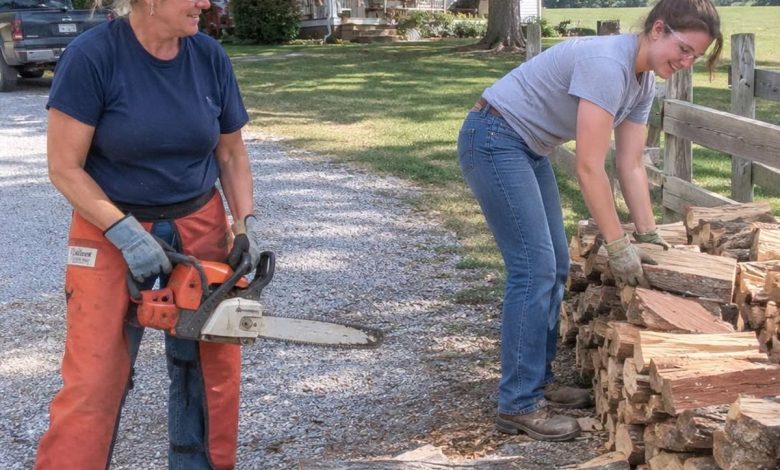
We began at six-thirty Wednesday morning, as soon as there was enough light to see. I wore Dad’s old leather chaps over my jeans and my county hard hat with the face screen. Kenzie wore safety glasses and ear muffs and a pair of my work gloves that were too large for her.
We burned through a gallon of mix before ten o’clock. That big Stihl drinks gas like a tractor. I’d cut through a limb as thick as a man’s waist, and Kenzie would come behind me and trim off the smaller branches and drag them to the burn pile in the pasture. Then I’d move on to the next one. The sawdust flew in clouds and stuck to the sweat on our arms and necks until we looked like we’d been rolled in cornmeal.
By noon my arms were trembling. I couldn’t hold a cup of water without spilling it. We sat in the shade of the porch and ate the bologna sandwiches Mom had made for us, and neither of us spoke. Kenzie looked down at her hands, which had blisters across both palms where the gloves had rubbed, and then she looked at me.
“How did Grandpa do this?” she asked.
“He was younger,” I said. “And he had Dwight.”
She didn’t answer that. She just finished her sandwich and pulled her gloves back on.
By supper we had the top of it cut apart and dragged off the lane. All the branches and upper limbs, the whole crown of the tree, cut into pieces and piled along the edge of the pasture. What remained was the trunk itself, lying across the gravel like a fallen pillar, four feet thick and forty feet long, with the root ball still standing at one end.
I did not know how we were going to move it. I lay awake that night in Mom’s spare bedroom with my arms aching so badly I couldn’t sleep, thinking about that trunk.
Chapter Four: Amos
The second morning, I heard an engine coming down the county road.
It was six-forty-five, and Kenzie and I were standing at the trunk with our saws, trying to decide where to begin. The sound came from the north, a low rattling putter, getting closer. A truck turned in at the cattle guard and came slowly down the lane, as far as it could before the trunk stopped it.
It was an old Ford pickup, faded blue, with a log splitter hitched behind it. The splitter was the old kind, a gas engine on a small trailer with a steel wedge and a hydraulic ram, the kind you hardly see anymore except at farm sales. The truck stopped. The door opened. And out stepped Amos Whitcomb.
Amos Whitcomb is eighty-four. He farmed the place south of Mom’s for fifty years before retiring and moving into town. He and Dad were best friends. They traded labor every summer, hauling hay and mending fence, and every Saturday morning for thirty years they drank coffee together at the Main Street Café in Pinckney Ridge with a bunch of other old farmers at the long table in back.
He had brought his old log splitter. He walked around the front of his truck in overalls and a seed cap, slow, the way old farmers walk. He looked at the trunk. He looked at me in Dad’s chaps. He looked at Kenzie with her blistered hands.
He did not say one single word about Dwight.
He simply backed his truck around at the pasture gate, unhitched the splitter, and pushed it up against Mom’s white board fence. Then he pulled the cord. It started on the first try, rattling and smoking, and he looked at me over the top of it.
“You cut ’em in rounds, about eighteen inches,” he said. “I’ll split ’em. The girl can stack.”
That was all he said. That was all that needed saying.
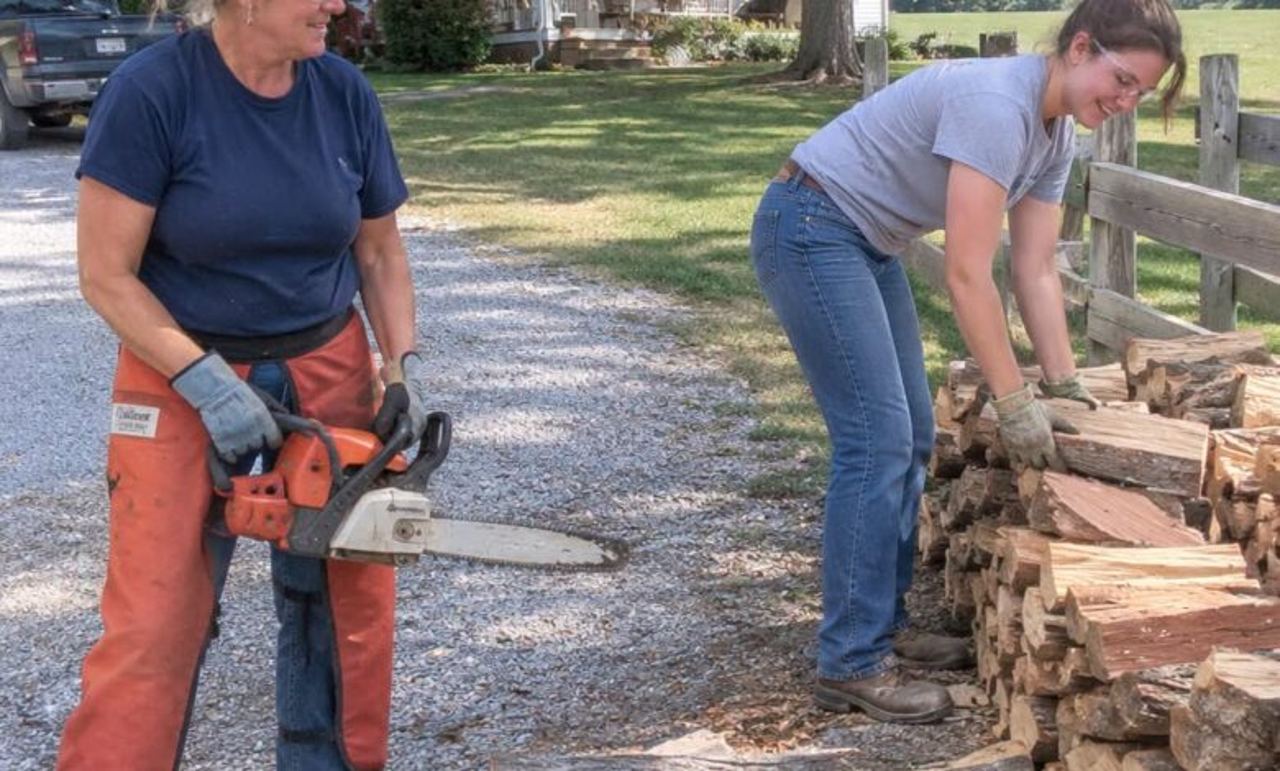
So I cut rounds. I started at the top end of the trunk, where it was narrower, maybe two feet across, and cut it into rounds eighteen inches long, one after another. Each one took a couple of minutes with Dad’s big saw. Then Kenzie and I rolled the rounds over to Amos, and he’d lift them onto the splitter, slow and careful, and the hydraulic ram would press them into the wedge, and they’d crack open like a rifle shot. Then he’d split the halves again, and again, until he had stove-sized pieces, and Kenzie would carry them over to the fence and start stacking.
By nine o’clock, two of the coffee men from the café had shown up too. Lyle Brandt and Ernie Schulte, both in their seventies, both retired farmers who had sat at that long table with Dad for thirty years. They pulled in behind Amos’s truck in Lyle’s Chevy, and they didn’t say anything either. They just got out with their work gloves and walked over to the woodpile and started stacking beside Kenzie.
Then two more. Bob Kessler and Floyd Mertz arrived around ten, with Floyd’s grandson, who is sixteen and plays football for Pinckney Ridge and could carry three rounds at once. Then Ray Fogle from the small engine shop came out at noon with a cooler of Gatorade and a spare chain for Dad’s saw, already sharpened.
They took turns stacking. Nobody gave a speech. Nobody asked where Dwight was, though I knew every one of them was thinking it, because Pinckney Ridge has about six hundred people and everybody knew he had taken the money. They simply stacked. One piece at a time, along Mom’s white board fence, bark side up so the rain would run off, the way Dad used to stack it.
Mom sat on the porch with a pitcher of tea and her Bible in her lap. She had come out at seven with her cane and settled into the old porch swing, and she watched every minute of it. Every hour or so she would get up and refill the tea pitcher and carry it down the steps to the men at the woodpile, and they would stop and drink and thank her, and go back to work.
Kenzie kept checking Grandma’s ankles for swelling. That’s the nurse in her. Mom’s ankles swell when her heart is acting up, and Kenzie knows that, and every time she walked up to the porch for tea, she’d crouch down and press her thumb against Mom’s ankle and watch to see if the dent stayed.
“Grandma, feet up,” she’d say.
“Yes, nurse,” Mom would say, and swing her feet up onto the porch railing.
That made Mom laugh for the first time in two weeks. I heard it from out by the trunk, over the sound of the saw. A real laugh, the laugh I remembered from when I was a girl, high and surprised and a little embarrassed. I shut off the saw for a second just to hear it.
Chapter Five: The Carving
On the third day, we reached the butt log.
That’s the bottom of the trunk, the biggest section, right above the roots. It was four feet across, the wood so dense and heavy that Dad’s big saw slowed to a crawl cutting through it. Each cut took ten minutes. Amos’s splitter couldn’t handle rounds that big, so we had to cut them thinner, a foot instead of eighteen inches, and even then it took two men and Floyd’s grandson to roll them over to the splitter.
At about two in the afternoon, I made a cut and the round dropped away, and I stopped.
There were letters in the bark. Old ones, carved deep years ago and grown over and stretched by the tree’s growth, but they were still legible. A heart, crooked. And inside it, two sets of initials and a date.
C.F. + N.W. 1966.
Clarence Fischer and Nadine Wilmes. My father and my mother. The summer they got engaged.
I shut off the saw and stood there staring at it. Kenzie came up beside me, and she saw it too, and she put her hand over her mouth. Then she turned and looked toward the porch.
Mom was already coming down the steps. She had seen us stop. She crossed the yard with her cane, slowly, and stood beside the round with the carving on it. She reached out and touched it. She traced the heart with one finger.
“He did that the night he asked me,” she said softly. “Right here. With his pocketknife. He was so nervous he cut himself.” She smiled. “He bled all over my good dress.”
None of us said a thing. The coffee men had stopped stacking. Amos shut off his splitter.
“Dwight used to sit under that heart on the tire swing,” Mom said. “When he was little. He’d trace it with his finger and ask what it said.” She looked down the lane toward the road. “Clarence told him it said that’s where everything started.”
She looked at the round for a long while. Then she looked at me.
“Don’t split that one,” she said. “Set it aside. Put it on the porch.”
So Floyd’s grandson rolled it up to the porch, and we set it by the front door, bark side out so the heart showed.
Chapter Six: Sixty Feet
On the third afternoon, I made the final cut on the butt log.
It was a little after four o’clock, three days and almost exactly three weeks after the storm. The last round came free from the root ball with a groan, and I shut off Dad’s saw and set it down on the gravel, and for a moment I could not move. My arms were shaking. My back was screaming. I had sawdust in my ears and my nose and down the back of my shirt.
The lane was open.
I stood there and looked at it. A quarter mile of gravel, clear, from Mom’s front porch all the way to the mailbox. The root ball was still there at the side, sticking up from its crater, but it was off the lane, and a car could get by it. An ambulance could get by it.
And along Mom’s white board fence ran a line of split oak, sixty feet long and stacked chest high.
Kenzie measured it later with a tape measure from the barn, just to make sure. Sixty-one feet, two inches. Four feet high. That’s six full cords of seasoned white oak, maybe more, the best firewood there is. It burns hot and slow and long. Mom heats her house with a woodstove in the kitchen and an old propane furnace she hates to use because propane is so expensive, and that wood would keep her warm for three winters. Maybe four.
The coffee men stepped back and looked at it with their hands on their hips. Nobody spoke for a minute. Then Lyle Brandt said, “Clarence would’ve stacked it neater,” and everybody laughed, and Ernie said Clarence had never stacked a straight row of wood in his life, and that started a whole argument that lasted until Amos told them both to hush.
Kenzie sat down on the last round. It was a big one from the butt log, too large to split, and Amos said to leave it as a chopping block. She sat on it with her legs crossed and her pocketknife out, the little Case knife her father had given her when she was seven, the one she still carries. She was bent over the top of the round, carving something into it.
“What are you doing?” I asked.
“Nothing,” she said, and put her arm around it so I couldn’t see.
“Kenzie.”
“You’ll see,” she said. “When I’m done.” And she would not let me look.
Then Dwight came up the lane.
Chapter Seven: The Back Pocket
I heard his truck before I saw it. A red Dodge with a dent in the tailgate, coming slowly over the cattle guard. Everyone heard it. The coffee men turned. Amos straightened up from the splitter. Kenzie stopped carving.
He came down the lane, the open lane, and I watched him take it in through his windshield. The fresh gravel where the trunk had been. The root ball standing off to the side. The burn pile in the pasture, still smoking.
He stopped beside the woodpile.
He got out of his truck slowly. He was wearing work clothes, jeans and a sweat-stained T-shirt, and he looked worse than I had ever seen him. He had lost weight. He hadn’t shaved in days. There were dark circles under his eyes like bruises. My big brother, who could fix anything, looked like a man who had been sleeping in his truck.
He looked down the whole sixty feet of it. All the way along the fence line, from one end of the woodpile to the other. I watched his eyes travel over it, slowly, piece by piece.
He looked at Amos, then at me in my sawdust and chaps.
Then at Mom on the porch.
She was sitting in the swing with her Bible in her lap and her feet up on the railing, where Kenzie had told her to keep them. She didn’t stand. She didn’t call out to him. She just watched him, with no expression at all on her face.
Nobody on that whole farm said a word. The splitter was off. The saws were off. You could hear the cows in the back pasture and a mockingbird in the cedar tree by the barn.
He walked to the steps and put one hand on the rail.
“Mom,” he said.
Then he reached into his back pocket.
He pulled out an envelope. A white one, from the Bank of Pinckney Ridge, the kind they hand you when you take out cash at the window. It was creased down the middle like it had been folded in his pocket for a long time. He held it out toward her, up the steps, and his hand was shaking.
“It’s eight hundred dollars,” he said. “It’s yours. I’m sorry.”
Mom looked at the envelope. She did not take it.
“Where’d you get it, Dwight?” she asked.
He did not answer for a long while. He looked down at the ground. When he finally spoke, his voice was so soft I could barely hear it from where I stood by the woodpile.
“Columbia,” he said. “The pawn shop on Business Loop. I sold my saw this morning. And Dad’s deer rifle.”
Chapter Eight: What Dwight Said
Mom rose from the porch swing.
She did it slowly, with one hand on the chain, and picked up her cane and came to the top of the steps. She stood there looking down at her son, at the envelope in his hand, and her face changed. It was not anger. It was something worse. It was the same face she made at Dad’s funeral when the casket was lowered.
“Your father’s rifle,” she said. “The Winchester.”
“I’ll get it back,” Dwight said quickly. “I’ve got ninety days. I’ll get it back, Mom, I swear I will. I just had to get your money back to you. I couldn’t come out here without it.”
“What happened to the eight hundred I gave you?”
He looked down at the steps. He was silent so long I thought he might not answer. Then he started talking, and once he started, it all came out.
“I spent it on my shed,” he said. “The day after you gave it to me. I bought tarps and roofing nails and rented a man lift from the rental place in Columbia. I had two hundred bales of hay getting soaked and my tractor and my planter sitting out under the sky, and the rain kept coming, and I panicked.” He wiped his face with the back of his hand. “I told myself I’d pay it back the next week. When the insurance money came.”
“And the insurance didn’t come,” I said.
He turned and looked at me. I don’t think he expected me to say it. But I knew. I had been watching those blue tarps flap on his shed for three weeks, and no one had come to put a new roof on.
“No,” he said. “It didn’t come. My farm policy lapsed in March. I missed a premium payment. Eighteen hundred and forty dollars.” He laughed, and it was a terrible sound. “I didn’t even know until I called the agent the day after the storm. The notices went to the old address, after Sharon moved out. I’ve been getting my mail at the café since the divorce, and I never changed it with the insurance company.” He shook his head. “The roof is going to cost fourteen thousand dollars. I don’t have fourteen thousand dollars. I don’t have fourteen hundred.”
Nobody said anything. The coffee men were staring at the ground. Amos had his hands in his overall pockets.
“So I took Mom’s money,” Dwight said. “Her coffee can money. And I spent it on tarps. And then every Saturday I told myself I’d come cut the tree, and every Saturday I got up and looked at that empty shed and I couldn’t do it.” His voice broke. “I couldn’t come out here and face her. With her money gone. And no way to get it back.”
Mom came down one step. Then another. She stopped on the bottom one, so that she was eye to eye with him.
“That’s not all of it,” she said quietly. “Is it, son.”
Dwight looked at her. Then he looked past her, toward the porch. At the round from the butt log sitting by the front door with the heart carved in the bark. C.F. + N.W. 1966.
His face collapsed.
“I couldn’t cut it, Mom,” he said. “That’s the truth. I could have borrowed a saw. Amos would’ve lent me his splitter. I came out here that first Saturday at six in the morning, and I parked at the road, and I walked up to the trunk with my saw.” He was crying now. Openly. My big brother, crying on Mom’s front steps in front of half the old men in Pinckney Ridge. “…
Read more stories
- Sammy Kershaw is on his way to country music’s biggest night with Mendy by his side.
In h
- When we were 13, my three best friends and I made a promise: someday, we’d ride motorcycle
- My Husband Had a Mistress But When His Mother Arrived at My Door I Discovered a Terrifying Family Secret That Changed Everything
- Can You Spot the Hidden Detail in This Horse Photo