How a Piano and a Chance Encounter Launched Elton John’s Stardom
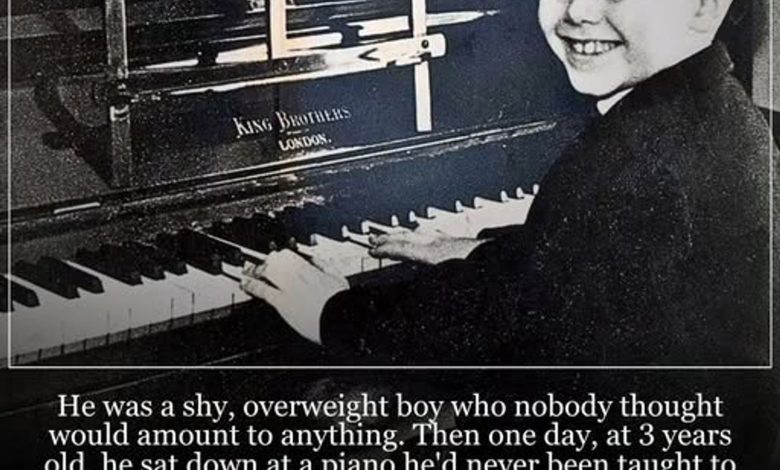
In the quiet suburb of Pinner, outside London, life moved at a sleepy pace, with nondescript houses lining the streets like soldiers at attention. Within one of these homes, a boy named Reginald Kenneth Dwight, born in 1947, found solace from his father’s emotional distance and absences in the enchanting world of music. His mother, a passionate music lover, filled their home with vibrant sounds of rock and roll and pop, igniting a spark in young Reggie. One fateful afternoon, he climbed onto a piano stool at his grandmother’s house, his tiny fingers dancing over the keys. Without a single lesson, he played a melody by ear, as if the music flowed through his veins. His mother stood watching, her heart swelling with hope; in that moment, she realized her son was destined for something beyond the ordinary.
By the age of eleven, Reggie’s prodigious talent had earned him a scholarship to one of London’s prestigious music academies. While other children reveled in carefree slumber on Saturday mornings, he took the train into the city to study classical piano. Yet, the rigid structure of classical music never quite captured his spirit. At school recitals, he would abandon the expected compositions of Chopin, opting instead for the lively tunes of Jerry Lee Lewis. He became a whirlwind of energy on stage, kicking over the bench and playing with a joy that scandalized his teachers and thrilled his peers.
As his teenage years unfolded amidst his parents’ bitter divorce, Reggie left school just weeks before his A-Level exams, chasing an elusive dream of making music his life. He moved in with his mother and stepfather, and in the intimacy of his small bedroom, he poured his heart into songwriting. The walls of that room bore witness to the raw emotions and lyrical struggles of a young artist finding his voice. But it was a chance encounter that would change everything.
When Reggie answered a small ad in a music paper looking for songwriters, he found himself face to face with an A&R manager holding an envelope left behind by another hopeful. Inside was the work of a young lyricist named Bernie Taupin, a name that meant nothing to him at that moment. Yet, as he read Taupin’s words, something clicked within him. He took the lyrics home, and there in the safety of his own space, he began to create melodies that danced with the words. For months, they collaborated by mail, crafting a bond that transcended distance and time until they finally met in person.
The chemistry was electric. They worked with a fervor that seemed impossible, lyrics flowing in under an hour, melodies composed in half that time. Two teenagers, each with a piece of the other’s soul, creating music that felt timeless. Reggie shed his given name, adopting the moniker Elton John—his first name from a saxophonist in a previous band and his last from a singer. This marked the genesis of a career that would soon captivate the world.
By the time he reached twenty-three, Elton was ready to take his music across the ocean. His first American gig was at a small, unremarkable club in Los Angeles, a far cry from the superstardom that awaited him. As he sat at the piano, he kicked the bench aside and unleashed a flurry of notes, effortlessly blending chaos with order. The audience erupted in excitement, the room igniting with energy that would change everything for the young artist.
In a matter of months, Elton John went from obscurity to a household name, his journey a testament to the power of music and the magic of unexpected partnerships. Looking back, it’s clear that the boy who once played alone in a small room transformed into a beacon of talent and creativity, proving that even the quietest corners of the world can harbor extraordinary dreams.
Read more stories
- Released in 1971, this cheerful pop hit sounded bright and carefree on the surface… But hidden inside the lyrics was a surprisingly sad story most listeners never noticed.
- Shelley Winters: A Voice That Refused to Be Silenced
- Ed Harris’s Journey from Frustration to Acceptance in Dutton Ranch
- The Last Ride: John Wayne’s Moving Farewell in The Shootist