I Was an Office Cleaner When My Handsome Boss Asked Me to Dinner – On Our 20th Anniversary, I Found an Application with My Name Circled in Red
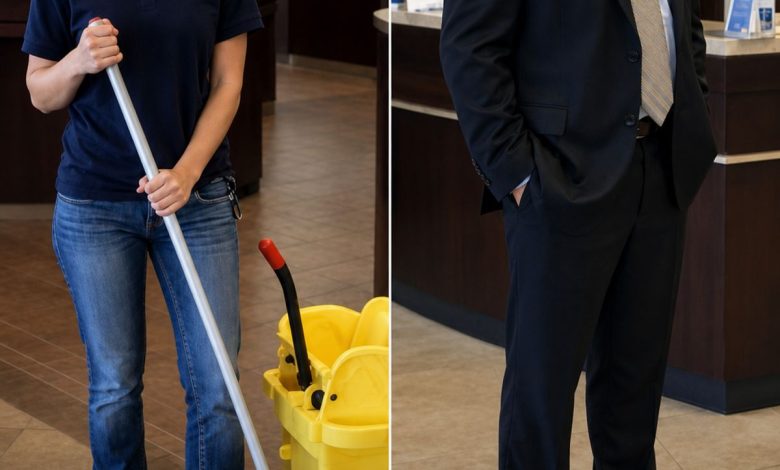
A former office cleaner spent 20 years wondering why the successful bank manager she married had chosen her. On their anniversary, she found her old job application hidden in his study, her name circled in red with instructions written months before they supposedly met.
Twenty years ago, I cleaned offices for a living.
Every evening, after the employees went home, I emptied trash cans, scrubbed floors, wiped fingerprints from glass doors, and tried not to think too hard about how different my life had turned out from the one I’d imagined.
That’s how I met Andrew.
He was 32 then.
Handsome in the irritating kind of way where he didn’t seem to know it. Dark hair, always slightly crooked tie, expensive shirts with the sleeves rolled up by six o’clock.
He managed the bank that occupied the third floor.
And I was the cleaner nobody noticed.
At least, that’s what I thought.
Most employees barely looked at me.
But Andrew always did.
“Evening, Claire,” he’d say every night.
Not “Hi.”
Not “Excuse me.”
But my name.
The first few times, I assumed he’d read it off my badge.
Then one Thursday, he stayed late.
I was emptying a bin outside his office when he appeared in the doorway.
“Can I ask you something?”
I immediately thought I’d broken something.
“Sure,” I said.
“Would you have dinner with me?” he asked.
I laughed because the idea seemed completely absurd.
He looked wounded.
“I’m serious.”
“You’re asking me?”
“I don’t see anyone else standing here,” he said.
I looked down at my cleaning uniform.
Then at his suit.
“Why?” I asked.
That question made him smile.
“Is that a no?”
“It’s a why,” I corrected him.
“Dinner first. Interrogation afterward,” he said with a smile.
I said yes.
Six months later, we were married.
Everybody thought we’d lost our minds.
My supervisor asked me three separate times if I was sure. Meanwhile, Andrew’s friends treated me politely while clearly trying to work out what he’d seen in me.
His mother was already gone by then, and his father had died when he was young.
My mother had died four years before I met him.
There weren’t many people left to object.
So we got married in a small church with 47 guests and a reception in the back room of an Italian restaurant.
Twenty years passed.
Andrew left banking eventually and started consulting. Meanwhile, I went back to school, and before long, we bought a house.
Like any couple, we had our share of arguments about money, laundry, whose turn it was to call the plumber, and whether the thermostat needed to be changed every six minutes.
We built a life.
And through all of it, Andrew treated me like I’d been the best thing that ever happened to him.
Still, part of me always wondered, “Why me?”
I hated myself a little for wondering.
But when you begin a marriage believing one person had every advantage, and the other had none, insecurity can survive long after the facts change.
Andrew could have dated women from his world.
Instead, he asked out the woman cleaning his office.
Whenever I asked why, he’d give me some variation of the same answer.
“You were beautiful.”
Or, “You made me laugh.”
Once he even said, “You threatened my printer.”
The printer had jammed while I was cleaning around it, and I’d called it a useless plastic parasite.
Apparently he’d overheard.

Those answers were sweet.
But they never quite answered the question.
On our 20th anniversary, I finally got one.
Just not the one I expected.
Andrew was downstairs making dinner.
He insists on cooking every anniversary because the restaurant where we had our first date closed years ago and he considers himself responsible for preserving the menu.
I went upstairs looking for our wedding album.
I thought it was in his study.
There was a stack of old folders on the top shelf of the closet.
When I pulled at the album beneath them, one folder slid forward.
It hit the floor and papers scattered everywhere.
I crouched down, irritated with myself, and started gathering them.
Then I saw the logo.
It was the company I’d worked for 20 years earlier.
I stopped.
There were employment applications inside.
Old ones.
Names I vaguely remembered.
Then I saw mine.
My photograph was clipped to the corner. I was 26 then, with shorter hair, a thinner face, and an expression that was trying very hard to look confident.
Then my eyes moved to my name.
It had been circled in red.
“CLAIRE”
And beside it, in handwriting I recognized immediately, were five words: “Hire her. Third floor only.”
It was Andrew’s handwriting.
For several seconds, I couldn’t make sense of what I was seeing.
Then I saw the date.
It was three months before I’d supposedly met him.
I sat down on the floor.
My first thought was that there had to be an explanation.
My second was worse.
Andrew had known who I was.
Not after I started cleaning his office.
But even before that.
He had somehow seen my application and specifically arranged for me to work on his floor.
I heard him coming upstairs.
“Claire?” he called out.
Panic decided for me.
I photographed the application with my phone, shoved the papers back into the folder, and returned it to the shelf.
Andrew appeared in the doorway.
“What are you doing?” he asked.
“I’m looking for our wedding album.”
He smiled.
“Twenty years and you still don’t know where anything is.”
Normally I would’ve thrown something at him.
Instead, I held up the album.
“Found it.”
He didn’t notice anything.
Or if he did, he didn’t show it.
At dinner, I pretended nothing had happened.
Andrew made the pasta from our first date, then opened the champagne while I set the table.
After dinner, we exchanged gifts. He gave me a bracelet, and I gave him a watch.
Then he made a little speech about 20 years together and how he’d choose me all over again.
I smiled through all of it.
A few minutes later, he went into the kitchen to get dessert.
I pulled out my phone.
I zoomed in on the photograph.
That was when I saw something else.

At the bottom of my application, almost hidden by the edge of another page, Andrew had written an address.
“14 Hawthorne Lane.”
I didn’t recognize it.
The next morning, Andrew went to work.
I waited 20 minutes.
Then I drove there.
Hawthorne Lane was 40 minutes outside town.
The houses got older as I went.
Number 14 sat at the end of a narrow road behind two enormous maple trees.
Or what was left of a house.
The paint had peeled almost completely away.
One shutter hung crooked.
The garden was gone.
The property looked as if nobody had lived there for years.
I sat in the car staring at it.
This was ridiculous.
I should have called Andrew.
Instead, I got out.
The front door was already open.
Not wide.
A few inches.
“Hello?”
Nothing.
I pushed it.
The hallway smelled like dust and damp wood.
There was almost no furniture.
A chair.
A broken table.
Old curtains.
“Hello?”
Still nothing.
Then I saw a cardboard box on the floor of the front room.
The top was open.
There were photographs inside.
I crouched.
The first few meant nothing to me.
A young woman standing beside a car.
Two women at a picnic.
A Christmas tree.
Then I picked up another photograph.
My breath stopped.
It was my mother.
She couldn’t have been older than 30.
And beside her was a woman I’d never seen before.
They had their arms around each other.
On my mother’s hip was a little girl.
It was me.
I turned the photograph over.
Two names were written on the back.
“Helen and Margaret.”
Helen was my mother.
I was still staring at it when the floor creaked behind me.
I spun around.
An elderly woman stood in the doorway.
She had a grocery bag in one hand and keys in the other.
“Who are you?”
I stood too quickly.
“I’m sorry. The door was open.”

She looked at the photograph in my hand.
Then at my face.
The grocery bag slipped slightly in her grip.
“Oh.”
“What?”
She stared at me.
“You have Helen’s eyes.”
My skin went cold.
“You knew my mother?”
The woman put the bag down.
“I’m Ruth.”
That meant nothing to me.
“Margaret was my sister.”
Andrew’s mother.
I looked at the photograph again.
“How did my mother know Andrew’s mother?”
Ruth sat down.
And over the next 40 minutes, she told me the part of my mother’s life I’d never known.
When my mother was 29, she worked at a pharmacy.
Margaret came in one afternoon with a split lip.
She said she’d fallen.
My mother didn’t believe her.
Margaret’s husband had become violent.
Andrew was six.
One night, things got bad enough that Margaret took Andrew and left.
She had almost no money.
No family nearby except Ruth, who was living overseas then.
My mother let them stay with us.
Not for a night.
For seven weeks.
I remembered none of it.
I had been three.
“Your mother helped her find a lawyer,” Ruth said. “Helped her get work too.”
I sat there holding the photograph.
“Why did they lose contact?”
“Life.”
Ruth shrugged sadly.
“Margaret moved. Your mother remarried. This was before everyone could find everyone online.”
“Did Andrew remember us?”
“Not clearly. He remembered a woman named Helen. A little girl. A yellow kitchen.”
Our kitchen had been yellow.
My throat tightened.
“Margaret never forgot.”
Ruth reached into the box.
She pulled out an envelope.
Inside was a letter.
My mother’s name was on it.
Margaret had apparently written it years later and never found an address to send it to.
Ruth let me read.
It wasn’t long.
Margaret thanked my mother for giving her somewhere safe to sleep.
For never asking her to explain bruises she wasn’t ready to explain.
For making Andrew pancakes on Sunday mornings.
Near the bottom was one sentence I read three times.
“You gave my son back a mother who wasn’t afraid every minute of the day.”
I started crying.
“Andrew found this after Margaret died,” Ruth said.
“When?”

“About 21 years ago.”
I looked up.
One year before he asked me to dinner.
“He tried to find Helen.”
“My mother was already dead.”
“I know.”
Ruth nodded.
“He found that out.”
Then she said, “He found you instead.”
There it was.
The red circle.
The application.
Third floor only.
“How?”
“You’d applied to that cleaning company. The bank used the same contractor. Andrew recognized your surname and photograph from Margaret’s things.”
I stared at her.
“He had them hire me?”
“He asked them to give you a position if you qualified.”
“On his floor.”
“Yes.”
“Why?”
Ruth looked almost surprised.
“Because he thought he owed your mother.”
That hurt more than I expected.
Not because it was cruel.
Because suddenly 20 years of my life felt as if someone had lifted the floorboards beneath it.
I drove home with the photograph on the passenger seat.
Andrew arrived at six.
He walked into the kitchen carrying flowers.
He saw my face.
Then he saw the photograph.
He stopped.
“Oh.”
That was all.
Oh.
“You knew me.”
He put the flowers down.
“Claire.”
“Before I met you.”
“Yes.”
“You arranged my job.”
His eyes closed briefly.
“Yes.”
“Third floor only.”
“Yes.”
I laughed.
It sounded awful.
“Twenty years.”
“I know.”
“No, I don’t think you do.”
He pulled out a chair.
I didn’t sit.
“Why didn’t you tell me?”
“Because I was a coward.”
At least he didn’t insult me with another answer.
“Was dinner part of it?”
“No.”
Too fast.

I stared at him.
“No,” he repeated. “Absolutely not.”
“How am I supposed to know?”
He looked devastated.
“You aren’t. That’s what I did by not telling you.”
That stopped me.
He continued.
“I found Margaret’s box after she died. I found Helen’s name. I spent months trying to locate her.”
“And found me.”
“Eventually.”
“So you decided to rescue the cleaner’s daughter?”
His face tightened.
“No.”
“You got me a job.”
“I got your application considered.”
“On your floor.”
“Yes.”
“Why?”
“Because your mother gave mine a chance when she needed one.”
He stepped closer.
“I thought I could do one decent thing for Helen’s daughter and never tell you. You needed stable hours. That contractor had an opening. I asked them to put you on the third floor.”
“Why your floor?”
He looked embarrassed now.
“Because I wanted to make sure they treated you properly.”
I stared at him.
Then I asked the only question that mattered.
“When you asked me to dinner, was that part of the promise too?”
His face changed.
“No.”
“Andrew.”
“Getting you onto the third floor was the promise.”
He took a breath.
“Asking you to dinner was me breaking every rule I’d made for myself.”
I said nothing.
“I wasn’t supposed to become part of your life. I thought I’d help you get steady work. That was it.”
“Then?”
“Then you threatened my printer.”
Despite everything, a laugh almost escaped me.
I swallowed it.
He continued.
“Then I started staying late when I didn’t need to.”
I remembered.
Of course I remembered.
“Then you brought soup for Martin downstairs because his wife was sick. You found a wallet in the lobby with $800 in it and turned it in without counting it. You sang terribly when you thought the building was empty.”
“I do not sing terribly.”
“You absolutely do.”
“Stay on topic.”
He almost smiled.
Then didn’t.
“I fell in love with you.”
“Before dinner?”
“Before I had the courage to ask.”
I sat down finally.
“Why didn’t you tell me then?”
“Because how?”
He sat opposite me.
“’Hello, Claire, your dead mother once saved my dead mother, and I secretly arranged for you to clean my floor. Pasta Friday?’”
I covered my eyes.

“It would’ve been better than 20 years.”
“I know.”
“Why keep the application?”
“I don’t know.”
“That’s a lie.”
He looked toward the study.
Then back at me.
“Because it’s the first page of our story.”
“No. It’s a page you hid from me.”
He nodded.
“You’re right.”
That mattered.
No defense.
No excuse.
Just right.
I asked him something I’d apparently been asking in different forms for 20 years.
“Why me?”
Andrew looked confused.
“You know I’ve always wondered.”
“Claire.”
“If my mother had never helped yours, would you have married me?”
He was quiet for a long time.
“No.”
I felt something collapse inside me.
Then he reached across the table.
“Because I wouldn’t have met you.”
I looked at him.
“That’s the only honest answer.”
His eyes were wet.
“I can’t tell you I would’ve found you anyway. That’s nonsense. There are millions of people we never meet.”
He took my hand.
“But your mother is why you walked onto my floor. She isn’t why I asked you to dinner. She isn’t why I married you six months later against everyone else’s advice. She isn’t why I’ve spent 20 years wondering how I got lucky enough that you said yes.”
I cried then.
So did he.
I wasn’t suddenly fine.
That part matters.
I was angry for weeks.
Not because Andrew had helped me get the job.
Because he’d let me build our marriage without knowing how its first chapter actually began.
But eventually I understood something.
He had arranged a meeting.
He hadn’t arranged what happened after it.
My mother had helped Margaret without knowing that decades later her daughter would need help too.
Margaret had carried that gratitude for years.
Andrew inherited it.
And somewhere between an old photograph, a cleaning application, and a red circle, two families crossed paths again.
I still wish he’d told me.
He knows that.
The application is no longer hidden in his study.
It’s framed.
Not because I think what he did was perfect.
Because the truth belongs in our story too.
Beside it is the photograph of our mothers.
Helen and Margaret.
Two women smiling at a camera, neither of them knowing what they’d set in motion.
For 20 years, I wondered why Andrew chose me.
Now I know I’d been asking the wrong question.
Our mothers created the chance.
Andrew chose what happened after we met.
And so did I.
So, here’s the real question: If you discovered your spouse had secretly arranged your first meeting 20 years ago, would the reason make the deception easier to forgive?
If you enjoyed reading this story, here’s another one you might like: A new headmaster publicly humiliated a teenager for carrying his disabled brother through school. But when one employee finally stepped forward, the entire hallway learned why the boy had been doing it for three years. What had the school been hiding?
Read more stories
- ‘Sister Wives’ Star Janelle Brown Goes Public with New Boyfriend Pete — and Christine Brown Has Already Weighed In — Photos
- Everyone Expected a Cute Moment. Then 6-Year-Old Luke Spring Matched a Pro Dancer Step for Step
- Linda Ronstadt Turned a Little-Known Mexican Song Into a Heartbreaking Classic — And Reconnected With Her Family’s Roots
- King Charles III Has a Surprising Response to Harry and Meghan’s Reported Move Back to the UK