My Son Was in the Middle of His School Performance When Police Officers Suddenly Appeared on Stage
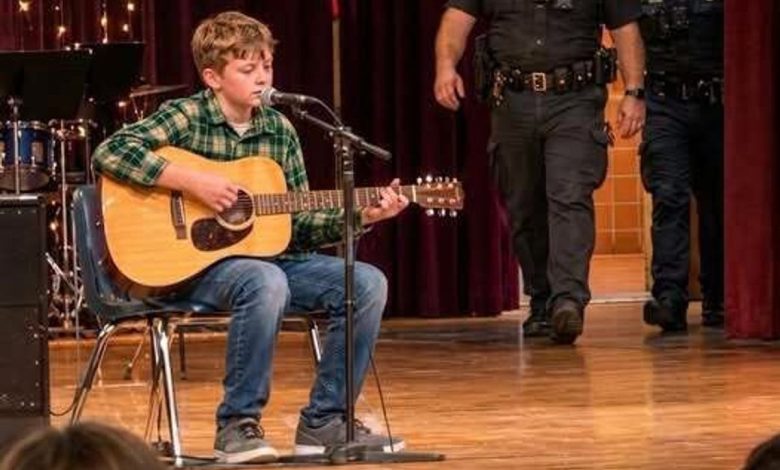
The double doors at the back of the gym hit the wall with a bang that made half the room jump.
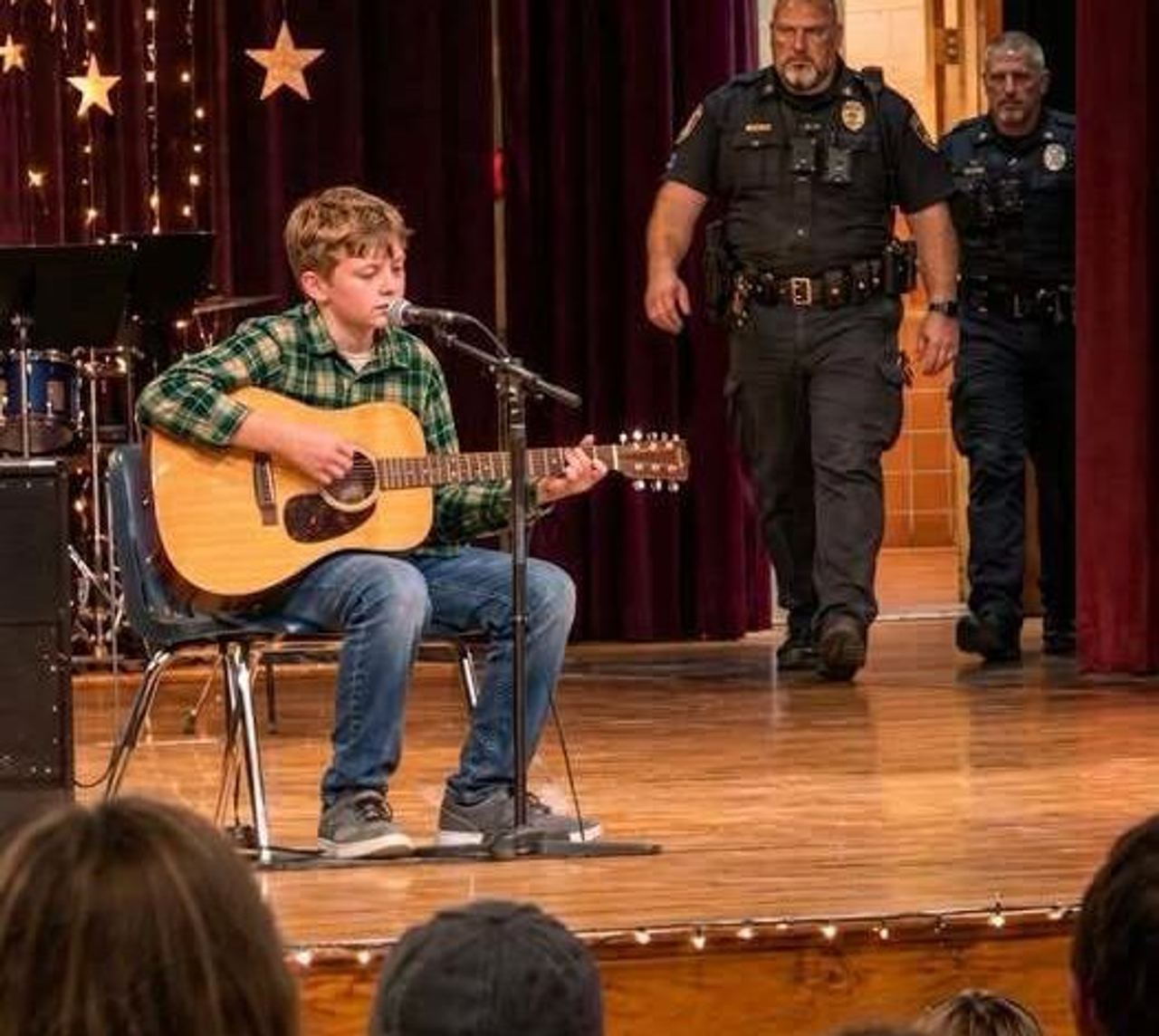
My son was in the middle of the second verse. He was standing alone on that little stage with his father’s old guitar, his voice thin and shaking but holding, and every parent in the room was either crying or trying very hard not to.
Then the doors opened, and two police officers walked in.
Full uniform. Dark blue. Belts, radios, badges catching the light from the high gym windows.
I knew that walk. I’d know it anywhere. Slow, heavy, careful. It’s the walk of someone coming to tell you something you don’t want to hear.
My whole body went cold.
I’d spent eleven years of my marriage waiting for that walk. Every night David worked a late shift, I’d lie awake listening for a car in the driveway that wasn’t his. Two officers at the door. Hats in their hands. That was the picture I carried around in my head for over a decade.
And it never came. Not like that. David didn’t die on the job. He died in a hospital bed in our living room, of an illness that took him slowly, one piece at a time, over fourteen months.
But my body didn’t know that. My body only knew the walk.
I stood up so fast my folding chair tipped backward and clattered on the floor.
People turned to look at me. I didn’t care. My eyes went straight to the stage, to Caleb, because he was the only person left in the world they could be coming about.
He’d stopped playing.
His fingers were frozen on the strings. His mouth was still open on the last word he’d sung. He was staring at the back of the gym, and his face had gone white.
The music teacher, Mr. Lowe, half rose from the piano bench. Principal Whitfield stepped away from the wall with her hand already out, like she was going to stop them, or ask them to wait, or ask them what on earth they were doing interrupting a Father’s Day assembly in the middle of a grieving boy’s song.
The officer in front took off his hat.
And I knew him.
Gray at the temples now. Heavier than I remembered. A thick mustache he’d had since before I met him.
Ray Delgado.
My husband’s partner for nine years. The man who’d carried one corner of David’s casket. The man whose phone calls I hadn’t returned in almost three years.
He didn’t look at me. He looked at the stage. At Caleb.
And then he did something I didn’t understand at all.
He nodded at my son. Just once. Slow.
Like he was saying, go on.
Behind him, the doors opened again.
And this time, it wasn’t two officers.
To understand why I couldn’t move, why I just stood there with my chair on the floor behind me and my hand pressed to my mouth, you need to understand how we got there. How my son ended up alone on that stage. And how badly I’d let him down before he ever got there.
My name is Jennifer. My son, Caleb, is twelve.
Three years ago, his father died.
After the funeral, Caleb didn’t cry. Not at the service, not at the cemetery, not at the house afterward when it was full of casseroles and people who didn’t know what to say. He sat on the stairs in his little black suit, the one we’d had to buy two days before because he’d outgrown his church clothes, and he watched everyone.
When the last guest left, I found him still sitting there.
“Do you want to talk, sweetheart?”
He shook his head.
“Do you want to come sit with me?”
He shook his head.
“Caleb. It’s okay to be sad. It’s okay to cry.”
He looked at me with David’s eyes, brown and serious, and said, “I know.” Then he went up to his room and closed the door.
That was the beginning.
He was nine then. Nine year olds are supposed to fall apart. I kept waiting for it. I read the grief books. I bought the workbook for kids with the cartoon bear on the front. I made an appointment with a children’s grief counselor, and he went three times and sat on her couch and answered every question with “I don’t know” until she gently told me maybe we should take a break and try again later.
We never tried again later.
He stopped inviting friends over. His best friend, Tyler, used to be at our house so often I bought his favorite cereal. After the funeral, Tyler came by twice, and both times Caleb said he was tired. The third time, Tyler’s mom called to ask if everything was okay, and I said yes, he just needs time.
He stopped coming down for dinner some nights. I’d call up the stairs, and he’d call back, “Can I eat in my room?” At first I said no. Then I said fine, just tonight. Then I stopped asking.
His teachers called twice.
The first time was in fifth grade. Ms. Barnes, his homeroom teacher, very kind, very careful. “He’s not disruptive at all,” she said. “That’s sort of the problem. He just isn’t there. He sits in the back and he doesn’t raise his hand, and when the other kids are doing group work, he kind of drifts off to the side.”
The second time was this year. Seventh grade. A different teacher, but the same words. Withdrawn. Quiet. Not participating.
“Is anything going on at home?” she asked.
I wanted to laugh. I wanted to say, his father died, what do you think is going on at home? But I just said, “We’re working on it.”
We weren’t working on anything. I didn’t know how. I’d lost my husband, and somehow in the same year, I’d lost my son too, even though he was still right there, eating cereal across the counter from me every morning with his eyes on his phone.
And lately, it had gotten worse.
That spring, there were whole days when he barely said a word to me. Not a fight. No slammed doors. Just nothing. I’d say good morning, and he’d nod. I’d ask how school was, and he’d shrug.
“How are you doing, bud? Really?”
“Fine.”
It was always fine.
Then one afternoon in May, I found the flyer.
It was crumpled at the bottom of his backpack, under a half eaten granola bar and a library book three weeks overdue. I wasn’t snooping. I was looking for the permission slip for his science field trip. But there it was, a sheet of yellow paper, folded into a tight little square.
LINCOLN MIDDLE SCHOOL FATHER’S DAY ASSEMBLY. FRIDAY, JUNE 13. INVITE YOUR DAD, GRANDPA, UNCLE, OR SPECIAL GUY! STUDENT PERFORMANCES AND READINGS. REFRESHMENTS TO FOLLOW.
There was a clip art picture at the bottom of a cartoon father and son holding hands.
I sat down on the edge of the kitchen chair and stared at it for a long time.
Father’s Day had always been hard. The first one after David died, Caleb and I didn’t even mention it. We just got through the day the way you get through a bad storm, inside, with the curtains closed, waiting. The second year, I took him to the movies to distract him. He sat through the whole thing without eating any popcorn, and in the car afterward he said, “You don’t have to do that, Mom.” The third year was last year. He spent the whole day in his room.
But a school assembly was different. An assembly meant a whole gym full of dads. Every kid with someone in the audience. Caleb sitting there with me and an empty chair where his father should have been.
That evening, I put the flyer on the kitchen table, unfolded and smoothed flat, and waited for him to come down.
He saw it immediately. He stopped in the doorway.
“You went in my backpack.”
“I was looking for the field trip form.”
He came over, picked up the flyer, folded it back into its tight little square, and put it in his pocket.
“Caleb, we should talk about this.”
“There’s nothing to talk about.”
“It’s a Father’s Day assembly. That’s going to be hard. For both of us.” I tried to keep my voice gentle. “I was thinking maybe you could stay home that day. I’ll call the school. Nobody will think anything of it. We could do something together. Go to the lake, maybe.”
He was quiet. He was looking at the floor.
“I want to go,” he said.
“Honey…”
“I want to go.”
“You don’t have to prove anything to anybody. If it’s going to hurt…”
“Mom.” He looked up at me, and for once his face wasn’t blank. There was something underneath it. Something tight and determined. “I want to go. Okay? Just let me go.”
“Okay,” I said slowly. “Okay. Do you want me to come?”
He hesitated. Then he nodded.
“Yeah,” he said. “You have to come.”
He went back upstairs without eating. I sat alone at the kitchen table and wondered what I’d just agreed to.
The next few weeks were strange.
Caleb was quieter than ever around me, but something in the house had changed. At night, after I’d gone to bed, I started hearing something through the wall between our rooms.
Guitar.
Very soft. So soft I thought I was imagining it the first time. A few notes, then stopping. Then the same few notes again. Then stopping.
I lay in the dark with my heart pounding.
David had taught Caleb to play when he was seven. They’d sit on the back porch on summer evenings, David with his big old acoustic, Caleb with a cheap little half size one we got at a pawn shop, and David would show him the chords one at a time. G. C. D. Caleb’s fingers were too small and he’d get frustrated, and David would laugh and say, “Everybody’s fingers hurt at first, bud. That’s how you know you’re learning.”
When David got too sick to hold the guitar anymore, he gave it to Caleb. His own guitar. The big one, with a crack near the bottom that David had glued himself years ago, and his initials scratched inside the sound hole.
Caleb put it in the back of his closet the week after the funeral. I hadn’t heard him play it since.
Now, every night, those same few notes through the wall.
One night I got up and stood outside his door. The playing stopped instantly, like he could feel me there. I raised my hand to knock. Then I lowered it and went back to bed.
I told myself I was giving him space. That’s what the books said. Give them space. Let them come to you.
But if I’m honest, I was scared. I was scared that if I opened that door, I’d hear the song I thought I heard. And I wasn’t sure I could stand it.
There were other strange things too.
One Saturday, Caleb asked if he could walk to the library alone. He never went to the library. He came back three hours later, and when I asked what book he got, he said they didn’t have it.
Another evening, I came into the kitchen and he was on the house phone, the old landline we never used anymore. He hung up so fast he almost dropped it.
“Who was that?”
“Nobody. Wrong number.”
“You were talking to a wrong number?”
“They were asking for somebody. I told them they had the wrong number.”
He went upstairs. I looked at the phone for a long time. I almost checked the call history. Then I didn’t.
And about a week before the assembly, my cell phone rang while I was at work.
I looked at the screen.
RAY DELGADO.
I hadn’t deleted his number. I’d thought about it. I’d thought about it a lot. But every time, my thumb just hovered there and I couldn’t make myself do it.
I let it ring.
A minute later, the little voicemail icon popped up.
I didn’t listen to it. I never listened to his voicemails. There were eleven of them in my phone, spread out over three years. Birthdays. Holidays. The anniversary of David’s death. I’d never opened a single one.
I put the phone face down on my desk and went back to work.
If I had listened to that one, everything would have been different. Or maybe not. Maybe it would have been exactly the same, except that I would have known. And I would have taken that moment away from my son.
I’ll never know which.
David was a police officer for sixteen years.
People sometimes hear that and imagine something dramatic. He wasn’t like the cops on TV. He mostly worked patrol in our part of town, which is quiet. He helped old ladies find their lost cats. He broke up fights outside the bars on Friday nights. He gave the same kids the same lecture about skateboarding in the bank parking lot about four hundred times, and he knew every one of them by name.
He was big and slow moving and gentle, with a laugh you could hear from the next room. He was terrible at cooking but made the same thing every Saturday morning: pancakes, too thick, slightly burned on the bottom. And while he made them, he hummed.
It was always the same song. He’d made it up himself, years before Caleb was born, on a long night shift when he was bored and missing me. It didn’t have a real name. We just called it the Saturday song.
It started out as humming. Then over the years, words got added. Some of them were David’s. Some of them were mine. Some of them Caleb made up when he was four and insisted be included, which is why the second verse has a line about a dog named Pickles that we never actually owned.
I’ll tell you the chorus, because it matters.
Hold the light, hold the light,
I’ll be home before the night.
If you can’t see me, look up high,
I’m the one who waves goodbye.
It’s not poetry. David would have been the first to say that. But on Saturday mornings, in our little yellow kitchen, with the pancakes burning and Caleb standing on a chair to help flip them, it was the most beautiful song in the world.
And the guys at the station knew it too. That’s the part I didn’t think about for three years.
David sang it on night shifts in the patrol car. He sang it in the break room. He sang it so often that the other officers started teasing him about it, and then started singing along, and then it just became a thing. When someone had a bad night, somebody would start humming the Saturday song. When the department had its holiday party, David would get up with his guitar at the end and they’d all sing it, a bunch of tired cops in ugly sweaters, arms around each other’s shoulders, way off key.
Ray Delgado was his partner. Ray was shorter than David, wiry, with a mustache and a temper and two daughters he talked about constantly. They were the kind of partners who finished each other’s sentences and argued about baseball for eight straight hours. Ray came to our house for dinner every other Sunday for nine years. He taught Caleb how to throw a curveball. He was Caleb’s godfather.
When David got sick, Ray was there.
He drove David to his treatments when I couldn’t get off work. He sat in the hospital waiting room through every surgery. Near the end, when David was in the hospital bed we’d set up in our living room, Ray came by almost every night after his shift. Still in uniform. He’d sit beside the bed and talk to David about nothing, about baseball, about who’d done what stupid thing at the station, even when David couldn’t answer anymore.
And the others came too. Big guys in uniform, filling up my living room, bringing food, mowing the lawn, fixing the gutter that had been leaking for two years. My house was full of blue for months.
At the funeral, there were over two hundred officers. Some from other towns, some from other states. They lined the road to the cemetery. They played the bagpipes. They folded the flag into a tight triangle and a young officer I didn’t even know knelt in front of me and handed it to me, and said something I don’t remember.
Caleb sat beside me and watched it all without crying.
And then, afterward, something in me broke.
I can’t explain it any better than that. For sixteen years, those uniforms had meant fear to me. Every shift, every late night, every siren in the distance. For fourteen months, they’d meant sickness. Officers in my living room meant my husband was dying. And on the day of the funeral, a sea of blue meant he was gone.
I couldn’t look at them anymore.
Ray kept coming by. Every Sunday, for a while. He’d bring a casserole his wife made or a pizza, and he’d ask if Caleb wanted to go throw the ball around. The other guys called too. Invitations to barbecues. The department softball game. The holiday party. Somebody offered to take Caleb to a baseball game.
I said no to everything.
“He’s not ready.”
“We’ve got plans that day.”
“Maybe next time.”
And then one Sunday, about four months after the funeral, Ray showed up at the door with a baseball glove under his arm. A new one. Caleb’s size.
“Thought he might be getting too big for the old one,” he said.
I stood in the doorway and didn’t let him in.
“Ray,” I said. “I need you to stop coming.”
He blinked. “Jen…”
“I can’t do it anymore. Every time I see you in that uniform, I…” My voice broke. “I just can’t. I need it to be over. Please. I need you to let us move on.”
He looked at me for a long time. He had the glove in his hands, turning it over.
“He’s my godson,” he said quietly. “I promised David.”
“David’s gone.”
It came out much harder than I meant. Ray actually flinched, like I’d hit him.
He set the glove down on the porch step, very carefully. Then he put his hat on and walked back to his car.
I closed the door and leaned my back against it and slid down to the floor.
When I looked up, Caleb was sitting at the top of the stairs.
I don’t know how long he’d been there. Long enough. He looked down at me, and I waited for him to say something. To ask why. To be angry.
He didn’t say anything at all. He just got up and went back to his room.
The next morning, the glove was gone from the porch step. I never asked what happened to it. I assumed Caleb threw it away.
That was almost three years ago. And slowly, everything went quiet. The barbecue invitations stopped. The phone calls became once a year, on the anniversary, and on Caleb’s birthday, and I never answered those either.
I told myself we were moving on.
What I was really doing was locking us both in a very small, very quiet house.
The morning of the assembly, Caleb came downstairs wearing a button up shirt.
A real one. Light blue, with a collar. I didn’t even know he owned it. It was a little too big in the shoulders, and the sleeves were rolled up twice.
It took me a minute to recognize it.
It was David’s.
I stood at the counter with the coffee pot in my hand and couldn’t say anything for a while.
Caleb poured himself cereal like nothing was strange. He didn’t look at me.
“That’s Dad’s shirt,” I said finally.
“Yeah.”
“Where did you get it?”
“The box in the garage.”
I’d packed all of David’s clothes into boxes about a year after he died. I couldn’t give them away and couldn’t look at them, so they’d been sitting in the garage under a tarp ever since.
“It looks nice on you,” I said, and my voice did something strange in the middle.
He shrugged. But I saw his ears go a little pink.
Then I saw what was leaning against the wall by the front door.
The guitar case.
David’s guitar case. Black, scuffed, with a sticker from a gas station in Tennessee that David had always meant to peel off and never did.
“Caleb,” I said carefully. “Are you doing something today? At the assembly?”
He took a long time to chew his cereal.
“Maybe,” he said.
“Maybe?”
“I signed up. Mr. Lowe said I could.” He put his spoon down. “I don’t know if I’ll actually do it. I might chicken out.”
“What are you going to play?”
He looked at me. Then he looked away.
“You’ll see.”
I wanted to push. I wanted to say, please tell me, please let me be ready. But something in his face stopped me. He was holding himself very carefully, like a glass that was filled right to the top.
“Okay,” I said. “You’ll be great.”
“You don’t know that.”
“I know you.”
He almost smiled. Then he picked up his bowl and put it in the sink, and grabbed the guitar case, and went out to the car.
The gym at Lincoln Middle School smelled like floor wax and coffee. They’d set out rows and rows of folding chairs, and there was a long table in the back with donuts and juice boxes. A banner hung over the stage, made by the sixth grade art class. HAPPY FATHER’S DAY in big, uneven letters, with handprints all around the edges.
The gym was packed.
Dads everywhere. Dads in work clothes who’d clearly snuck out of the office. Dads in sweatpants. Grandpas with canes. A few uncles. A tall man in a construction vest with his son sitting on his shoulders even though the boy was clearly too old for that.
I found two seats near the middle. Caleb went to sit with his class at the front, by the stage, the guitar case at his feet.
I sat down. The chair beside me was empty.
A man came down the row and stopped. “Is this seat taken?”
“Yes,” I said, too quickly. Then I felt stupid. “I mean… no. Sorry. It’s not.”
He sat down. He was maybe forty, with a sunburned neck and a kind face. His daughter waved at him from the front row, and he waved back with his whole arm like she was getting on a plane.
“Which one’s yours?” he asked me.
I pointed. “Blue shirt. Next to the guitar.”
He looked. “Ah. He playing something?”
“I think so. He won’t tell me what.”
“Teenagers,” he said, and laughed. “My girl’s reading a poem. She made me promise not to cry.” He held up a pack of tissues from his jacket pocket. “I came prepared.”
I laughed too, a little. Then he said, kindly, just making conversation, “Dad couldn’t make it?”
I felt the question land in my chest.
“He passed away,” I said. “Three years ago.”
The man’s face fell. “Oh. Oh, I’m so sorry. I didn’t…”
“It’s okay. You didn’t know.”
He was quiet for a second. Then he did a very simple thing. He reached over and squeezed my hand, just once, quick and awkward, the way you might squeeze a stranger’s hand at a funeral. And then he let go and looked back at the stage and didn’t say anything else.
I’ve thought about that man many times since. I never even got his name.
The assembly started.
Principal Whitfield gave a little speech about fathers and father figures and the important men in our lives. A boy in sixth grade read a poem about his dad’s truck. Two girls did a skit that involved a fake mustache and made the whole room laugh. A shy boy played a song on the trumpet so loudly that a baby in the back started crying.
Every time a kid finished, they looked out into the audience. And every time, a dad was waving back. Or wiping his eyes. Or standing up to clap.
I watched Caleb watching them.
He sat very straight in his chair. He didn’t laugh at the skit. He didn’t turn around to look at me. He just watched every kid finish and every dad stand up, one after another, with that same careful glass of water look on his face.
I almost went up there and took him home. I swear I almost did. I had my purse in my lap and my hand on the strap.
Then Mr. Lowe stepped up to the microphone.
“Our next performer is Caleb Morrison, from Ms. Patterson’s seventh grade class.”
Caleb stood up.
He picked up the guitar case and walked up the steps to the stage. Alone. He didn’t look at anyone.
He knelt down and opened the case. He took out David’s guitar, the big old acoustic with the glued crack near the bottom, and put the strap over his shoulder. It was too big for him. The body of the guitar almost covered his whole chest.
Mr. Lowe brought a stool over. Caleb shook his head. He wanted to stand.
My heart was in my throat. I hadn’t known he was planning anything until that morning. I hadn’t seen him hold that guitar in three years. And now my son was standing in front of four hundred people in his dead father’s shirt, holding his dead father’s guitar.
He stepped up to the microphone. It was set too high. Mr. Lowe hurried over and lowered it.
Caleb looked out at the audience.
He searched for a second. Then he found me. Our eyes met. I gave him the smallest nod I could, because I didn’t trust myself to do anything bigger.
Then he looked up. Not at the audience. Up. Toward the high ceiling of the gym, toward the metal beams and the old caged lights.
“This one’s for my dad,” he said quietly.
The microphone caught it. The whole gym heard.
And then he started to play.
The first notes were the ones I’d been hearing through the wall at night. G. C. G. D. Slow. I knew them before the first chord had finished ringing.
I put my hand over my mouth.
He started to sing.
His voice was soft at first, so soft you had to lean forward. It cracked on the second line. He stopped, swallowed, and kept going.
Saturday morning, kitchen’s warm,
pancakes burning, here’s the storm.
Little hands upon the pan,
I’m the luckiest in the land.
It was the Saturday song.
The one David hummed every Saturday of Caleb’s whole life. The one I hadn’t been able to listen to since the funeral. The one I’d turned off in my own head every time it started to play, because hearing it felt like having my chest opened.
Caleb was singing it to four hundred strangers.
The man next to me had his tissues out already. I heard someone behind me whisper, “Oh no,” in that soft way people do when something is about to break their heart.
Caleb got through the first verse. His fingers slipped on one chord and buzzed, and he winced, and kept going.
Then the chorus.
Hold the light, hold the light,
I’ll be home before the night.
His voice wobbled on the word ho…
Read more stories
- My Daughter Said I Wasn’t Important Enough for Her Wedding—Until She Discovered What I Found on Her Marriage Certificate
- “OMG, I put this together for a quick weeknight dinner and now I’m in trouble — it vanishe
- Toss frozen hash brown patties into the baking dish with 4 other ingredients for a meal so
- The Boy Who Stole Bread and the Judge Who Changed His Life wrk