My Stepmother Tried to Force Me to Buy Dad’s 1978 F-150 Until the Bidders Remembered the Promise He Made
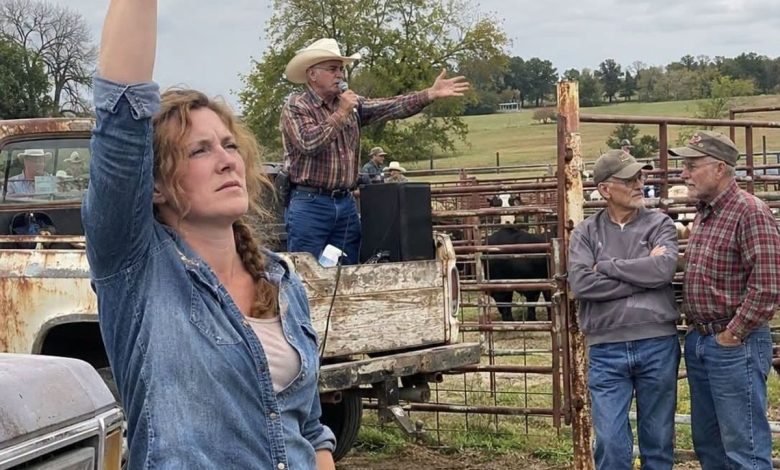
By two o’clock that afternoon, Boone Tillery had already auctioned off everything else.
The tractors. The welder. The baler that only functioned if you kicked it in exactly the right place. Mom’s canning jars, sold by the box. Thirty-one boxes in all. A woman from Hays bought every last one for forty dollars and stacked them into the back of a minivan while I stood there watching.
Then Boone climbed up onto the bed of his pickup with the microphone.
He pointed toward the Ford.
A two-tone 1978 F-150, tan and brown, parked on the gravel beside the machine shed. The tailgate had a dent in it shaped like a cow’s head, and there was a crack running along the bottom of the windshield that Dad had intended to fix ever since the first Bush administration.
“All right, folks,” Boone said. “Here’s the one a lot of you came for.”
I was standing at the edge of the crowd in my green barn coat, holding a white bidder card in my hand.
Number 112.
I had six thousand two hundred dollars in my checking account. It had taken me two full years to save that much.
And I already knew it probably wouldn’t be enough.
I rode in the cab of that truck every Saturday from the time I was nine years old.
Dad would honk twice in the driveway at six forty-five in the morning. Never once. Never three times. Twice. Mom used to say you could set your watch by it. I’d run out with my shoes untied, climb up onto the bench seat, and he’d hand me a thermos lid filled with hot chocolate while we drove the eleven miles into Merrill with the heater blowing warm air onto our feet.
He always parked outside the Corner Café on Main Street. Same place every time, right in front of the window, so he could keep an eye on it from his chair.
The same men were always inside. Emmett Riggle. Dale Prentice. Hollis Bauer. Old Lyle Swank, back when he was still living. Plus a shifting cast of others. Farmers and ranchers in seed caps, drinking black coffee from thick white mugs and arguing about rain.
Dad would take his seat. I’d sit beside him and eat a cinnamon roll the size of my head.
And at some point, every single Saturday, someone would glance out the window at that Ford and say something about it. That it was rusting out. That he ought to trade it in. That a man with four hundred acres could surely afford something made after disco.
And Dad always answered the same way.
“That one’s Cassidy’s when I’m gone.”
The first time he said it, I was nine.
Hollis Bauer had just told him the truck sounded like a cement mixer with bronchitis. Everyone laughed.
Dad set down his coffee.
“Can’t sell it,” he said. “That one’s Cassidy’s when I’m gone.”
Then he reached over and ruffled my hair.
I still remember Emmett Riggle, who sat on Dad’s left every Saturday, turning to me and raising his mug just a little. Like he was making a toast.
“Well, then,” Emmett said. “Guess we’ll all have to keep an eye on it for her.”
I didn’t really understand what he meant. I was nine. I thought “when I’m gone” meant when he went into town to the feed store.
But I remembered it.
He said it when I was twelve and learning to drive the truck out in the pasture. He said it when I was sixteen and sobbing in the cab after a boy named Travis dumped me at the county fair. He said it when I was twenty-two and home from college for Mom’s funeral, sitting at that same table with my eyes swollen shut.
He said it at my vet tech graduation. He said it at the café the Saturday after he married Charmaine. He said it the week he got his diagnosis.
Twenty-five years. Every Saturday I was there, and probably plenty when I wasn’t.
That one’s Cassidy’s when I’m gone.
He died in June.
Pancreatic cancer. Fourteen months from the day the doctor in Salina first said the word to the day the hospice nurse called me at four in the morning.
His will left everything to Charmaine.
The house. The land. The equipment. The money, what little there was. Everything.
It was legal. I knew that. Our family lawyer, an old man named Ferris Waddell who had handled Mom’s will too, sat me down in his office after the funeral and explained it as gently as he could, like he was talking to a child.
“A spouse gets what the will says, Cassidy. And the will says Charmaine.”
“But the truck. He always said—”
“I know what he said,” Mr. Waddell said. “Half of Merrill knows what he said.”
“So doesn’t that count?”
He took off his glasses and rubbed his eyes.
“A promise made over coffee,” he said, “holds up nowhere but in the people who heard it. I’m sorry, honey. I truly am. It isn’t in the will. It isn’t in writing. There’s nothing I can do.”
So I didn’t call anyone.
There was no one to call.
When Charmaine put the farm up for auction in September, I found out the same way everyone else did. From a flyer pinned to the bulletin board at the co-op, stuck between a lost dog poster and an ad for piano lessons.
HARLAN FARM DISPERSAL AUCTION. SATURDAY, OCT. 4. 10 A.M. TRACTORS, IMPLEMENTS, LIVESTOCK EQUIPMENT, HOUSEHOLD. 1978 FORD F-150, RUNS.
Runs.
That was the entire description. One word.
I stood there in front of that bulletin board for a long time.
Then I went home and checked my bank account.
I’m a vet tech at a large-animal clinic in Russell, about forty minutes from Merrill. Most days, I have my arm inside a cow or I’m helping hold down a horse that doesn’t want a shot. I’m good at what I do. It doesn’t pay much.
Two years before Dad died, I’d started setting money aside. A little from every paycheck. Fifty dollars. A hundred, if I could manage it. I told myself it was for a future house down payment. Or for an emergency.
But I knew what it was really for.
I knew Dad was getting older. I knew Charmaine was his wife. I knew what a will was. Some part of me understood it, even then.
By October, I had six thousand two hundred dollars.
I thought maybe that would do it. A 1978 F-150 with a cracked windshield and a dented tailgate. Runs. In Kansas, at a farm auction, maybe it would sell for four thousand. Maybe less, if the day dragged.
I thought I had a chance.
Charmaine had been married to Dad for twelve years.
She came into our lives two years after Mom died. A widow from Great Bend. Fifty-one. A bookkeeper at a farm supply company. Dad met her when he went in to dispute an invoice.
I was twenty-two, grieving, and angry at everything. I did not make things easy for her.
I’ll be honest about that, because it matters. I wasn’t the hero in every part of this story.
The first time Dad brought her to the house, I went out to the barn and stayed there until she left. The first Thanksgiving, she made a sweet potato casserole with little marshmallows on top, and I made sure everyone knew Mom never put marshmallows on hers. The first Christmas, she gave me a sweater she had knitted herself, and I thanked her, put it in a drawer, and never wore it.
I never called her Mom. She never asked me to. I hardly even called her Charmaine. I called her “she.” As in, “Is she coming?” As in, “Did she move Mom’s dishes?”
She had. She’d moved Mom’s dishes to the top shelf of the hutch in the dining room and put her own dishes in the kitchen cabinets. I remember standing there staring at it and feeling like someone had reached into my chest with their hand.
Dad caught me looking.
“Cass,” he said. “It’s her kitchen now too.”
“I know.”
“Do you?”
I didn’t answer.
One Christmas, maybe five or six years into their marriage, we were all at the farmhouse. Dad, Charmaine, me, Dad’s brother Earl, and Earl’s wife.
After dinner, Charmaine and I ended up alone in the kitchen. I was washing dishes, she was drying. It was the only time we were ever alone together for more than a minute.
She stayed quiet for a long while, drying a gravy boat. Then she said, without looking at me:
“Do you know I’ve felt like the outsider in this house the whole time?”
I stopped washing.
“Every picture on the wall is your mother,” she said. “Every recipe card in that drawer is in her handwriting. The men at the café call your dad by your mother’s last name sometimes, did you know that? ‘How’s the Kessler place?’ Like I’m not even here.”
She set the gravy boat down.
“I’m not trying to replace her, Cassidy,” she said. “I just wanted to belong somewhere.”
I didn’t know what to say.
So I said nothing. I washed the next plate. And after a minute, she picked up another towel and kept drying.
I’ve thought about that conversation a lot since June.
I should have said something. Anything. I should have said, I’m sorry. Or, I didn’t know. Or even just, That must be hard.
I never did grow warm toward her.
That part is on me.
But what she did at the auction wasn’t about warmth.
That morning was cold. Early October, with the wind coming hard out of the northwest across the stubble fields. I had on my green barn coat over a sweatshirt and still couldn’t stop shivering.
There were more people there than I expected. Maybe a hundred and fifty. Trucks and trailers lined the county road. A Lutheran church food truck was selling sloppy joes and coffee. Kids were running between the hay wagons.
I signed in at the folding table by the machine shed. A woman from Boone’s auction company took my name, checked my driver’s license, and handed me a white card.
I folded it once and slid it into my coat pocket.
I didn’t bid on a single thing all morning. I just wandered. Around the shed. Through the barn. Past the equipment lined up in the yard with little numbers on it.
I stood in front of Dad’s welder for a long time. He taught me to weld on that machine when I was fourteen. I burned a hole right through my jeans, and he laughed so hard he had to sit down on a bucket.
It sold for six hundred dollars to a man I didn’t know.
The men from the café were there.
All of them. Emmett. Dale. Hollis. A few more. They stood together in a loose knot near the hay barn, in their caps and seed jackets, drinking church coffee from styrofoam cups.
Men who had bought Dad’s calves every fall for thirty years.
Men who had carried his casket.
Emmett saw me and nodded. Dale lifted his coffee cup a little, the way he used to at the café.
I nodded back. I didn’t walk over.
I didn’t know what I’d even say. Hey, remember how Dad promised me that truck? Could all of you please not bid on it?
You can’t ask something like that. Not there. A farm sale is a farm sale. Everything is for sale. Anyone can bid. That’s how it works.
So I just stood by myself near the shed, my card in my pocket, and waited.
At one o’clock, I saw Charmaine.
She was standing near the house with her sister, Ruth, who had come up from Tulsa to help for the week. Charmaine was wearing a brown wool coat and sunglasses even though the sky was cloudy. Her hair was grayer than I remembered. She’d gotten thin. Thinner than thin.
She saw me.
For a second, I thought she might come over. She took half a step.
Then her sister said something, and she turned away.
By two, Boone had sold everything else.
The tractors. The baler. The cattle chute. A hundred and sixty-two lots. Every single thing my father had ever owned that wasn’t nailed down.
And then he climbed onto the back of his pickup with the microphone, the crowd drifted toward the machine shed, and he pointed at the Ford.
“All right, folks,” he said. “Here’s the one a lot of you came for.”
Boone Tillery is about sixty-five. Big, red-faced, with a voice like a cattle prod. He has been running farm auctions in this part of Kansas since before I was born. He handled Grandpa Harlan’s sale in 1991. He had known Dad for forty years. They went to high school together. They played on the same terrible football team.
He came to Dad’s funeral. He was one of the men standing at the back of the church because there weren’t enough seats.
He looked out over the crowd for a moment before he started. He found me. He looked at me just a beat too long.
Then he looked back at the truck.
That was when Charmaine walked up to his pickup.
She went straight to the tailgate. Took off her sunglasses. Spoke quietly, but I was close enough to hear her. I don’t think she realized I was standing that near. Or maybe she did.
“Open it at nine thousand,” she said. “She wants it. She can pay like anybody else.”
I felt the blood drain out of my face.
Nine thousand.
I had six thousand two hundred. Nine thousand for a 1978 F-150 with a cracked windshield. No one would pay that. It wasn’t worth half that to anyone.
Not to anyone except me.
And she knew that.
Boone looked down at her for a long moment.
He didn’t say anything. He just looked at her. His expression didn’t change, but something in his jaw did.
Charmaine held his gaze. She didn’t blink.
Then Boone raised the microphone.
“Folks,” he said. “Seller’s asking nine thousand on the Ford.”
No one moved.
There’s a rhythm to a farm auction. A certain sound. Boone starts high, somebody laughs, somebody shouts out a low number, Boone snatches it and runs with it. Bid cards go up and down. Ring men yell “Yep!” and point. It’s fast, loud, and keeps rolling all day.
This wasn’t that.
It was quiet. The wind was blowing. Someone’s child was crying by the food truck. That was the only sound.
A dozen men stood alongside the truck. Emmett, Dale, Hollis. Wendell Kraus, who ran the elevator. Pete Ochoa, who had sold Dad his first bull. A few others I knew from the café, from church, from my whole life.
Hands in their pockets. Every single one of them.
“Eight thousand,” Boone said. “Who’ll give me eight?”
Nothing.
Usually, out there, someone always tosses out a low number to get it moving. Fifteen hundred! Two thousand! Someone always does. It’s practically law. It breaks the silence. It gets the ring men going.
No one said a thing.
“Seven,” Boone said. “Six. Somebody give me six on a good running Ford.”
Not one card went up.
And they were all looking at me.
That was what I couldn’t bear.
Every one of them. Emmett. Dale. Hollis. Wendell. Pete. Their eyes on me. Not on the truck. Not on Boone. On me.
I thought she had told them something.
I thought she had gone around that morning, quietly, while I was circling the shed, and spoken to each one of them. I thought they knew exactly what she was doing. I thought they were part of it.
I thought they were standing there waiting to see me go to nine and break.
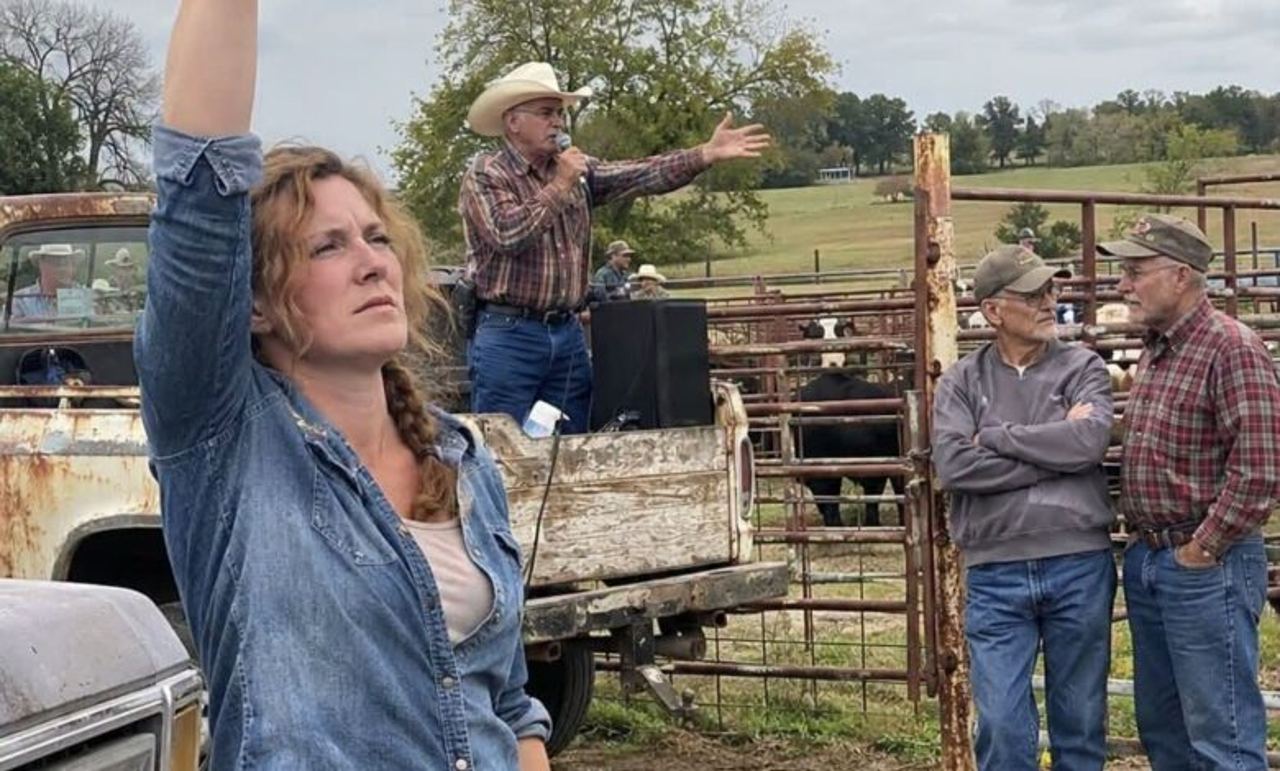
I thought, This is what she wanted. Not the money. This. Me standing here in front of everybody I’ve ever known, being forced to pay for something Dad promised me for free.
My chin started trembling.
I hate that. I’m thirty-four years old. I’ve had my arm up to the shoulder inside a breech calf at three in the morning during a snowstorm. I’ve helped hold down a stallion for a vet with a broken wrist. I do not cry in front of people.
My chin trembled anyway.
I kept the card down by my green coat and stared at the gravel.
I couldn’t look up. If I looked up, I’d see their faces. And if I saw their faces, I’d cry.
There was a tiny piece of red glass in the gravel by my boot. Probably from a taillight. Some tractor, some year. I stared at it like it was the most interesting thing in the world.
Then I heard footsteps on the gravel.
Charmaine. Coming closer to Boone’s truck.
I lifted my eyes just enough to see her. She had put her sunglasses back on. She was standing right at the tailgate.
“Lower,” she said.
Boone looked down at her.
“You want to pass it, Charmaine?”
He said it into the microphone. I don’t know if he meant to. His voice carried over the whole yard. Over the hay barn and the food truck and the hundred and fifty people standing in the cold.
Forty people were looking at her now. Maybe more.
She looked out at all of them. All those faces. The men lined up by the truck. The women by the food truck. People from church. People who had come to her wedding.
She didn’t say anything for a long moment.
“Lower,” she said again. And nodded.
Boone didn’t waste even a second.
“Five,” he said. “Forty-five. Forty-one hundred, folks.”
He dropped it like a rock.
Forty-one hundred.
He didn’t go forty-eight, or forty-five, or forty-three. He went straight to forty-one. Like he had already made up his mind.
That was when I raised my card.
I don’t remember deciding to do it. My arm just went up.
I held it as high as I could. Straight overhead. Arm locked. The way Dad taught me at my first cattle sale when I was ten and scared to death of the auctioneer.
“Get it up there, Cass,” he had said, standing behind me with his hand on my shoulder. “Don’t be shy about it. Man can’t sell you anything he can’t see.”
My hand was shaking so badly the number wobbled.
Boone pointed right at me.
“I’ve got forty-one hundred from number 112,” he said. “Do I hear forty-two?”
He looked down the line of men.
Slowly. One by one. Emmett. Dale. Hollis. Wendell. Pete.
Not a hand.
Not a twitch. Not a nod. None of them even took his hands out of his pockets.
Boone looked over the rest of the crowd. A hundred and fifty people.
Nothing.
Then he looked at Charmaine.
She opened her mouth.
Then closed it again.
That was when I noticed Emmett Riggle.
He was standing at the very end of the row of men. Seventy-four years old. Thin as a fence post, wearing the same faded Pioneer seed cap I’d seen on him for as long as I could remember. He had sat on Dad’s left at the café every Saturday morning for twenty-five years. He was the one who raised his mug to me when I was nine.
He was the only man there who wasn’t looking at me.
He was looking at Charmaine.
Not angry. Not cruel. Just steady. Like he was waiting for something.
And Charmaine was looking back at him.
I didn’t understand it then.
Boone took a breath.
“Going once,” he said.
No one moved.
The wind blew. A flag on someone’s trailer snapped. The kid by the food truck had stopped crying.
“Going twice.”
Charmaine was still looking at Emmett. Her hands were clenched into fists at her sides.
Emmett didn’t move. His hands stayed in his jacket pockets. He just looked at her.
Then, very slowly, he shook his head.
Just once. Just a little.
Charmaine looked away.
“Sold,” Boone said. “Forty-one hundred dollars. Number 112.”
He slapped the side of the truck with his flat hand. Once. Hard.
“Congratulations, Cassidy.”
He used my name. Not my number.
I didn’t move.
I stood there with my card still held up in the air. I couldn’t seem to figure out how to lower my arm. My whole body felt frozen.
Then someone started clapping.
I don’t know who. Somewhere in the back. One person. Then another. Then the men by the truck took their hands out of their pockets and started clapping too. Dale. Hollis. Wendell. Pete Ochoa was clapping with his coffee cup still in one hand, spilling coffee onto his boots.
And then the whole yard was clapping. A hundred and fifty people. For a forty-one-hundred-dollar truck.
I lowered my card.
And I cried. Right there on the gravel. In front of everybody.
Hollis Bauer got to me first.
He’s a big man. Bigger than Dad ever was. He put an arm around my shoulders and squeezed so hard my feet almost left the ground.
“There you go, girl,” he said. “There you go.”
“I thought—” I couldn’t get the words out. “I thought you were all—”
“We know what you thought,” Dale Prentice said. He was standing in front of me now, cap in his hands. “Saw it on your face. Near broke my heart.”
“Why didn’t anybody bid?”
Dale looked at Hollis. Hollis looked back at Dale.
“Walt told us for twenty-five years straight,” Dale said. “We figured we’d heard it enough times to believe him.”
Behind them, Boone climbed down off his truck.
He walked straight over to Charmaine. Stood close to her. Said something I couldn’t hear. She didn’t answer. She just stood there in her sunglasses, staring at the Ford.
Then she turned and walked back toward the house.
Her sister Ruth followed behind her.
The screen door slammed shut after them.
I paid at the folding table by the machine shed.
The woman from the auction company ran my debit card. Forty-one hundred dollars. Plus the buyer’s fee. I watched the little machine think about it forever, held my breath, and then it went through.
She handed me a receipt. And a set of keys.
The keys were on Dad’s old key ring. A brass ring with a little plastic Merrill Co-op tag so worn you couldn’t read it anymore. And a bottle opener shaped like a bass. Mom had bought it for him at a gas station in Missouri on their honeymoon.
I stood there holding it.
“You okay, hon?” the woman asked.
“Yeah,” I said. “Yeah. Sorry. I’m fine.”
I wasn’t fine. I walked out to the truck, opened the driver’s door, climbed up onto that bench seat, and sat there with both hands on the wheel and cried so hard I couldn’t see.
It still smelled like him. Coffee and diesel and that wintergreen chewing gum he switched to after he quit tobacco. His sunglasses were still on the dash. An old Royals cap was lying on the seat beside me.
My seat. The passenger side. Where I had sat every Saturday morning for twenty-five years.
I don’t know how long I stayed there.
At some point, someone tapped on the window.
It was Emmett.
I rolled the window down. It was the old crank kind. It squeaked.
Emmett rested his forearm on the door. He looked at me for a while. He didn’t say anything about me crying. He just waited until I had finished.
“She asked me to bid it up,” he said.
I stared at him.
“This morning,” Emmett said. “Charmaine came and found me by the hay barn. Asked if I’d throw in a few bids on the Ford. Run it up. She said she’d cover me if I got stuck with it. Said it was her truck now and she wanted what it was worth.”
I couldn’t say anything.
“I told her I’d think about it,” Emmett said.
He looked out across the yard toward the house.
“I guess I thought about it,” he said.
“She asked anybody else?”
“Nope. Just me.” Emmett rubbed his chin. “Figured I was the easiest mark, I suppose. Old man. Sat beside Walt the longest. Thought I’d do it for her out of respect for his wife.”
“Why didn’t you?”
Emmett looked at me then. Really looked at me. His eyes were watery blue. Old-man eyes.
“Because I sat next to Walt the longest,” he said.
He told me the rest while standing there with his arm on the door.
How he had told Dale and Hollis about it that morning. How the word had moved down the line. Quietly. Not a meeting. Not exactly a plan. Just one man telling another, and that man telling the next.
“Nobody said, ‘Let’s do this,’” Emmett said. “Nobody said much of anything. Just, ‘You hear what she asked Emmett?’ And then a fella would nod. And that was that.”
“So you all just decided not to bid.”
“We all just decided to keep our hands in our pockets,” Emmett said. “That’s all. Free country. A man doesn’t have to bid on anything he doesn’t want.”
He almost smiled.
“Boone knew,” he said. “Don’t ask me how. Boone always knows. You saw how fast he dropped it?”
“Straight to forty-one.”
“I’ve seen Boone Tillery sell a three-legged goat for two hundred dollars,” Emmett said. “That man can wring a nickel out of a fence post. He’s never dropped a price that fast in his life.”
I wiped my face with the sleeve of my coat.
“I thought she’d told you something,” I said. “I thought you all were in on it. I thought you were waiting to watch me go to nine.”
Emmett’s face changed.
“Cassidy,” he said. “Look at me.”
I looked at him.
“Your daddy sat next to me every Saturday morning since 1983,” he said. “He talked about two things. Rain and you. Mostly you. You know how many times I heard about your first calf? Your first cattle sale? Your vet tech certificate? You know he carried that certificate in his wallet for a month so he could show people?”
I didn’t know that.
“When he got sick,” Emmett said, “the last time he came into the café, he could hardly sit up. He’d lost so much weight his coat hung on him like a sail. And he looked out the window at that truck. And he said it one more time.”
He stopped.
“He said, ‘That one’s Cassidy’s when I’m gone, Emmett. You make sure.’”
I lowered my forehead onto the steering wheel.
Emmett patted the door twice. Gently. The way you’d pat a horse.
“So I made sure,” he said.
I drove the Ford home that night.
Forty minutes, with the crack in the windshield catching the headlights of every oncoming car. It pulled to the left when I braked. The heater only worked on high. The radio picked up only two stations, and one of them was nothing but sermons.
It was the best drive of my life.
I parked it in front of my little rental house in Russell and sat in it for another hour in the dark.
Then I went inside and called my best friend, Tasha, and told her everything, and she said, “Oh, honey. Oh, honey,” about forty times. Then she said, “That woman.”
“I know.”
“That woman, Cass.”
“I know.”
“Nine thousand dollars. For a truck she knew you’d sell a kidney for.”
“I know.”
Tasha was quiet for a second.
“You okay?”
I looked out the window at the Ford sitting under the streetlight.
“I don’t know,” I said. “I think so. I don’t know.”
For about two weeks, I was angry.
Not sad. Angry. The kind of anger that wakes you up at three in the morning with your heart po…
Read more stories
- I retired and bought a quiet cabin by the lake with only my name on the deed — then my dau
- My husband’s childhood friend yanked my chair away while I was holding our three-year-old
- My Husband Sold My Car So I’d Lose Weight—Until One Phone Call Turned the Whole Thing Around
- In 1999, George Jones was 68 years old and had a song nominated at the CMA Awards. The rec