THE TOMATO BOX
“Put it down right now!”
“Don’t touch it!”
“Ma’am, street selling is illegal.”
The words cut clean through the cold air, sharper than the wind that drifted along the empty street corner.
The old woman didn’t answer right away.
She stood beside her small wooden box, fingers curled tightly over its edge, knuckles pale against the worn grain. A thin fog hung low over the street, softening the edges of distant buildings and swallowing the early morning light into a dull gray haze. The pavement beneath her feet was still damp, reflecting faint streaks of sky like a broken mirror.
For a moment, nothing moved.
No pedestrians. No passing cars close enough to matter. Just the quiet hum of a city not fully awake yet.
Then she lifted her eyes.
“I know, my dear,” she said softly.
Her voice carried a tired warmth, the kind that came from years of speaking gently even when life gave no reason for it.
The younger officer shifted his weight, glancing briefly at his partner before looking back at her. Up close, the details became clearer—her sweater was frayed along the cuffs, threads pulling loose like they had given up holding together. Her skirt had faded into a color that no longer belonged to anything in particular. Her shoes were clean, but worn thin, shaped by years of careful steps.
Beside her, the vegetables were arranged with surprising precision.
Tomatoes in one row. Carrots stacked neatly. Cucumbers aligned as if someone had taken time—real time—to make them look presentable.
Not random. Not careless.
Deliberate.
“I need money,” she continued, her fingers tightening slightly on the edge of the box. “For my son.”
The words landed differently.
The senior officer, standing a step behind, let out a slow breath through his nose. He had heard stories like this before. Some true. Some not. Most somewhere in between.
“What kind of illness?” he asked, not unkindly.
The old woman hesitated.
Just for a fraction too long.
“He’s… very sick,” she replied, her gaze dropping to the vegetables. “There’s no one else. No help.”
The wind picked up briefly, brushing past them, carrying the faint smell of damp concrete and distant exhaust. A loose strand of her gray hair slipped free and clung to her cheek, but she didn’t move to fix it.
The younger officer’s expression softened.
He crouched slightly, not yet touching anything, just observing.
“These are from your garden?” he asked.
“Yes,” she nodded quickly. “All of them. I grew them myself.”
He studied the tomatoes more closely.
They were clean. Too clean, maybe. Their red surfaces smooth, almost glossy under the muted light.
Behind him, the senior officer shifted his stance again, exchanging a brief glance with the third officer who had stayed quiet until now.
The violation was clear.
Unlicensed street selling. Public obstruction. A minor offense, technically.
But the scene in front of them didn’t feel like something that needed punishment.
Not like this.
Not today.
The senior officer stepped forward slightly, his tone measured.
“We’ll let it go this time.”
The words settled into the space between them like a small release of pressure.
The old woman’s shoulders dropped, just a little.
Relief.
Too fast.
“Thank you, sir,” she said, nodding quickly. “Thank you.”
“But listen carefully,” he added, his voice firm again. “You can’t keep doing this. Next time, it might not be us.”
“Yes, yes, of course,” she replied, her voice quick now, almost eager. “I understand.”
The younger officer straightened, brushing his hands lightly against his pants.
“Since we’re already here,” he said with a small smile, “we might as well buy something.”
The old woman’s reaction was immediate.
“No,” she said.
Too fast.
The word came out sharper than anything she had said before, cutting through the air with a different kind of tension.
The officers paused.
She seemed to realize it instantly.
“I mean… that’s not necessary,” she corrected, forcing a thin smile. “I have many customers already.”
The younger officer glanced around.
The street remained empty.
The fog hadn’t lifted. The sidewalks were still bare. No footsteps. No voices. No signs that anyone had been there recently.
“Many customers?” his partner echoed, a faint note of curiosity slipping into his voice.
The old woman nodded.
“Yes. In the mornings. You just missed them.”
Her laugh followed—light, brief, and completely hollow.
It didn’t reach her eyes.
Her fingers shifted again on the edge of the box.
Gripping.
Holding.
Guarding.
The younger officer took a step closer.
“All right,” he said gently, as if easing into something. “Then we’ll just take a few tomatoes.”
He reached down.
And that was when she moved.
Fast.
Too fast for someone her age.
She stepped forward, placing herself between him and the box, one hand lifting slightly as if to block without fully committing to the motion.
“No,” she said again, quieter this time—but more urgent. “Please… leave them.”
The air changed.
Subtle. But real.
The senior officer’s eyes narrowed slightly.
There it was.
Not fear of being fined.
Not embarrassment.
Something else.
Something sharper.
“Ma’am,” he said slowly, “it’s just a tomato.”
She shook her head.
“No,” she whispered. “Let others have them.”
Others.
The word hung there, fragile and misplaced.
The younger officer’s smile faded.
He looked at her—really looked this time.
The trembling in her hands.
The way her eyes flicked—not randomly, but searching.
Checking.
Calculating.
Not the behavior of someone simply trying to sell vegetables.
The third officer finally stepped forward, folding his arms loosely.
“That’s strange,” he said casually. “You say you have customers… but you don’t want to sell?”
The old woman didn’t answer.
Her lips pressed together.
Her breathing grew just slightly uneven.
The younger officer crouched again.
Slower this time.
More deliberate.
“Ma’am,” he said quietly, “we’re just trying to help.”
She didn’t move.
Didn’t step aside.
Didn’t agree.
That was all the confirmation he needed.
He reached past her.
Not aggressively.
Not forcefully.
But with enough certainty that hesitation no longer existed.
Her hand lifted instinctively, as if to stop him—
Then froze mid-air.
Too late.
His fingers closed around one of the tomatoes.
For a moment, everything seemed to hold its breath.
He lifted it slowly.
Turned it in his hand.
Examined it.
From the outside, it looked normal.
Smooth skin. Deep red color. Slight natural imperfections.
But then—
He paused.
Just slightly.
His brow furrowed.
The weight.
His grip adjusted.
He pressed gently.
Not soft like fruit should be.
Not firm in a natural way either.
Different.
Wrong.
The ambient sound of the street seemed to fade, replaced by a low, rising tension that had no clear source.
The senior officer noticed immediately.
“What is it?” he asked.
The younger officer didn’t answer right away.
He looked at the tomato again.
Then at the woman.
Her face had gone completely still.
Not pleading.
Not explaining.
Frozen.
Eyes locked on his hand.
On that single object.
Everything she had been trying to protect.
The realization hit quietly.
But completely.
He stood up.
Slowly.
Still holding the tomato.
The fog drifted behind them, soft and indifferent, as if the world itself had stepped back to watch.
The younger officer’s expression changed.
Not confusion anymore.
Not sympathy.
Clarity.
Sharp. Immediate. Unavoidable.
He looked at his partner.
Then spoke.
“Arrest her. Now.”
“Arrest her. Now.”
The words landed hard.
Too hard.
The old woman flinched as if something inside her had already known this moment was coming.
But the younger officer didn’t move to restrain her.
Not yet.
Instead, his eyes stayed locked on hers.
And for a brief second—so quick it could have been missed—he gave the smallest shake of his head.
No.
Don’t react.
The old woman froze.
Her breath caught in her throat.
The senior officer stepped forward immediately, his voice sharp, controlled.
“Hands behind your back.”
The third officer moved to her side, guiding her arms gently—but firmly—backward. Cold metal cuffs clicked into place, the sound echoing far louder than it should have in the quiet street.
To anyone watching, it was a routine arrest.
Clean. Efficient. Unremarkable.
But there was something different in the way the younger officer held the tomato.
He didn’t toss it aside.
He didn’t bag it.
He held it carefully, almost deliberately, like something fragile—and dangerous.
“Bag the produce,” the senior officer said loudly, for the benefit of no one in particular.
Then, quieter—just enough for the younger officer to hear:
“Careful.”
The younger officer gave a slight nod.
He turned the tomato again in his hand, then slipped a small folding tool from his pocket.
The blade flicked open with a soft metallic snap.
The old woman’s eyes widened.
“No—” she started.
But the younger officer cut her off—not with words, but with a look.
Steady.
Focused.
Reassuring.
Trust me.
The blade pressed lightly against the surface.
A gentle slice.
The skin parted too easily.
Not the way real fruit should.
Inside—
Not pulp.
Not seeds.
A tightly wrapped, vacuum-sealed packet.
Small.
Precise.
Professional.
The air seemed to drop ten degrees.
The third officer swore under his breath.
The senior officer’s jaw tightened.
The younger officer said nothing.
He peeled back just enough of the wrapping to confirm what they already suspected.
Not vegetables.
Not survival.
Something else entirely.
The old woman’s knees nearly gave out.
“I didn’t—” she whispered, her voice breaking. “I didn’t want—”
“Quiet,” the senior officer said sharply.
Too sharply.
Then, more quietly, under his breath, without looking at her:
“Not here.”
The younger officer straightened, slipping the packet back into the tomato casing with careful precision.
He closed his knife.
Looked up.
And raised his voice again—louder now.
“Possession. Distribution. Multiple counts.”
The words carried.
They were meant to.
“Let’s move.”
The third officer nodded, guiding the old woman forward.
She stumbled once, catching herself, her breath coming in shallow, uneven bursts.
To anyone watching, it looked like fear.
And it was.
Just not for the reason they thought.
As they led her toward the patrol car, the younger officer hung back for half a step.
Just enough.
He leaned in slightly.
His voice barely above a whisper.
“You’re not under arrest,” he said.
The old woman blinked.
Confused.
Terrified.
“What…?”
“You’re under protection.”
Her eyes filled instantly.
Not with relief.
Not yet.
With something more fragile.
Hope.
“Do exactly what we say,” he continued, his tone steady, controlled. “And your son stays safe. Understand?”
Her lips trembled.
She nodded.
Once.
That was all he needed.
The door of the patrol car opened.
She was guided inside.
The door shut with a heavy, final sound.
The senior officer walked around to the driver’s side, pausing just long enough to glance at the younger officer.
“You saw the mark?” he asked quietly.
The younger officer nodded.
“Same packaging,” he said. “Same method.”
The third officer exhaled slowly.
“That means—”
“They’re close,” the senior officer finished.
Too close.
The engine started.
The car pulled away from the quiet street corner, leaving behind nothing but damp pavement and a wooden box of perfectly arranged vegetables.
The ride was silent.
Not the comfortable kind.
The kind that pressed in from all sides.
The old woman sat rigid in the back seat, her cuffed hands resting awkwardly in her lap. Her eyes moved constantly—window, mirror, front seat, door—like she was trying to memorize every detail in case something went wrong.
Because something always went wrong.
That was how this worked.
She had learned that quickly.
“They told me…” she whispered suddenly, unable to stop herself. “They said if I spoke to anyone—”
“You won’t,” the younger officer said calmly, without turning around.
“They’ll kill him,” she continued, her voice shaking now. “My son—he’s at home, he can’t even—”
“He’s not at home,” the younger officer said.
That made her stop.
Her breath caught.
“What?”
The senior officer glanced at the rearview mirror.
“Pick-up team got him twenty minutes ago,” he said. “Medical unit too.”
The old woman stared at him.
Not understanding.
Then slowly—
Very slowly—
Understanding.
“They’re… safe?” she whispered.
The younger officer finally turned slightly, just enough for her to see his expression.
Yes.
The word broke something inside her.
A quiet, controlled collapse.
Tears slipped down her face, silent and unstoppable.
For the first time since they had arrived, her hands stopped trembling.
They didn’t take her to the station.
Not directly.
Instead, the car turned off the main road, slipping into a narrow side street lined with abandoned storefronts and shuttered windows.
The engine cut.
The silence returned.
The senior officer stepped out first, scanning the area.
The third officer followed.
Then the younger one opened the back door.
“Stay with me,” he said.
She nodded.
They walked her inside one of the buildings—a temporary operations point, already set up.
Monitors.
Radios.
Movement.
Controlled chaos.
“Get those cuffs off her,” the senior officer said immediately.
The third officer hesitated for half a second.
Then did it.
The metal clicked open.
The old woman rubbed her wrists, still trying to process everything happening around her.
A woman in medical scrubs approached, offering a blanket.
“You’re safe,” she said gently.
The old woman held the blanket like it was something unreal.
Across the room, the younger officer stood over a table where the opened tomato now lay under bright light.
The packet was fully exposed.
Clear.
Identifiable.
One of the analysts leaned in.
“That’s high-grade,” he said quietly. “Same network.”
The senior officer nodded once.
“Good,” he said.
Then louder:
“Let’s finish this.”
They didn’t wait long.
Because they didn’t have to.
The signal had already been sent.
The “arrest.”
The “confiscation.”
The disruption.
To the people watching—from a distance, from a car, from somewhere unseen—it meant only one thing:
Something had gone wrong.
And when things went wrong…
They came to fix it.
The van arrived thirty-two minutes later.
White.
Unmarked.
Too clean for the neighborhood.
It slowed just enough as it passed the original street corner.
Paused.
Then turned.
Right into the trap.
Inside the operations room, every screen lit up.
“Target acquired,” someone said.
“Three occupants.”
“Wait for confirmation,” the senior officer replied.
The younger officer stood still, eyes locked on the feed.
“Come on…” he murmured.
The van door slid open.
One man stepped out.
Then another.
Scanning.
Tense.
Looking for signs.
For mistakes.
For her.
“She’s not there,” one of them said, his voice caught by the directional mic.
“Of course she’s not,” the other snapped. “Something went wrong.”
He reached for his phone.
That was the moment.
“Now,” the senior officer said.
Everything moved at once.
Doors burst open.
Commands shouted.
Boots hit pavement hard and fast.
The men didn’t even have time to react properly before they were on the ground, restrained, disarmed, overwhelmed by precision and force.
Clean.
Efficient.
Final.
Back inside, the old woman watched the screen.
Her hands clutched the blanket tighter.
“Is it… over?” she asked.
The younger officer stepped beside her.
He watched the final moments—the suspects secured, the scene locked down, the operation complete.
Then he looked at her.
Really looked at her this time.
Not as a suspect.
Not as bait.
As a person who had been pushed too far by circumstances she never chose.
“Yes,” he said quietly.
“It’s over.”
Her lips parted.
No words came out.
Just a breath.
A long, trembling breath that carried weeks—months—of fear out with it.
Later, as the morning finally broke through the fog, the street corner looked different.
Warmer.
Lighter.
The wooden box was gone.
The vegetables too.
In their place—
Nothing.
Just an empty space where something heavy had finally been lifted.
At the hospital, her son slept peacefully for the first time in days.
Machines hummed softly.
Monitors blinked in steady rhythm.
The old woman sat beside him, her hand resting gently over his.
The younger officer stood in the doorway for a moment.
Then stepped inside.
She looked up at him.
Her eyes were still red.
But no longer afraid.
“Thank you,” she whispered.
He shook his head slightly.
“You did the hard part,” he said.
She managed a small smile.
Fragile.
Real.
He turned to leave.
Paused.
Then added, almost as an afterthought—
“If anyone asks…”
She nodded.
“I know.”
He gave one last look at the quiet room.
Then stepped out into the hallway.
The door closed softly behind him.
And for the first time—
Everything was finally… still.
A Woman Walked Into Power—and Made the Truth Speak
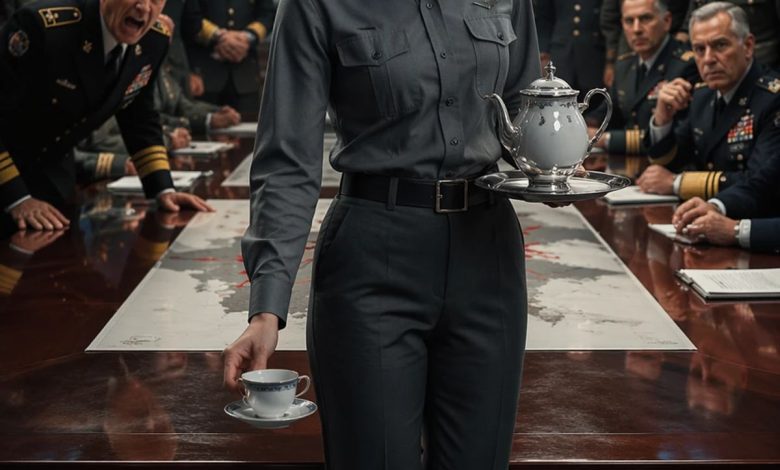
“Get her out of this room. Now.”
No one realized they had already lost control.
“Get her out of this room. Now.”
The admiral’s voice cracked across the conference table like a gunshot—sharp, sudden, impossible to ignore.
The woman didn’t react.
Read more stories
- KSI Freaks Out as a Britain’s Got Talent Performance Pushes the Limits
- The McCoys’ “Hang On Sloopy” Rockets to No. 1 and Grows into Ohio’s Unofficial Anthem in 1965
- Jackie DeShannon’s Timeless Classic “What the World Needs Now Is Love” Still Uplifts and Inspires Generations
- Released in 1971, this heartbreaking ballad changed how people heard breakup songs forever… because it wasn’t about anger or betrayal, but the quiet moment two people realize love is already gone.