1983 – Bonnie Tyler Wanted a Record Bigger Than Ordinary Pop. Why Did Jim Steinman Answer With a Vampire Love Song?
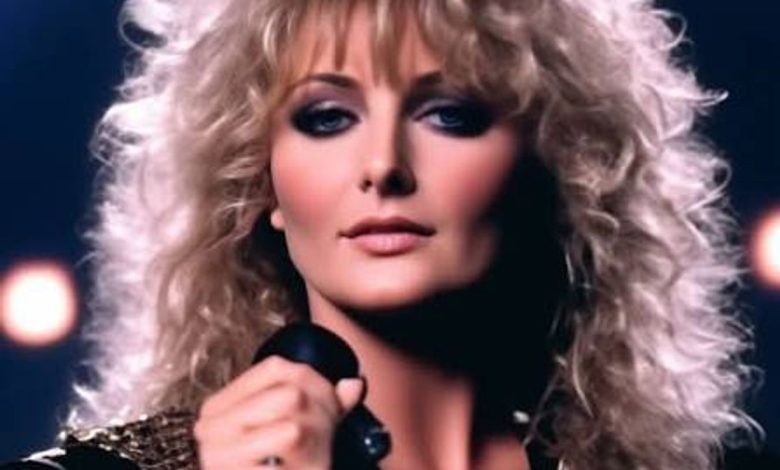
Bonnie Tyler did not go looking for a normal ballad.
She wanted drama.
After the success of “It’s a Heartache,” Tyler had become internationally recognizable, but she wanted the next phase of her career to feel larger and stranger. She admired the enormous theatrical records Jim Steinman had written for Meat Loaf and wanted that kind of scale.
Steinman did not give her a polite love song.
He gave her darkness, choirs, pounding piano, enormous drums, Rory Dodd’s ghostly answering voice and a lyric that sounded as if love itself had become supernatural.
Years later, Steinman revealed why.
“Total Eclipse of the Heart” had been conceived as a vampire love song.
Its original idea was so closely connected to darkness, immortality and impossible desire that he later reused it in a musical about vampires.
In 1983, Bonnie Tyler took that gothic idea and made it one of the biggest records on earth.
The Voice Needed Something Huge
Tyler’s voice had already been transformed before the song reached her.
After surgery on vocal nodules in the 1970s, her naturally husky delivery became even rougher. It was the kind of voice that carried damage without needing to explain it.
That rasp made her unusual in a pop market filled with cleaner singers.
But it also created a challenge.
A small song could disappear beneath the personality of the voice.
Tyler needed material capable of standing beside it.
Jim Steinman specialized in exactly that problem.

His songs did not behave like ordinary songs. They behaved like scenes from films that had not been made yet – full of operatic changes, adolescent obsession, motorcycles, angels, darkness and impossible vows.
Where another writer might hear Tyler’s rasp and offer blues-rock, Steinman heard theater.
The Song Had Been Waiting in the Dark
Steinman later explained that “Total Eclipse of the Heart” was originally connected to a musical idea based on Nosferatu.
The working concept was “Vampires in Love”.
That revelation changes how the lyric feels.
The constant darkness is not decorative.
The desperate calls to turn around do not sound like a normal breakup when you imagine one lover separated from another by something eternal.
Steinman said the words were full of vampire imagery – darkness, power and love struggling inside it.
The idea did not reach the stage in that original form, but it remained in his imagination.
When Tyler needed material, the theatrical world finally found a voice.
A Recording That Refused Restraint
The production was built to escalate.
It begins with piano and space. Tyler enters low and intimate, sounding almost as if she is trying to hold the emotion inside her throat.
Then the record keeps opening.
Backing vocals arrive.
Drums grow larger.

Synthesizers and guitars push outward.
The chorus does not merely repeat the verse’s emotion. It detonates it.
Rory Dodd’s “turn around” lines function almost like a phantom voice calling from another part of the song. Tyler answers with increasing desperation.
The famous final form ran close to seven minutes on the album. Radio edits shortened it, but even cut down, the record still felt gigantic.
This was pop music behaving like melodrama without apology.
Bonnie Tyler Made Excess Believable
Steinman’s writing could easily become ridiculous in the wrong hands.
That was part of its danger and part of its appeal.
The emotion is always one step away from being too much.
Tyler’s voice saved it from weightlessness.
She sounded as if she had actually lived through whatever impossible night the lyric described.
Her rasp put dust on the cathedral.
When she reaches the chorus, the performance is not technically smooth. It is human enough to make the fantasy hurt.
That combination – Steinman’s scale and Tyler’s weathered voice – turned theatrical excess into emotional credibility.
The Video Made the Dream Even Stranger
The music video did not attempt realism either.
Filmed at Holloway Sanatorium in England, it presents Tyler inside a surreal Gothic world of boys with glowing eyes, dancers, wind, white clothing and dreamlike corridors.
The imagery is more nightmare than narrative.
That was exactly right.
A conventional romance video would have shrunk the song.
Instead, the clip accepted Steinman’s logic: if the emotion feels supernatural, the images should too.
In the early MTV era, that visual extravagance helped the record become more than a voice on radio.
It became a world.
A No. 1 That Felt Too Large for the Charts
“Total Eclipse of the Heart” reached No. 1 in Britain and the United States.
In America, it stayed at the top for four weeks. It became Tyler’s signature song and one of the defining power ballads of the decade.
Its success also made her the first Welsh artist to top the U.S. Billboard Hot 100.
The record has never really gone away.
It returns during eclipses, talent shows, karaoke nights and every cultural moment requiring melodrama at maximum volume.
What should have been tied to 1983 production has survived because the song’s emotion is almost mythic.
It is not “I miss you.”
It is “the universe has changed because you are gone.”
Why the Vampire Idea Matters
Knowing the original concept does not reduce the song to a novelty.
It explains why ordinary romantic language was never enough for it.
Vampire stories are built around desire that cannot resolve normally. Love becomes hunger. Time becomes a threat. Night becomes a permanent environment.
“Total Eclipse of the Heart” uses the same emotional physics.
The singer is not negotiating a relationship.
She is trapped inside a force.
That is why the song can survive endless parody and still become moving again the moment Tyler’s voice enters.
The theatricality is not a layer on top of the emotion.
It is the emotion’s natural size.
A Ballad That Turned Darkness Into Spectacle
Bonnie Tyler asked for something bigger than conventional pop.
Jim Steinman reached into an unfinished Gothic idea and gave her a song where heartbreak sounded eternal.
The result was absurd, beautiful, excessive and completely sincere.
That combination is almost impossible to manufacture.
In 1983, it sounded like lightning trapped inside a record.
Four decades later, when the piano begins and the distant voice asks her to turn around, the room still changes.
Why It Had to Be Too Much
Jim Steinman’s instinct was never to make emotional music behave politely. His songs were built like miniature operas: enormous drums, sudden changes, choirs, images of darkness and desire, and characters who sounded as if ordinary romance had already failed them. With Bonnie Tyler, that excess finally met a voice rugged enough to survive it. Her rasp prevented the production from floating away into pure fantasy.
The original idea’s connection to vampires makes the record’s language easier to understand. Steinman later explained that the song had been conceived as a kind of vampire love song, with darkness becoming both threat and attraction. That theatrical origin does not make “Total Eclipse of the Heart” less emotionally real. It gives heartbreak a supernatural scale. The beloved person is not merely absent; the whole world seems to lose its light.
Tyler’s performance is what makes that scale believable. She does not sing the verses as a detached character in a musical. She sounds exhausted, hungry and defiant. By the final climaxes, the production is almost impossibly large, but the cracked edge in her voice keeps the listener connected to a human body inside the spectacle. The song succeeds because the melodrama is not hiding the emotion. The melodrama is the emotion.
Turn Around and Enter the Drama Again
This is not background music. It was built for the moment when ordinary language fails and only a storm will do. Return to Tyler’s great Gothic epic, then hear another Steinman-written performance where her voice once again reaches for something larger than life.
Read more stories
- My Daughter-in-Law Gifted Me a White Maxi Dress to Wear to Her Wedding – When I Arrived at the Ceremony, I Was Speechless
- My Wife Came Home from a Weekend Retreat with a Birthmark She Swore She’d Never Had
- I Met the Perfect Man on Vacation, But My Best Friend Exposed His Shocking Secret — Story of the Day
- I Adopted My Best Friend's Son After He Left Him – Years Later, the Boy Invited His Biological Father to a Hockey Game and Gave a Speech That Made Me Break Down