Brother and Sister Discovered Dozens of Deliveries After Their Mother Died—Then They Opened the First One
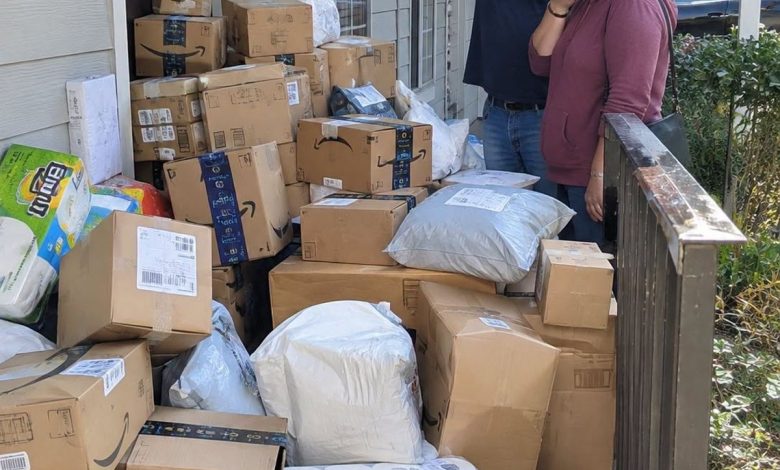
Packages were everywhere.
Boxes were piled against the wall outside her apartment door. Shopping bags crowded the mat. Smaller padded envelopes were tucked into every open space between them, as if someone had tried to cram as many deliveries as possible into one narrow hallway.
My brother came to such an abrupt stop at the top step that I bumped right into him.
“What on earth?” Ben said under his breath.
I moved around him and stared.
There must have been thirty deliveries. Maybe even more. They covered the entire strip of carpet in front of apartment 4C. One box was so large it leaned against the doorframe. A plastic department store bag had fallen sideways, and a piece of white tissue paper poked out from one corner.
Our mother had been gone for a week.
And someone had been buying things.
Mom was not someone who shopped. You need to know that, otherwise none of this will make any sense.
She wore sweaters she had knitted two decades earlier. She still owned the same brown couch we used to jump on when we were children, complete with the burn mark on the left arm from the year Ben tried making s’mores with a candle. She used her grandmother’s dishes, the ones with the tiny blue windmills, because “perfectly good is perfectly good.” When the toaster broke, she repaired it with a paper clip and kept using it for another six years.
The priciest thing I ever saw her buy for herself was a winter coat, and she talked about it for two months as if she’d committed a felony.
“Maybe people sent sympathy gifts?” Ben suggested.
I crouched and checked the label on the nearest package.
“No,” I said. “These are from stores.”
I looked at another one. Then another.
Almost all of them had her name on them. Ruth Callahan, 4C.
Our mother’s name. Printed neatly. On box after box after box.
I took her keys from my coat pocket. They were on a ring with a tiny plastic strawberry Ben had given her when he was seven.
“I’m opening one,” I said.
Let me start earlier.
My name is Claire. I’m thirty-four years old. My brother Ben is thirty-eight. Our father left when I was three and Ben was seven, and after that it was just the three of us. Mom worked at the county library for twenty-six years. She raised us in a small rented house on Hadley Street, and then, after we were both grown and gone, she moved into this fourth-floor apartment in a brick building on Crestview Avenue.
She lived here for fifteen years. She always said it was the perfect size. “Two bedrooms,” she would say. “One for me, and one for whichever of you turns up hungry.”
About two years ago, her heart began to fail.
At first it happened gradually. She got winded going up stairs. Then she had to stop at the landing. Then her ankles began to swell, and the doctor used a lot of terms I later had to look up, and after that came pills, appointments, and then even more appointments.
We knew she was getting worse. We weren’t blind.
But neither of us thought we would lose her this quickly.
She was admitted to the hospital at the end of September. She stayed there for nearly three weeks.
Even lying in that bed, with tubes in her arm and a monitor chirping beside her head, she could not stop being our mother.
“Claire,” she said one afternoon, “please tell me you’re eating something besides sandwiches.”
“I eat other things.”
“Name one.”
I considered it. “Soup.”
“From a can?”
“Soup is soup, Mom.”
She shut her eyes and sighed as though I had personally let down every woman in our family for the last four generations.
Then she opened them again and looked over at my brother, who was folded into the plastic chair by the window.
“And Ben. You look exhausted. Are you sleeping?”
“I’m sleeping fine.”
“You have bags under your eyes like a raccoon.”
“Thanks, Mom.”
We laughed. Both of us laughed, right there in that hospital room. Because she was in a bed with a failing heart, and what concerned her was my soup and Ben’s under-eyes.
That was Mom.
She also gave us instructions. About the apartment.
She gave them to us on the second-to-last good day, while she was sitting up and drinking apple juice through a bendy straw.
“The spare keys are in the kitchen drawer,” she said. “The one by the stove. With the rubber bands.”
“Okay, Mom.”
“And don’t throw away Grandma’s plates.”
“We would never throw away Grandma’s plates.”
“Ben would.”
“I would not!” Ben called from the chair.
“You tried to donate them to Goodwill in 2009.”
“I was moving! I thought they were extras!”
“There is no such thing as extra windmill plates,” Mom said, and then she sipped her apple juice with tremendous dignity.
I promised her we would handle everything. I said it like it was far-off future business. Like she would be back home in a week, telling us where everything belonged.
I simply hadn’t imagined doing any of it without her.
She died on a Tuesday morning, a little after six. Ben was there. I was downstairs in the cafeteria getting coffee. I’ve had to learn to live with that.
The funeral was Saturday. The library closed early so her former coworkers could attend. Half the building came. Mrs. Okafor from across the hall baked a lemon cake so enormous it took two people to carry it inside.
And then, the following Tuesday, exactly one week later, Ben and I drove to Crestview Avenue with a trunk full of empty cardboard boxes to begin sorting through her belongings.
We stayed in the parking lot for ten minutes before either of us got out.
“Are you sure we’re ready for this?” Ben asked.
I looked up at the fourth floor. At her kitchen window. The blinds were halfway open, exactly how she always left them so her spider plant could get the afternoon sun.
“No,” I said. “But we have to begin somewhere.”
Ben got out first. He lifted the stack of empty boxes from the trunk and held them against his chest like armor.
“Come on,” he said.
We climbed the stairs together. She had climbed those stairs every day for fifteen years, even when she had to stop at every landing.
Then we reached her floor.
And stopped.
So there I was, crouched in the hallway, holding her strawberry keychain, ripping the tape off the nearest box.
It was medium-sized. Plain brown cardboard. I used the edge of her apartment key to cut through the tape and folded back the flaps.
Inside, wrapped carefully in brown packing paper, was a mixing bowl.
A blue ceramic mixing bowl. Deep blue, like the sky just before night fully falls. Glossy inside. A thin white stripe circling the rim.
I lifted it out with both hands.
At the bottom of the box, beneath it, was a card in a white envelope.
I knew the handwriting before I even turned it over. Loopy, slightly shaky at the ends, each i dotted with a tiny circle. She had used that same handwriting on every lunch bag, every permission slip, every birthday card of my entire life.
For Claire’s birthday. Please open on the day.
My birthday was still three weeks away.
The envelope wasn’t sealed. The flap was only tucked in.
I know I should have waited. I know that was what it said. But I was crouched on a hallway floor one week after my mother died, holding a blue bowl, and I couldn’t wait three weeks to hear her voice.
I slipped the card out.
My darling Claire,
I hope I’m there to make your birthday pancakes. But if I’m not, I want you to have this.
You always loved the blue bowl we used when you were little. I broke it years ago and never found another quite like it.
I finally found one.
Love, Mom.
I couldn’t breathe.
I remembered that bowl. I had not thought about it in twenty years, but the moment I read the note, I could see it perfectly. The old blue bowl on the counter on Hadley Street. Mom whisking pancake batter in it every birthday morning. Letting me lick the spoon. Me sitting on the counter in my pajamas, swinging my legs, watching the batter spin round and round.
She had dropped it when I was eleven. It shattered all over the kitchen floor. I cried harder than I cried when our hamster died.
She had searched for another one for years. At garage sales. In antique stores. I had forgotten that. She had never stopped looking.
Ben stepped closer.
“What is it?”
I held the card up. He took it from me. He read it once. Then he read it again, more slowly.
“She bought this for your birthday?”
I nodded. Tears were dropping onto the bowl. I wiped them away with my sleeve, as if they might somehow damage it.
“She knew,” I whispered.
“She knew what?”
I looked around at the boxes surrounding us. Lined against the wall. Stacked by the door. More than twenty others waiting.
“She knew she might not make it home.”
We sat on the hallway floor for a long time. I couldn’t tell you how long.
I kept the bowl in my lap. Ben leaned back against the wall with his knees drawn up, staring at the packages as if they might suddenly speak.
Mom had never once told us she was preparing for the possibility that she might die.
Not a single time.
Whenever we visited her in the hospital, she talked about ordinary things. The weather. Whether it would rain on Thursday. Mrs. Okafor’s grandson getting into college. Whether Ben had finally repaired his leaking kitchen faucet.
“It’s still dripping, isn’t it?” she would say.
“It’s barely dripping.”
“Benjamin.”
“It’s fine, Mom.”
I had thought she was only trying to stay hopeful. Keep things light. Keep our spirits from sinking.
Now I wondered how much she had been holding back from us. And for how long.
“Should we open another one?” Ben asked softly.
I looked down at the birthday note in my lap. Please open on the day.
“Maybe we shouldn’t,” I said. “Some of these could be meant for later.”
He nodded slowly.
“Okay,” he said. “Then let’s at least bring them inside before someone steals them.”
We carried everything in.
It took six trips each. Ben hauled the large boxes. I took the bags.
The apartment smelled like her. Lavender soap and old books and something that was simply Mom. Like a sweater that had been washed a hundred times.
Her reading glasses were folded on the side table beside the couch, resting on top of a library book. The due date was in two days. I made a mental note to return it. That’s the kind of ridiculous thing your brain does when it can’t cope with the larger things.
Her knitting basket sat next to her chair. A half-finished sweater lay on top. Dark green. One sleeve completed. The needles still threaded through the yarn, exactly where she had left them.
On the kitchen counter sat her favorite coffee mug. White, chipped on the handle, with faded red letters that said WORLD’S OKAYEST MOM. Ben had given it to her as a joke when he was nineteen. She had used it every morning since then.
There was still a dried ring of coffee at the bottom.
I stood in the kitchen doorway and stared at that mug, and for one second I thought my knees were going to buckle.
Ben came up behind me carrying an armful of boxes. He saw what I was looking at. He said nothing. He just touched my shoulder as he passed.
Then he quietly moved all the packages into the living room and arranged them along the wall beneath the window.
We counted them.
Twenty-eight.
Most had arrived during Mom’s final hospital stay. They had been sitting in the hallway for days. A few had slips taped to them from the building manager saying they’d been held in the front office and brought up that morning.
“She must have ordered them before she went to the hospital,” Ben said.
I checked a few shipping labels. Some of the order dates were from early September. One was from the end of August.
“Some of these are almost a month old,” I said. “Before the hospital. Before she even got really bad.”
Ben looked at me.
“She was planning this already,” he said. “Before we even knew.”
That night, I went back to my own apartment and couldn’t sleep.
I lay in bed staring at the ceiling, thinking about August.
I had taken Mom to the cardiologist in August. I sat in the waiting room for an hour, answering work emails on my phone. When she came out, she was quiet. I asked what the doctor had said.
“Oh, the usual,” she said. “Take the pills. Keep my feet up. Go easy on the salt.”
“That’s all?”
“That’s all, honey. Let’s go get lunch. My treat.”
We went to the diner on Fourth Street. She ordered a grilled cheese and a strawberry milkshake. An entire milkshake. She never ordered milkshakes. She said they were a waste of four dollars.
She drank every bit of it.
I had thought it was odd. I had been so busy with work that I let it pass.
Now I lay in the dark and understood what the doctor had really told her that day.
And I understood what she had done with that information.
She ordered a strawberry milkshake. And then she went home and began shopping.
We came back the next day. And the day after that.
We found the first real clue on Thursday, in her kitchen drawer.
The drawer by the stove. With the rubber bands. Exactly where she had said the spare keys would be.
The keys were there. And next to them was a folded sheet of lined paper.
I unfolded it.
At the top, in her loopy handwriting, she had written: Packages for Claire and Ben.
Under that was a list. Dates. Store names. Short little descriptions.
Claire’s birthday: blue bowl.
Ben’s birthday: woodworking tools.
Christmas: two packages. (One each. NO PEEKING.)
Ben — Feb. Scarf. He never wears one.
Thanksgiving: pans. Claire’s turn to host.
And at the very bottom, underlined twice:
Open together: last.
Ben was reading over my shoulder. He stopped at the second line.
“Woodworking tools?” he said.
“You used to build furniture.”
“That was years ago.”
“So?”
He didn’t answer. He walked to the window and looked down into the parking lot.
Ben used to be good. I mean truly, seriously good. In his twenties, he worked in a cabinet shop, and on weekends he would drive around to construction sites and estate sales and pick up old wood people were throwing away. Barn boards. Broken church pews from a closed chapel. An old oak door from a demolished schoolhouse.
He turned it all into beautiful things. Tables. Shelves. A rocking chair for Mom that she sat in every night until the springs in her back got too bad.
He used to talk about opening his own workshop. Just something small. Custom work. He even had a name for it. Callahan & Sons, even though he didn’t have sons, because he said it sounded old-fashioned and dependable.
Then the cabinet shop shut down. He got laid off.
Eventually he found another job. Warehouse logistics. It paid better. But it was ten-hour days, sometimes twelve, and he would come home so exhausted he could fall asleep sitting upright.
His tools went into the garage. They had stayed there ever since. Collecting dust beneath a blue tarp.
Mom used to ask about his projects every time she saw him.
“Making anything lately, Benny?”
“Too busy, Mom.”
“Too busy for something you love?”
“Too busy for anything.”
“Maybe she wanted you to begin again,” I said.
Ben shook his head without facing me.
“She shouldn’t have spent money on me.”
That sounded exactly like Ben.
What I hadn’t told anyone, and what Ben had never said out loud, was that for the past year he had been paying for most of Mom’s groceries. And some of her prescriptions. I had found the receipts once in her purse, with his initials written on them in her handwriting. B paid.
He had been doing it even when his own finances were tight. Even when his car needed new brakes and he drove on the bad ones for two months.
“She wanted to,” I said.
He didn’t reply.
He kept his eyes on the window.
We decided to organize the packages by date. We would only open the ones whose time had already come. Or the ones we couldn’t identify.
Some were easy to match to her list. A set of nonstick baking pans for Thanksgiving. A thick gray wool scarf in a gift box, with Ben — February written on the lid. A box of Christmas decorations, little glass birds with real feathers for tails, which we set aside unopened.
But some of them didn’t match her list at all.
One package contained fabric. Several yards of cotton fabric, matching spools of thread, and three sewing patterns still in paper envelopes. Dresses. Simple ones.
Another contained a set of watercolor paints. Not a child’s set. A real one, in a metal tin, with twenty-four little squares of color and two good brushes and a pad of thick watercolor paper.
And another held a wooden birdhouse kit. The kind you assemble yourself. With a little roof and a round hole in the front and a tiny wooden perch.
Ben lifted the birdhouse kit and stared at it.
“Did Mom suddenly pick up twelve hobbies?” he said.
I picked up the fabric.
It was soft cotton. White, covered with tiny yellow flowers. Daisies, maybe. Little yellow centers and small white petals.
My stomach tightened.
I recognized this pattern.
When I was a teenager, I sewed. Constantly. Mom had an old Singer machine she got from her own mother, and she taught me how to use it when I was twelve. After that, I was unstoppable. I made skirts out of old curtains. Tote bags out of jeans. Blouses out of fabric scraps from the remnant bin at the craft store, where everything cost a dollar a yard.
Most of what I made was awful. Crooked seams. Wandering hems. Buttons that didn’t line up with their buttonholes.
Mom kept every single piece.
I wanted to be a fashion designer. I had sketchbooks full of designs. I took every art class my high school offered. I applied to a design program in Chicago and got accepted.
Then I looked at the cost. And I looked at Mom’s library salary. And I went to the state university instead and earned a degree in business administration. Because that was the sensible thing to do.
After college, I took an office job handling scheduling for a medical supply company. It paid steadily. It came with health insurance. It was fine.
I kept telling myself I would return to sewing someday.
Then Mom got sick.
I started spending my evenings driving her to appointments. Picking up prescriptions. Sitting beside her in waiting rooms. Doing her laundry when she couldn’t carry the basket downstairs to the basement.
My sewing machine went into the hall closet. Behind the vacuum.
I hadn’t touched it in two years.
“Claire?” Ben said.
I was just standing there with the fabric in my hands.
I turned it so he could see.
“I made Mom an apron from this pattern,” I said. “When I was sixteen. This exact fabric.”
He looked at it for a moment. Then he smiled.
“The one with the crooked pocket?”
“She wore it for years.”
“She told Aunt Linda the pocket was supposed to be crooked,” Ben said. “She said it was a design choice. Linda believed her.”
I laughed.
Then, in the middle of laughing, I started crying again. I couldn’t help it. It came out of me like a hiccup.
Mom had remembered something I had nearly forgotten myself.
She had gone searching for this fabric. Somewhere. Probably online, squinting at her old laptop with her reading glasses sliding down her nose. She had found the exact pattern from an apron I made at sixteen.
Ben set down the birdhouse kit, came over, and put his arm around me.
We stood there in the living room, among twenty-eight boxes, while I cried into his shoulder.
On Saturday, we finally began going through her bedroom.
I had been avoiding it. Ben had too, I think. We kept inventing reasons to work in the kitchen or the hall closet instead.
But eventually there was no avoiding it.
Her bed was made. Of course it was. She had made her bed every morning of her life, even the morning she went into the hospital. The quilt was spread smooth. Her pillow had a small dent in it.
On her bedside table sat a lamp, a glass of water with dust filmed across the top, a bottle of hand lotion, and a small spiral notebook with a green cover.
Ben picked up the notebook.
He opened it.
“Shopping lists,” he said. “And delivery dates. And order numbers.”
He turned a few pages.
Then he stopped.
“Claire,” he said. “Come here.”
Between the shopping lists, in the margins, in her loopy handwriting, she had written notes.
Ben says he’s fine, but he looks tired.
Claire hasn’t mentioned sewing in months.
Ben fell asleep in the chair again. Third visit in a row.
Claire answered work emails the whole time at Dr. Mehta’s. Didn’t even look up when they called my name.
I read that one twice. My face got hot.
Then there was another one, by itself, near the bottom of a page:
They keep asking what I need. I wish they’d tell me what they need.
I sat down on the edge of her bed.
I read that line several times.
I turned the page.
Ask Ben about his workshop.
Find Claire’s old sketches. (Hall closet? Box marked SCHOOL?)
Yellow daisy fabric — found it! $6.49/yd. Order 3 yds.
Blue bowl — keep looking. (Check estate sale site again.)
Watercolors — for me. It’s my turn.
Birdhouse — build with Ben in spring. If I’m home.
I put my hand over my mouth.
There was more. Pages of it. Notes about our birthdays. About our favorite foods. Ben’s love of burnt toast, which she had always found appalling. My terrible habit of eating cereal for dinner. Things we had said during hospital visits that I didn’t even remember saying.
I remembered one of those visits then. Reading her notes brought it back.
It was a Wednesday afternoon. I had come straight from work, still wearing my lanyard. She was sitting up in bed, and out of nowhere she asked, “Are you still drawing designs, honey?”
“Not really,” I had said.
“Why not?”
“Life gets busy, Mom.”
She looked at me for a long moment. She looked disappointed. Not angry. Just sad, the way she used to look when I came home with a B-minus on a test I hadn’t studied for.
I had assumed she was only being sentimental. Growing older. Thinking about the past.
Now, sitting on her bed with her notebook in my lap, I understood.
She had been worried about me.
And next to the date of that visit, in the notebook, she had written: Not really. Life gets busy. — C. And beneath it, pressed so hard the pen had nearly gone through the paper:
That’s not good enough.
Ben gently took the notebook from my hands.
He sat down beside me on the bed.
“She noticed everything,” he said.
“Apparently.”
He turned another page.
Then his whole expression changed.
“What?” I asked.
He didn’t answer. He simply handed it back to me and pointed.
At the top of the page, written carefully, in her very best handwriting, as if it was something she wanted to get exactly right:
They’ve both been putting their lives on hold. I don’t want them doing that forever.
I looked at her empty side of the bed. At the dent in her pillow.
She had been the sick one. She had been the one dying.
And she had spent what energy she had left worrying about what her illness was doing to us.
Ben sat with his elbows on his knees, looking down at the carpet.
“There’s something I haven’t told you,” he said.
I waited.
“I turned down a job last spring,” he said.
I stared at him. “What job?”
“A good one. A really good one. Assistant manager at a custom furniture company. Up in Grand Rapids. They make high-end stuff. Dining tables. Built-in bookshelves. They saw photos of some of my old work online and reached out.” He shrugged. “More money. Better hours. Real woodworking. They said I could even do some of my own designs.”
“Ben. Why didn’t you take it?”
“It was in Grand Rapids, Claire. Three hours away.” He looked at me. “I couldn’t leave while Mom was sick.”
I just stared at him.
“You never told me,” I said.
“Neither did you,” he said.
“Neither did I what?”
“When you stopped applying to design programs.”
My face warmed.
“How did you know that?”
“Mom told me,” Ben said. “Last year. She said you were thinking about going back to school. Some part-time program. Evening classes. She was so excited about it. She told me three different times.”
“I was,” I said quietly. “I filled out the application. I even picked out a portfolio. And then her appointments started happening more often. And then she couldn’t drive anymore. And I thought, how am I supposed to go to class three nights a week when she needs me Tuesdays and Thursdays?”
“So you never sent it.”
“I never sent it.”
Ben looked down at his hands.
“I thought you were doing okay,” he said.
“I thought the same about you.”
We sat there on our mother’s bed.
For months, we had been asking each other if we needed help.
You okay?
I’m fine. You okay?
Yeah, I’m fine.
Every phone call. Every hospital visit. Every time we crossed paths in the parking garage. And we had both given the same answer every time.
And we had both been lying.
Suddenly I remembered something Mom had said during one of her last hospital visits. It was late. Ben had gone down to move his car. I was fixing her pillow.
She had reached up and taken hold of my wrist.
“Claire,” she had said. “You and Ben don’t have to protect each other from everything.”
I had brushed it off. “We don’t, Mom.”
“Yes, you do,” she had said. “You’ve done it since you were little. You both think…
Read more stories
- When producer Chips Moman brought a Jimmy Webb song titled Highwayman into his Nashville s
- My Husband Kissed Another Woman in Front of Our Grandsons—Then His Own Mother Revealed the Secret That Almost Tore Our Family Apart
- Zach Top has a CMA Awards performance on the way, and we have one song suggestion for him.
- I Purchased My Parents a $425,000 Beach House. Four Days Later, My Sister and Her Husband Tried to Claim It. They Had No Idea I’d Already Put Protections in Place.