My First Love Disappeared Until His Double Came Looking for Me
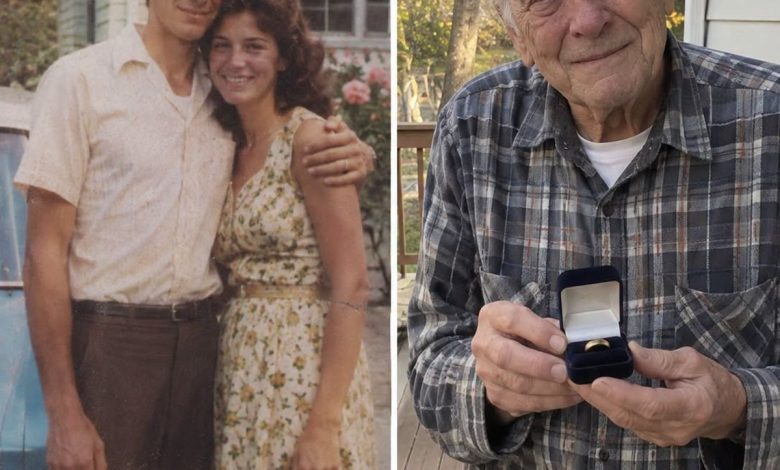
The man I didn’t know placed the box on the table between my red carnations and my coffee, still untouched.
It was little and blue. The sort made of cardboard, with a lid that slips over the top. One corner had turned soft and fuzzy with age, the way cardboard does after years of being handled.
“I gave someone my word,” he said. “Whatever happened, this had to get to you.”
His hands trembled. So did mine. But mine had been trembling since 1963, so there was nothing new in that.
I raised my eyes from the box to his face.
And my breath caught.
He had Benjamin’s blue eyes. Not merely blue. That exact shade, like the deep end of a swimming pool. He had Benjamin’s uneven smile, the left side lifting higher than the right. And he had that same little dimple in the center of his chin. The one I used to brush with my thumb when I was seventeen, as though it were a switch that could turn him on and off.
It felt as though the boy I had loved had stepped out of my memory and simply aged sixty years without me.
“Who are you?” I asked.
Before he had the chance to reply, the bell above the door clattered.
My niece Wren rushed in. Her coat hung halfway off one shoulder. Her car keys were still clutched in her hand. She wore the expression of a woman who had carefully arranged something and then nearly lost her nerve in the parking lot.
She saw us. She froze.
I turned to her.
“You knew about this,” I said.
Wren walked over and stopped beside the table. She remained standing.
“Aunt Isobel,” she said. “I knew a man had found something that might be yours.”
“Might.”
“I needed proof,” she said. “Before I put hope back into your hands.”
I dragged the box toward me across the table.
With both hands.
“I have been carrying my own hope for sixty-two years,” I said. “I did not need you deciding which day I was permitted to hold it.”
Wren’s face sank. She lowered herself slowly into the chair beside me.
“You’re right,” she said. “I’m sorry.”
The stranger dropped his gaze to the tabletop. He looked like a man who had wandered into the center of a family quarrel and wished the floor would split open and swallow him.
“Open it,” he said softly. “Please, ma’am.”
I had been sitting in that coffee shop for twenty minutes before he arrived.
Wren had called me the evening before. She had sounded odd on the phone. Too bright.
“Let’s have coffee tomorrow before you go out to the tree,” she had said. “The Marigold. On Fifth. Ten o’clock. My treat.”
“You hate the Marigold. You say the muffins taste like sawdust.”
“I’ve changed my mind about the muffins.”
I should have known right then. Wren has not changed her mind about anything in forty-two years. But I was tired, and it was the fifteenth of June, and on the fifteenth of June I am always a little somewhere else.
So I went. I stopped first at the florist on the corner and bought my carnations, as always. Twelve red carnations wrapped in white paper. I ordered a coffee I did not want. I sat by the window and waited for Wren.
And instead, a man in a blue windbreaker came through the door, scanned the room, saw me, and went pale.
He stood there by the entrance for nearly a full minute. Then he came straight to my table and asked whether I was Isobel Carver.
I said yes.
He sat down. He placed the box on the table.
And here we were.
I lifted the lid.
Inside, resting on yellowed tissue paper, was a silver ring.
Not a diamond. Benjamin had never had diamond money, and I had never wanted that even once. It was a narrow silver band with a small flat top. Engraved into that flat surface, very tiny, were two sets of initials. B.H. and I.C.
A man at the pawn shop on Delaware Street had scratched them in for two dollars extra. I had stood beside Benjamin at the counter and watched him do it. Benjamin had paid the two dollars in quarters.
Beneath the ring was a photograph. So faded the yellow had nearly turned white.
Me at eighteen. In that dress. Standing under the willow tree in Miller’s field. Benjamin behind me, both arms around my waist, his chin resting on the top of my head. He was laughing at something beyond the edge of the picture.
I knew what he had been laughing at. His cousin Danny had been trying to operate the camera and had dropped the lens cap into a puddle.
I flipped the photograph over.
His handwriting. That terrible slanted handwriting his mother used to say looked like a fence in a windstorm.
Isobel, I will come home to you.
Seven words.
The chair beneath me seemed to shift. The whole room tilted about two degrees and then stayed there.
I laid my hand flat against the table.
At the next table, a little girl sat with her mother. Six, maybe seven years old, with a paper cup of chocolate ice cream melting in front of her. She had chocolate on her chin.
She looked up at me.
Then she slid down from her chair, took two small steps to our table, and pushed a clean napkin toward me.
“Here,” she whispered.
I took it. I pressed it to my mouth.
And that was what did it, if you want the truth. Not the ring. Not the photograph. Not the seven words.
It was a child I had never seen before deciding a stranger needed a napkin.
I began to cry. Right there in the Marigold, with the espresso machine hissing and the radio playing something by the Eagles.
The little girl’s mother whispered, “Sorry,” and pulled her back to their table.
“No,” I said through the napkin. “Don’t be sorry. Thank you, sweetheart.”
The little girl smiled at me, chocolate still on her teeth.
The man across from me leaned in.
“My name is Edward,” he said. “Benjamin is my father.”
The espresso machine. The two women near the counter debating a recipe for lemon bars. The traffic outside on the avenue.
All of it receded somewhere far away.
I looked at him again. Truly looked.
Benjamin’s eyes. Benjamin’s dimple. Benjamin’s way of sitting with one shoulder slightly higher than the other.
Benjamin’s son.
“No,” I said.
Edward stayed still.
“My Benjamin died in Vietnam,” I said.
“He was declared missing,” Edward said carefully. “Later, he was presumed dead. Those are not the same thing, ma’am.”
“His mother stood on my porch in her housecoat and told me he was gone.”
“I know.”
“Then what exactly are you telling me?”
Edward inhaled.
“That my father lived,” he said. “He was badly injured. Another unit found him, far from where he was supposed to be. He had no tags. He couldn’t tell anyone who he was. It took years to sort out his identity. By the time his records were finally corrected, his mother had died. And the address the army had for her led to a house that had changed hands twice.”
I want to try to explain what that does to a person.
For sixty-two years, I had built my entire inner life around one fixed point. Benjamin Hale did not come home.
That was the wall. Everything else inside me leaned against it. My whole life had been built against that wall.
And this weary man in a windbreaker was telling me the wall had never been there at all.
Benjamin had been alive. Somewhere beneath the same sky. Breathing the same weather. Watching the same moon landing on a television somewhere, on the same night I watched it with my father.
While every June sixteenth, I stood at a florist counter and asked for red carnations for a man I believed was in the ground.
“Where has he been?” I asked.
Edward glanced at Wren.
“Don’t look at her,” I said. “Look at me. I’m eighty years old, young man. Nothing you say is going to break me that a telegram didn’t already try.”
He looked at me.
“My father suffered a severe head injury during the war,” he said. “It damaged his memory. Permanently. He lost most of what came before it. And in the past few years, dementia has taken a great deal more.”
I sat with that.
“He forgot me,” I said.
“He forgot almost everything before the injury. His childhood. His mother’s face. His street. He didn’t know his own middle name until 1971, when the records came through.”
I laughed.
It was one short, ugly sound, in a coffee shop, with a napkin crushed in my fist.
“That is a remarkably convenient answer,” I said. “After sixty-two years.”
“It’s not convenient,” Edward said quietly. “It’s simply true. And I have hated it my whole life.”
He placed a folder on the table beside the box.
Inside were papers. Service records. A discharge summary from a veterans’ hospital in Ohio. A photocopy of something called a casualty status correction, dated 1971, with a stamp so faint you had to angle it toward the window to read it.
I angled it toward the window.
HALE, BENJAMIN THOMAS. Previously reported missing in action, presumed deceased. Status corrected: Living.
Thomas. His middle name was Thomas. After his grandfather.
I had known that since I was sixteen. He had not known it until 1971.
“How did you find me?” I asked.
“The photograph gave me your face and a willow tree,” Edward said. “There was an old high school yearbook page in the box too. Roosevelt High, class of ’63. It had your name under your picture. Isobel Carver. And someone had drawn a heart around it in blue ink.”
I closed my eyes.
“Then I searched your name,” Edward said, “and I found a newspaper article. From a couple of years ago. About a woman who has read to children at the same hospital every Thursday for forty-one years.”
I opened my eyes and looked at Wren.
“I called the hospital volunteer office,” Edward said. “They wouldn’t give me your number. They gave me your niece’s. You had listed her as your emergency contact.”
Wren twisted her hands together in her lap.
“He called me three weeks ago,” she said. “I almost hung up on him. I thought it was some kind of scam. I made him send me copies of everything. I called the veterans’ office myself. I called a man in Ohio who had worked at the hospital where they treated him.” She looked at me. “After I knew it was real, I told him about the willow. I told him you go every year. On the same day.”
I looked down at the carnations resting on the table in their white paper sleeve.
It was the sixteenth of June. I had lost track. The fifteenth had been yesterday.
It would have been Benjamin’s eightieth birthday.
It was Benjamin’s eightieth birthday.
People have asked me the same question all my life.
Some ask it kindly. Some ask it the way you would ask why a house has stood empty for so long.
Isobel, did you never want a husband? Children? Didn’t you get lonely?
The honest answer was always the simplest one. And nobody ever believed it.
I never stopped loving Benjamin.
We met in eleventh grade at Roosevelt High. In a hallway. Because of a dropped textbook.
I know. It is such a foolish way to meet a person that I have always been a little embarrassed to tell it.
It was my chemistry book. It slipped off the top of my stack when I turned the corner by the gym, slid skidding across the floor, and a dark-haired boy stepped on it.
“Oh, no,” he said, looking down. “I killed your book.”
“You didn’t kill it. You stepped on it.”
He picked it up. There was a dusty sneaker print across the cover.
“It’s dead,” he said. “I’m very sorry for your loss.”
I laughed. I couldn’t help myself.
He handed it back to me. “Benjamin,” he said. “Ben. Hale.”
“Isobel.”
“That’s a long name,” he said. “Can I just call you Belle?”
“No,” I said.
He called me Belle from that day forward. For all the time I knew him.
No one else in eighty years has ever called me that. Not my mother. Not my sister. Not one other soul.
He worked afternoons at his uncle’s garage on Delaware Street. He came to school every morning with motor oil under his fingernails, no matter how hard he scrubbed them. He was not a good student. He failed chemistry twice.
But he was an extraordinary listener. I have learned since then that this is much rarer than being good at chemistry.
He would sit across from me in the cafeteria and ask about my day. And then he would actually listen to my answer. He would ask questions about it. He would remember what I had said the next day.
No one else had ever done that. Not even my mother.
There was a willow tree at the edge of Miller’s field. Past where the sidewalk ended. A big old weeping willow with branches hanging all the way to the grass, so that if you stood beneath it, it felt like being inside a green room.
That tree became ours. The way things become yours when you are seventeen. No paperwork. Absolute certainty.
We planned everything under it.
A house with a porch. A large one, with a swing.
Four children. Then three. Then “however many show up.”
A dog he wanted to call Rooster, for reasons he never properly explained.
“Why Rooster?”
“Because it’s a good name.”
“For a chicken.”
“For a dog that thinks it’s a chicken,” he said, very seriously.
I never did understand it.
We bought the ring in May of senior year. At the pawn shop on Delaware Street, three doors down from his uncle’s garage. It cost eleven dollars. The engraving was two dollars extra.
He did not get down on one knee. He simply held it out in his palm while we stood on the sidewalk outside the pawn shop, with a bus rattling past.
“It’s not an engagement ring,” he said. “I can’t afford an engagement ring. It’s a promise ring. It’s a promise that I’ll buy you an engagement ring. Eventually.”
“That’s a lot of promises in one ring.”
“It’s a strong ring,” Benjamin said. “It can handle it.”
Then his number came up.
His letter arrived in the mail on a Tuesday. I remember because Tuesday was meatloaf night at our house, and I could not eat a bite of it.
He was to report on June seventeenth. The day after his eighteenth birthday.
“Happy birthday to me,” he said, standing on my porch with the letter folded in his hand. He tried to smile. It didn’t work.
On his birthday, the sixteenth, he took me to the corner store on Elm Street. He was trying to buy me flowers. The only flowers they had were red carnations, in a bucket by the register, slightly wilted.
He bought one. He tucked it behind my ear.
“There,” he said. “Now you’re official.”
That night we went out to the willow.
We stayed there until the edges of the sky turned gray.
I wore the yellow dress. It was the ugliest thing I owned. A hand-me-down from my cousin Patricia, too wide in the shoulders, with a collar that never lay flat. But once he had told me I looked like walking sunshine in it.
So it was the only thing I could possibly have worn.
We talked all night. About everything. About nothing. About Rooster. About the porch swing.
Around three in the morning, he grew quiet.
“I’m scared, Belle,” he said.
“I know.”
“I’m really scared.”
“Me too,” I said. “Courage is being scared out of your wits and going anyway.”
He looked at me.
“Where’d you get that?”
“I just made it up.”
“That’s good,” he said. “That’s really good. Can I keep it?”
“It’s yours,” I said.
He held both my hands. Because they would not stop shaking.
“No matter how long it takes,” he said, “I’ll come home to you.”
“Promise?”
“I promise.”
He took the photograph from his shirt pocket. The one Danny had taken that afternoon, the one where Danny dropped the lens cap. He had gotten it developed at the drugstore that same day, one-hour service.
He wrote on the back of it, leaning against his knee, in that awful handwriting.
Isobel, I will come home to you.
“So you don’t forget,” he said.
“I’m not going to forget.”
“So I don’t forget, then,” he said.
He put it back in his shirt pocket with the ring. He said he would carry them both. He said they would keep him safe.
At six in the morning, he walked me home. He kissed me on my front porch.
At eight, his uncle drove him to the bus station.
I did not go. He asked me not to. He said he wanted to remember me on the porch, not crying at a bus station.
So I stood on my porch in my yellow dress with a carnation behind my ear and watched his uncle’s truck go down the street.
He wrote me eleven letters.
They arrived every few weeks. Then less often. They were short. His handwriting got worse, if that was even possible. He wrote about the heat, and the bugs, and a boy from Tennessee named Earl who snored like a freight train.
He never wrote about anything bad. Not once.
At the end of every letter, he wrote the same thing.
Still coming home. — B.
Eleven months after he left, his mother climbed my front steps.
It was eight o’clock in the morning. I was at the kitchen table eating toast. I heard footsteps on the porch, looked through the screen door, and there she was.
Mrs. Hale. In her housecoat. Pink, with little flowers on it. Her hair was still in curlers. She was holding a piece of yellow paper in both hands.
I knew before she said a word.
I dropped my toast.
“Isobel,” she said through the screen. Her voice was very quiet. “Isobel, honey.”
Missing in action.
Then, after a stretch of months I only remember in fragments, a second telegram.
Presumed dead.
I was nineteen years old.
And something in me simply decided.
It wasn’t dramatic. I did not make a vow. I did not throw myself on a grave. There wasn’t even a grave. There was nothing to bury.
I just kept waking up every morning and being unable to imagine anyone else in the chair across from me.
And then thirty years passed. And then sixty.
After that, Mrs. Hale and I had tea every Sunday. For five years. We sat in her kitchen on Pine Street and talked about him. She showed me his baby pictures. She told me about the time he got his head stuck in the banister.
She died in 1969. Her heart.
At her funeral, Benjamin’s uncle shook my hand and said, “You were good to her, Isobel. You were the only one who still came by.”
Someone bought her house that fall. Someone else bought it again three years later.
And a letter from the army, in 1971, with a stamp so faint you had to tilt it toward the window, went to that address. And someone who had no idea who Benjamin Hale was threw it away.
My father worried about me. He never said it aloud, but he did.
In 1972, a nice man named Gerald Pruitt asked me to marry him. He was an accountant. He was kind. He had a good laugh and a station wagon and he brought my mother roses on her birthday.
I said no.
That night my father sat me down at the kitchen table.
“Isobel,” he said. “Benjamin’s gone. You know that. Gerald is a good man. You could have a good life.”
“I know, Daddy.”
“Then why?”
I looked at him for a long time.
“Because when I picture the chair across from me,” I said, “it’s still Benjamin sitting in it. And it wouldn’t be fair to Gerald. To spend his whole life sitting in somebody else’s chair.”
My father didn’t argue. He only nodded. He patted my hand.
Gerald married a woman named Barbara two years later. They had four children. I went to the wedding. I was happy for him. I truly was.
But here is the part I always want people to understand. Because they hear “she never married,” and they imagine a woman sitting alone in a dark room with the curtains closed.
That was not my life.
I poured it out sideways.
I taught Sunday school at First Methodist for twenty years. I ran a food pantry out of the church basement for eleven years. Canned beans and boxed macaroni and diapers, every Saturday morning.
When my sister Carol’s marriage fell apart in 1998, I helped raise her two girls. Wren was fifteen. She slept in my spare room for two years of high school. She would come home from school, sit at my kitchen table, and tell me about every boy who had ever been mean to her.
Now she is forty-two. She calls me every Sunday with forty-two-year-old problems. Her mortgage. Her boss. Her son’s driving test. I enjoy every one of them tremendously.
And in 1984, I began volunteering at the children’s hospital downtown.
Back then it was the old brick wing. With radiators that clanked all winter like someone was hitting them with a hammer.
I read to the children on Thursday afternoons.
I have done it every Thursday I’ve been physically able to, for forty-one years. Through two new buildings. Through four different volunteer coordinators. Through a broken wrist in 2006, when I read with my left hand holding the book and a nurse turning the pages.
I have read Charlotte’s Web aloud about two hundred times. I know exactly which page to slow down on. I know which children need you to hold the book so they can see the pictures. And which ones need you to hold their hand instead.
There was a boy named Teddy, in 1991. He was eight. He had leukemia. He made me read Charlotte’s Web to him eleven times in one month.
Every time we reached the part where Charlotte dies, he would say, “Wait. Stop. Go back.” And I would go back to the beginning of the chapter. And he would listen to it all over again, holding his breath, as if maybe this time it would end differently.
It never did.
He didn’t either.
I still have the bookmark he made me. It is a piece of construction paper with a spider drawn on it in purple crayon.
I was Volunteer of the Year in 1994. There is a plaque. I keep it in a drawer, because it embarrasses me.
None of it replaced Benjamin. Nothing ever came close.
But loving him had left me holding far more love than one life could use. And I had to put it somewhere.
So I gave it away in handfuls. For six decades.
And every June sixteenth, I bought red carnations.
Because that’s what the corner store had on his birthday, the day before he shipped out. Because he had tucked one behind my ear and said, There. Now you’re official.
I carried them out to the willow in Miller’s field. The field is a park now. There are benches and a playground and a paved path for joggers. But the city left the willow. I wrote them a letter once, in 1988, when they were planning the park, asking them please to leave the tree. I don’t know if that is why they did. I like to think it is.
Every year, I sat on the grass beneath that tree for an hour. And I told Benjamin what he had missed.
The moon landing. Color television. My father’s funeral. Wren’s wedding. Personal computers, which he would have hated. Cell phones, which he would have taken apart.
I talked to him as if he could hear me.
I never once imagined he might actually be somewhere he could.
“Why today?” I asked Edward, at the Marigold. “Why not a year ago? Why not thirty years ago?”
“Because my father asked me to find you,” he said. “Last month.”
My fingers tightened around the little girl’s napkin.
“He said my name?”
Edward nodded. I watched his jaw work before he could answer.
“I moved him into full-time care in May,” he said. “His needs had become more than I could manage at home. When I was clearing out his room, I found this box. In a locked drawer of his dresser. He’d kept that drawer locked since I was a boy. If I’m being honest, I always assumed it was tax papers.”
“Did he know what was in it?”
“Not all of it. He gets pieces. Some days more than others.” Edward’s voice thinned. “But he held it. And he got very upset. And then he had one of those windows. The doctors call them lucid intervals. We just call them good minutes.”
“And?”
“He looked right at me,” Edward said. “Clear as anything. And he said, Belle must have the box.”
The room tilted again.
Only one person in the history of the world had ever called me Belle.
“Is he safe?” I asked. “Where he is. Is he cared for?”
“Yes. It’s a good place. Up near Willow Falls. I checked it out for four months before I moved him.”
“Is he dying?”
Edward’s whole face tightened. And I saw something underneath all that careful calm.
“His health is declining,” he said. “That’s what they tell me. That’s the phrase they use.”
And then I understood what was actually sitting across from me.
Edward was not only a man delivering a miracle. He was a son losing his father. Running one final errand for him. Because it was the only thing left he could still do.
Wren reached over and laid her hand on my arm.
“We can take you home, Aunt Isobel,” she said. “You can have some time with it. Think about it.”
Edward closed the lid of the box very gently.
“You don’t have to decide anything today,” he said.
“No,” I said.
Wren tipped her head. “No?”
I opened the box again. I set the ring back into its tissue paper. I closed the lid. I laid my hand flat across the top.
“I have spent sixty-two years talking to that man as if he could hear me from under a tree,” I said.
My hands were still trembling. But my voice, for once in its life, was not.
“If he’s close enough to answer, I am not waiting one more day.”
I looked at Edward.
“Take me to him,” I said.
It was a two-hour drive north. Wren followed us in her own car. I rode with Edward.
I kept the blue box on my lap the whole way.
I asked my questions in the only order I could bear.
“Did he ever mention me? Ever?”
“He remembers feelings much better than facts,” Edward said. “He always has. Even before the dementia. There were nights he’d get restless. He’d sit up in bed and talk about a girl in a yellow dress. A girl whose hands wouldn’t stop shaking. He never had a nam…
Read more stories
- In early 2026, after months of pancreatic cancer treatment kept him away from the road, Ri
- There are so many beautiful things in life, but nothing compares to the joy of holding you
- My Pregnant Daughter Was Battling Cancer When She Asked for Just One Joyful Day: a Gender Reveal Party. But Hours Before the Celebration, a Phone Call Brought Her and Her Husband to Tears—and I Worried the Box in Our Backyard Might Never Be Opened.
- A Charity Gives a Woman’s 12-Year-Old Son with Cancer One Wish – He Uses It to Feed 300 Homeless People, but Then a Stranger Asks Her, ‘He Hasn’t Told You the Truth, Has He?’