My Daughter’s Teacher Wouldn’t Paint Her Face Like the Other Girls, but What She Said to My Little Girl Shattered My Heart!!
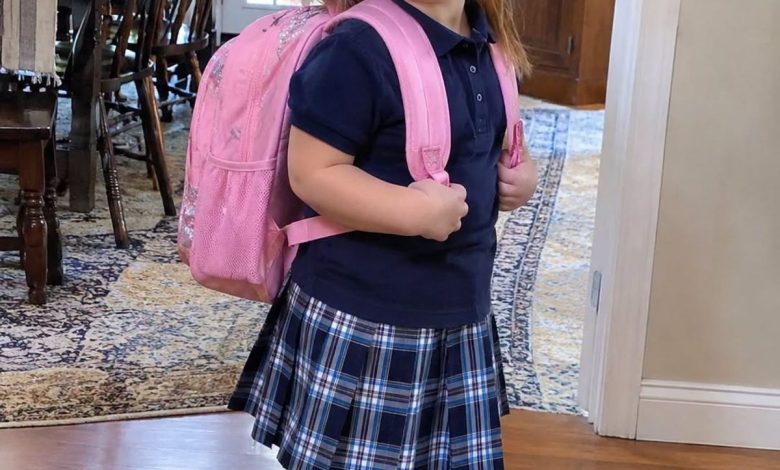
My daughter woke me at five-forty on the morning of her very first school festival. She padded into our bedroom wearing her purple unicorn pajamas, climbed onto the bed, and planted herself squarely on my stomach with all her weight, which at six years old comes to about forty-two pounds of pure determination.
“Mommy,” she whispered, two inches from my face. “It’s festival day.”
“It’s still dark, baby,” I muttered.
“Festival day,” she repeated, louder this time, as if I hadn’t understood. “There’s face painting, Mommy. Kenzie says there’s face painting and a bouncy castle and a cakewalk. I want a butterfly.”
I cracked open one eye. Victoria was beaming at me in the dim gray window light, that huge, full-face smile that pushes her cheeks so high her almond-shaped eyes almost vanish. Beside me, my husband, Chris, groaned and dragged his pillow over his head.
“A butterfly,” I said. “What color?”
She considered it with complete seriousness.
“Pink,” she said. “And purple. And sparkly.”
She had been talking about the Fall Festival at Brookside Elementary for an entire week. Every afternoon when I picked her up, it was the first thing she said. The bouncy castle, the cakewalk, the hay bales by the playground, the face painting. Her teacher had sent home a flyer with a pumpkin printed on it, and Victoria had taped it to the refrigerator herself, crookedly, with what looked like forty pieces of tape.
I dressed her in her favorite clothes, purple leggings and a pink sweater with a sequin heart on the front that changes color when you brush your hand over it. I brushed her fine brown hair into two small pigtails and tied them with purple bows. She wanted her sparkly sneakers, the pair that light up when she stomps. She stomped the whole way to the car.
At the school, at eight-thirty, I walked her to the side entrance where the first graders met. The parking lot was packed with cars and the playground was already decorated with hay bales and orange balloons tied along the fence. Parents were carrying in folding tables and crockpots for the chili lunch. I could see the giant inflatable castle being filled on the soccer field, sagging and rising like something alive and breathing.
I knelt in front of Victoria at the door. She was practically vibrating.
“Be good,” I told her. “Have so much fun. Get your butterfly.”
“Pink and purple and sparkly,” she said.
“Pink and purple and sparkly.” I kissed her forehead.
She flung her arms around my neck and squeezed hard, the way she always does, with her entire body. Then she let go and ran inside, pigtails bouncing and sneakers flashing, and she never looked back. She never does. It’s one of the things I love most about her.
Everything seemed completely normal.
I drove to work. I’m a makeup artist and wig designer at the Indiana Repertory Theatre in downtown Indianapolis, and that week we were in tech rehearsals for A Christmas Carol, which meant sixty actors and a hundred and forty costume changes and my hands covered in latex and spirit gum from nine in the morning until midnight. I was in the makeup room at the theater, attaching a false nose to the actor playing Scrooge, when my phone rang.
It was an hour and ten minutes after I had dropped her off. The screen said Brookside Elementary.
“Mrs. Parker?” a woman’s voice said. Calm, but deliberate. “This is Diane Whitaker. The principal at Brookside.”
“Is Victoria okay?”
“She’s safe,” Mrs. Whitaker said quickly. “She isn’t injured. But she’s been crying for about twenty minutes, and she keeps asking us to call you. She won’t stop. She says she wants to go home.” She paused. “Could you come pick her up?”
“What happened?”
There was another pause. A longer one.
“She’s very upset,” Mrs. Whitaker said. “She hasn’t been able to tell us exactly why. I think it would help if you came.”
I was already reaching for my car keys. I left the Scrooge actor sitting in my chair with only half a nose.
Chapter Two: Victoria
My daughter, Victoria, has Down syndrome.
We learned when I was twenty weeks pregnant. A doctor in a small, chilly room at St. Vincent Hospital in Indianapolis showed us the blood test and ultrasound numbers and used the word “abnormality” four times in ten minutes. Chris squeezed my hand so tightly it hurt. On the drive home, neither of us spoke for forty minutes. Then, stopped at a light on Keystone Avenue, Chris turned to me and said, “She’s ours. That’s the only thing I need to know.”
She was born on a snowy February morning, six years and eight months before that festival. Six pounds, eleven ounces. She had a heart defect, a small hole between the chambers, and she needed surgery when she was five months old at Riley Children’s Hospital. She spent nine days in the cardiac ICU with tubes and wires everywhere, and I slept in a chair beside her and learned every beep of every machine by heart.
She came home. She grew. She rolled over late and sat up late and didn’t walk until she was twenty-two months old, holding onto Chris’s fingers as she crossed our living room in Carmel, Indiana, while I cried and recorded it on my phone. She talked late too. Her first word was “mama.” Her second was “more.” Her third was “no.” She has never been shy about using any of them since.
She is the most joyful person I have ever met. She hugs strangers in the grocery store. She dances to the music in the dentist’s waiting room. She tells every cashier at Target that she loves them, and she means it every single time. She loves purple, and unicorns, and butterflies, and her big brother Owen, who’s nine and lets her win at Candy Land. She loves her daddy’s pancakes and my makeup brushes, which she steals out of my bag to paint the cat.
Sending her to first grade was one of the hardest decisions I had ever made.
She had done two years of preschool in a special program run by the district, with eight children in a classroom and three teachers. She had thrived there. But this year, her team recommended placing her in a regular first-grade classroom at Brookside, our neighborhood school, with an aide for part of the day and pull-out sessions for speech and occupational therapy. It’s called inclusion. All the research says it’s best for kids like Victoria. They learn more. They make friends. The other children learn too.
In June, we sat in a conference room at the district office with seven people around the table and wrote her Individualized Education Program. Her IEP, everyone calls it. Twenty-two pages. Goals for reading and math and speech and fine motor skills. An aide for four hours a day. Speech therapy twice a week.
And I worried about everything.
Would the other kids tease her? Would they stare at her face, at her eyes, at the way she speaks? Would she understand if someone was cruel? Would she even recognize cruelty, my daughter who hugs strangers? Would she tell me if something happened?
But Victoria wanted to go to school more than anything in the world. She had watched Owen get on the bus every morning for four years, standing at the window in her pajamas with her hands pressed to the glass. All summer, she wore her new backpack around the house, a purple one with a unicorn on it, even to bed.
For the first two weeks, she was happier than I had ever seen her.
Every afternoon, she came racing out of the building into my arms, talking so quickly I could barely follow her. About her new friends. About Kenzie, who sat next to her and had a pet hamster named Cheeto. About recess and the slide and the library, where the librarian let her check out two books instead of one. She would show me the drawings she made in class, pulling them from her unicorn backpack. A rainbow. A cat. Our family, four stick figures holding hands, with me drawn very tall and with huge hair, which I chose to take as a compliment.
Her teacher was new. A young woman named Miss Price, fresh out of college, in her first year of teaching. I had met her for five minutes at open house in August, in a crowded classroom full of parents. She seemed nice. Bright and upbeat, with a high blonde ponytail and a sweater with apples on it. She shook my hand and told me she was so excited to have Victoria in her class.
I believed her. I had no reason not to.
Chapter Three: The Hallway
When I pulled into Brookside’s parking lot, the festival was in full swing. Kids everywhere. Kids climbing on hay bales, kids lined up for the bouncy castle, kids tearing across the playground holding balloons. And so many of them had painted faces. Tigers and kittens and spiderwebs and rainbows and superhero masks. A little boy ran past me with a green dinosaur on his cheek, roaring.
I went through the side entrance. The front hallway was crowded with tables and decorations. And there, waiting for me by the trophy case outside the principal’s office, perched on a small bench with the principal’s hand on her back, was Victoria.
Her face was red and blotchy. Her eyes were swollen. One of her pigtails had half fallen out. She was clutching a tissue in both hands, twisted into a rope.
The second she saw me, she ran straight into my arms.
“Mommy,” she sobbed into my neck. “I want to go home. I want to go home.”
I held her. I picked her up, all forty-two pounds of her, and held her against my chest, and I looked over her head at Mrs. Whitaker. The principal was a tall woman in her late fifties with short gray hair and reading glasses hanging from a beaded chain. She looked worried and helpless.
“She came in from the gym about twenty-five minutes ago,” Mrs. Whitaker said softly. “Crying. She won’t tell us what happened. She just keeps saying she wants you.”
I carried Victoria a little farther down the hallway, away from the office, near the double doors leading into the gym. Through the doors, I could see the face-painting station set up at a long table under a paper banner that read FACE PAINTING! in bubble letters. A young teacher sat there with a paint palette and a cup of brushes, painting butterflies onto another little girl’s cheeks. She had a high blonde ponytail. She was laughing with the child in front of her.
There was a line of kids waiting. All girls. Seven or eight of them.
I set Victoria down and knelt beside her on the hallway floor so we were eye level.
“Sweetheart,” I said. “What happened? You can tell me.”
She looked at me with her swollen eyes. Then she turned and pointed through the gym doors toward the face-painting table. Toward the teacher with the blonde ponytail, whose back was to us. Too far away to hear us.
“She said makeup is for pretty girls,” Victoria whispered. “And it won’t help me. Because I’m not pretty.”
I couldn’t breathe.
“I was in line,” Victoria said. Her voice trembled. “With Kenzie. And Kenzie got a butterfly. And when it was my turn, I sat down in the chair. And Miss Price looked at me and said no.” She wiped her nose on her sleeve. “She said face paint is like makeup, and makeup is for pretty girls. She said it won’t help me because I’m not pretty. And she said go play in the bouncy castle instead.”
I knelt there on the hallway floor of my daughter’s elementary school and felt something inside me go cold and still. Like ice spreading across a lake.
Victoria looked up at me. Her chin was shaking.
“Mommy, am I not pretty?” she asked. “Will I never be pretty?” She grabbed my hands. “Please don’t lie to me.”
I wiped away her tears with my thumbs. I kissed her forehead, right in the middle, where I always kiss her.
“Victoria,” I said. “You are beautiful, sweetheart. You are the most beautiful girl I have ever seen in my whole life. Don’t ever let anyone tell you anything different.”
“But Mommy,” she said, and her voice cracked. “She’s a teacher. Teachers don’t lie.”
I looked through the gym doors at the young woman with the blonde ponytail. She was still smiling. She had finished the butterflies and was holding up a hand mirror for the little girl to admire them. The little girl squealed. The next girl in line climbed into the chair. Miss Price picked up a brush and began painting a pink heart on her cheek, completely unaware that I was standing there.
And then an idea came to me.
Chapter Four: The Butterfly Table
“Baby,” I said. “Go back to Mrs. Whitaker, okay? Go sit with her in the office. Tell her Mommy will be there in five minutes. I just need to take care of something.”
Victoria looked at me.
“Are we going home?”
“We’re going to the movies, sweetheart,” I said. “The new unicorn one. And after that, we’ll get your favorite ice cream. Cotton candy with rainbow sprinkles. I promise.”
She gave me one last hug, a hard one, with her whole body. Then she hurried back down the hallway in her light-up sneakers. I watched until she disappeared into the principal’s office, until I saw Mrs. Whitaker rest her hand on Victoria’s back and guide her into a chair.
Then I turned toward the gym.
Miss Price had only met me once, for five minutes at open house in a packed classroom. She wouldn’t remember my face. She didn’t know I was Victoria’s mother. And I meant to keep it that way, at least for a little while.
Because I wanted to know. I wanted to hear her say it herself. I wanted to know whether my six-year-old daughter had misunderstood, the way six-year-olds sometimes do. Or whether a grown woman, a teacher, had looked at my child and decided she wasn’t worth a butterfly.
So I walked straight toward her table as she finished painting the little girl with the pink heart.
I stood at the end of the line. Behind the last little girl. A tall woman in a black theater T-shirt with spirit gum on her fingers and her hair piled into a messy bun, waiting for face paint. The little girls in line glanced up at me curiously. One of them giggled.
Miss Price finished the pink heart and held up the mirror. The girl ran off. The next one climbed up. I watched her paint a rainbow, then a kitten, then another butterfly. She was good. Quick hands, steady hands. Bright colors. Each girl got the mirror at the end and a little compliment.
“There, gorgeous.”
“Look how pretty you are.”
“Oh, that’s perfect on you, sweetie.”
When the last little girl ran off, I stepped forward.
Miss Price looked up at me, surprised.
“Oh,” she said, laughing. “Hi! Are you here to help? We could use another painter. The line has been crazy.”
“Actually,” I said, smiling back, “I was hoping you’d paint me.”
She laughed again.
“Seriously?”
“Seriously,” I said. I sat down in the little chair. My knees nearly reached my chest. “I’m somebody’s mom. My kid said I should get a butterfly too. I’m a sucker for butterflies.”
“Okay!” she said brightly. She picked up a clean brush. “What colors?”
“Pink and purple,” I said. “And sparkly.”
She dipped the brush into pink and began on my left cheek. Up close, she looked even younger than I’d first thought. Maybe twenty-three. She had a little spray of freckles across her nose, pale blue eyes, and a tiny silver cross hanging from a chain around her neck.
“Busy morning?” I asked.
“Oh my gosh, so busy,” she said. “I’ve probably done sixty kids. The first graders all wanted butterflies. I don’t think I can paint another butterfly ever again.” She laughed. “Kidding. It’s fun. I love this part.”
“I heard there was a little girl crying earlier,” I said casually. “One of the first graders. I saw her in the hallway when I came in.”
Miss Price’s brush paused for just a second. Then it kept moving.
“Oh, her,” she said. She made a face. “The Down syndrome girl. Victoria. She’s in my class.”
“What happened?” I asked. “She seemed really upset.”
Miss Price sighed, long and heavy, like she had been dealing with something exhausting all morning. She dipped her brush into purple.
“Honestly? I just told her the truth,” she said. “She sat down and wanted a butterfly like the other girls. And I just thought, why? What’s the point? Face paint is basically makeup. And makeup is for making pretty girls prettier.” She shrugged one shoulder as she painted. “It’s not going to do anything for her. With her face. You know?”
I didn’t move. I sat perfectly still in that little chair with her brush against my cheek.
“I told her to go play in the bouncy castle instead,” Miss Price said. “I thought I was being nice, honestly. Saving her from being disappointed. Like, why get her hopes up?” She switched brushes and picked up the glitter. “And then she just started crying and ran out of the gym. Kids like that get so emotional.” She gave a little laugh. “It’s been a whole thing.”
She was dusting glitter onto my cheek when I saw them.
Standing in the gym doorway, maybe fifteen feet behind her. Mrs. Whitaker, the principal, with her reading glasses hanging from the chain. And holding her hand, Victoria. With her blotchy face and her half-undone pigtails. She had gotten worried when I didn’t come back in five minutes. She had asked Mrs. Whitaker to help her find me.
They had heard every word.
Chapter Five: The Mirror
Miss Price set down the glitter and picked up the hand mirror. She held it in front of my face with a wide smile.
“There!” she said. “Gorgeous!”
I looked into the mirror. A pink and purple butterfly stretched across my left cheek, sparkling. It was beautiful. She really was talented.
“It’s lovely,” I said. “Thank you.”
I didn’t stand up. I stayed in that little chair, looking at my own reflection, for a long moment. Then I lowered the mirror and looked at her.
“Miss Price,” I said quietly. “My name is Erin Parker. I’m Victoria’s mother.”
All the color drained from her face.
She stared at me. Her mouth opened and closed. I watched her replay every word she had just said, one after another, in her mind. I watched her realize it.
“I…” she said. “Mrs. Parker, I didn’t…”
“Turn around,” I said.
She turned. And she saw her principal standing in the gym doorway. And beside her, holding her hand, the little girl in the pink sweater with the sequin heart.
Mrs. Whitaker’s face was stone. I have never seen anyone look so furious and so calm at the same time.
“Miss Price,” she said. Very quietly. “Please come to my office. Now. Mrs. Atkins will take over the face painting.”
Miss Price stood up. Her hands were shaking. She set down her brush and palette. She walked across the gym toward the doorway, eyes fixed on the floor, and when she passed Victoria, she didn’t look at her. She couldn’t.
Victoria watched her go. Then she looked at me, still sitting in the face-painting chair with a butterfly on my cheek.
“Mommy,” she said. “You got a butterfly.”
“I did,” I said. I opened my arms. “Come here, baby.”
She came. Slowly at first, then running. I lifted her onto my lap in that little chair, and she leaned close to look at my cheek and touched the sparkles with one finger.
“It’s pretty,” she said.
“So are you,” I said.
Then I did what I had come there to do.
I set her down in the chair. I stood up and moved around to Miss Price’s side of the table. I picked up the palette. I looked through the brushes in the cup and chose the three I wanted. A fine liner. A flat. A round. Then, from the small fanny pack I always wear to work, I pulled out my own brushes. The good ones. The ones I use on actors at the theater.
The kids in the gym were beginning to notice. A few of the girls who already had painted faces drifted over to watch. Then a few more. Parents too.
I knelt in front of my daughter.
“Victoria,” I said. “Do you know what Mommy does at work?”
She nodded.
“You make the actors pretty.”
“I make them whatever they need to be,” I said. “Old. Young. Scary. Funny. Kings and queens and ghosts.” I dipped my liner brush into pink. “But I have never once in my whole life painted anyone more beautiful than you.”
I painted her the most beautiful butterfly I have painted in fifteen years of doing this for a living.
It stretched from her left temple down across her cheekbone, wings opened wide, pink in the center fading into purple at the edges, with fine black veining I drew using the liner brush, the way I would paint a fairy for a production of A Midsummer Night’s Dream. I added tiny white dots along the wing edges. I painted a second, smaller butterfly lifting toward her right eyebrow, as if the first one had brought along a friend. I covered them both in glitter. Lots of glitter. And on the tip of her nose, I painted a tiny purple heart.
It took me eleven minutes. Victoria sat perfectly still the entire time, which she has never done for anything in her life. Her eyes stayed closed. She was smiling.
When I finished, I held up the mirror.
She opened her eyes. She looked at herself.
For a long time, she said nothing at all. She just stared. Turned her head to the left and then to the right. Touched the purple heart on her nose.
“Mommy,” she whispered. “Is that me?”
“That’s you,” I said.
She kept looking for a long moment. Then she said, very softly, “I’m pretty.”
“You’re pretty,” I said. “You were always pretty. The butterflies just came to say so.”
By then there were about thirty kids gathered around the table. And their parents. Somebody’s dad was recording on his phone. And a little girl with a ponytail and a tiger on her cheek stepped out from the crowd. It was Kenzie, Victoria’s friend, the one with the hamster named Cheeto.
“Victoria,” Kenzie said. “Yours is the prettiest one.”
Victoria looked at her. Then she smiled so wide her eyes disappeared.
Then another little girl said, “Can I have one like Victoria’s?”
And another. And another. And by the time Mrs. Atkins came over to take over the face painting, there was a line of nineteen little girls and four little boys, all asking for a butterfly just like Victoria’s.
Chapter Six: Ice Cream
We went to the movies. The new unicorn one, at the AMC on Michigan Road, at one-fifteen on a Saturday afternoon. Victoria refused to let me wash her face. She sat in the dark theater with her popcorn in her lap and her butterflies glittering in the light from the screen, and every few minutes she would reach up and touch the purple heart on her nose just to make sure it was still there.
Afterward, we went to Handel’s for ice cream. Cotton candy with rainbow sprinkles. She ate every bit of it, got sprinkles on her butterfly, and I didn’t care at all.
In the car on the way home, she was quiet for a while. Then she said, “Mommy?”
“Yes, baby?”
“Why did Miss Price say I’m not pretty?”
I had been thinking about how to answer that question ever since the hallway. I still didn’t know. I tightened my grip on the steering wheel.
“I think,” I said slowly, “that Miss Price learned something wrong somewhere. About what pretty means. Somebody taught her a wrong thing a long time ago, and she believed it.”
“Like a wrong answer on a test?”
“Exactly like a wrong answer on a test,” I said.
She thought about that.
“Can she fix it?”
“I hope so,” I said.
That night, after the kids were asleep, I sat at the kitchen table with Chris and told him everything. He listened without interrupting, the way he always does. When I got to the part about makeup being for pretty girls, he set his coffee cup down on the table very carefully, and his jaw tightened. When I got to the part where Miss Price said “the Down syndrome girl,” and “kids like that,” and “with her face,” he stood up from the table and went out onto the back porch and stood in the dark for ten minutes.
When he came back in, his eyes were red.
“I want her fired,” he said. “I want her out of that school. I want her out of teaching.”
“I know,” I said.
“Erin, she’s six. Victoria’s six. She asked you if she’ll never be pretty.”
“I know, Chris.”
He sat down again. He covered his face with his hands.
“What did you say to her?” he asked. “When she asked.”
“I told her she was beautiful,” I said. “And then I painted her the best butterfly I’ve ever painted in my life, in front of the entire first grade.”
He looked up at me. Then he laughed, a tired, broken laugh.
“Of course you did,” he said. “Of course you did.”
Chapter Seven: The Meeting
Mrs. Whitaker called me at home Sunday night. She apologized for phoning on a weekend. She said she hadn’t slept.
“Mrs. Parker,” she said. “I want you to know that Miss Price has been placed on administrative leave, effective immediately. She will not be in the classroom on Monday. We have a long-term substitute coming in. Mrs. Delgado. She has twenty-two years of experience, including special education.”
“Thank you,” I said.
“And I’d like to meet with you and your husband,” she said. “This week. With the district’s director of special education. To talk about what happens next. For Victoria.” She paused. “And about Miss Price.”
We met Wednesday morning at the district office on Third Avenue, in the same conference room where we had written Victoria’s IEP in June. Mrs. Whitaker was there. And Dr. Ramona Ellis, the director of special education, a small, sharp woman in her sixties with silver hair who had worked in the district for thirty years. And the district’s huma…
Read more stories
- The Worn Coat Everyone Mocked Carried a Truth He Never Expected
- After a month without speaking to me, my boyfriend posted his new woman in the middle of t
- My Stepmother Tried to Force Me to Buy Dad’s 1978 F-150 Until the Bidders Remembered the Promise He Made
- I retired and bought a quiet cabin by the lake with only my name on the deed — then my dau