Elvis Presley’s “If I Can Dream” Endures as a 1968 Plea for Hope, Peace, and Humanity
A song shaped by a shattered American moment
By the time “If I Can Dream” was recorded in 1968, the United States was deep in a season of grief, anger, and upheaval. The assassination of Dr. Martin Luther King Jr. had shaken the country, and the mood of the year was marked by conflict, protest, and an anxious search for moral direction. Out of that atmosphere came a song that did not try to escape the moment, but answer it.
Written by Walter Earl Brown, “If I Can Dream” was conceived as a direct expression of hope, peace, and unity. Its lyrics reach for a better future without denying the darkness that made such a plea necessary. That tension is part of what gives the song its staying power: it is both wounded and determined, sorrowful and defiant.
Why Elvis connected so deeply with it
Elvis Presley had recorded ballads, gospel, rock and roll, film songs, and blues-inflected performances across his career, but “If I Can Dream” struck a particularly personal chord. The song’s language is not casual or ornamental; it is urgent, almost prayerful. It asks for a world of understanding and insists that despair cannot be the final word.
That sincerity mattered to Elvis. He reportedly said he would only sing songs he truly believed in, and this one plainly met that standard. Rather than sounding like an assignment or a polished studio exercise, the performance feels inhabited from within, as though Presley recognized in the lyric a chance to say something larger than entertainment.
There must be lights burning brighter somewhere.
The defining finale of the 1968 NBC Comeback Special
The song achieved its most lasting impact as the emotional finale of Elvis’s 1968 NBC Comeback Special, the television event that reintroduced him as a commanding live presence. The special is often remembered for its raw energy and career-renewing confidence, but its final note was not swagger. It was conviction.
Placed at the end of the program, “If I Can Dream” transformed the special’s meaning. Instead of closing on nostalgia or spectacle alone, Elvis ended with a statement of purpose. Dressed in white and singing with mounting intensity, he delivered the performance less like a pop star finishing a set than like an artist trying to make contact with a wounded country.
A vocal performance built on restraint and release
Part of the song’s power lies in how Elvis sings it. He begins with control, shaping the opening lines with gravity rather than excess. Then the performance rises, phrase by phrase, into something far more impassioned. By the end, the vocal is pushing against the limits of the arrangement, carrying both strain and resolve.
That arc mirrors the song’s message. “If I Can Dream” is not naive optimism packaged as sentiment. It is hope spoken in full awareness of suffering. Presley’s voice makes that contradiction audible: he sounds heartbroken, but unwilling to surrender. The result is one of the most emotionally direct recordings of his career.
More than a comeback song
Although it is inseparable from the Comeback Special, “If I Can Dream” has endured because it means more than a milestone in Elvis’s professional story. It stands as one of the clearest examples of him using his platform to channel a broader human longing—for dignity, compassion, and a future better than the present.
That is why the song continues to resonate well beyond its original release. Listeners return to it not simply for its historical importance, but for its moral clarity. In an era still marked by division and unrest, the recording feels less like a period piece than a recurring appeal: to believe that empathy, justice, and understanding are still worth reaching for.
Why it remains one of his most meaningful recordings
Many Elvis songs endure because of their hooks, their sensuality, or their role in shaping popular music. “If I Can Dream” endures for a different reason. It gathers together his vocal authority, his instinct for drama, and a rare sense of public purpose. It is a performance in which message and singer meet at exactly the right moment.
That combination helps explain why the song is so often singled out as one of the most meaningful records he ever made. It captured Elvis Presley not only as a superstar, but as an interpreter of collective feeling. In just a few minutes, he turned national pain into a plea for common humanity—and that plea still lands.
Quick Facts
- Song: “If I Can Dream”
- Artist: Elvis Presley
- Written by: Walter Earl Brown
- Released: 1968
- Context: Written following the assassination of Dr. Martin Luther King Jr.
- Signature performance: Finale of Elvis Presley’s 1968 NBC Comeback Special
- Core themes: Hope, peace, unity, and humanity
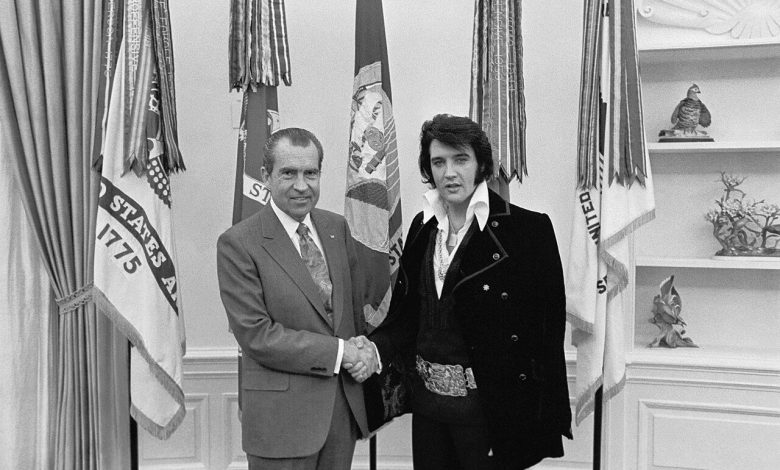
Image credits: Ollie Atkins, chief White House photographer at the time. See ARC record. / Wikimedia Commons / Public domain; Ollie Atkins, chief White House photographer at the time. See ARC / Wikimedia Commons / Public domain; MGM / Wikimedia Commons / Public domain.