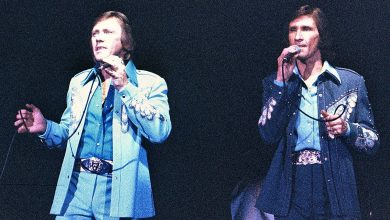
Bill Medley Took the Wheel After Phil Spector — and Turned “(You’re My) Soul and Inspiration” Into a Defining Righteous Brothers Hit


A duo at a crossroads
In late 1965, The Righteous Brothers were in a precarious but promising position. Bill Medley and Bobby Hatfield had separated from Phil Spector and Philles Records, stepping away from the hitmaking partnership that had helped define their early sound. That meant freedom, but it also meant risk: the next single would have to convince listeners that the duo could survive outside Spector’s orbit.
For any act associated so closely with a powerful producer, the departure raised an obvious question. Could The Righteous Brothers still sound like themselves without the architect of their most famous records? Instead of spending months chasing a replacement or trying to replicate Spector’s methods through someone else, Medley made a more radical decision. He would produce the next record himself.
The song that almost slipped away
The material that would become their statement of intent came from Barry Mann and Cynthia Weil, one of the great songwriting teams of the era. They had begun writing “(You’re My) Soul and Inspiration” in the wake of “You’ve Lost That Lovin’ Feelin’,” the towering hit that had already linked the writers, the duo and Spector in pop history.
But the newer song did not immediately complete its journey to record. It lingered in an unfinished or unused state, more possibility than product, while the group’s circumstances changed around it. That made it a curious choice for such an important moment: not a freshly commissioned reset, but a near-missed song from the same creative stream that had produced an earlier triumph.
Bill Medley steps into the producer’s chair
Medley’s move was more than a credit change. Producing The Righteous Brothers himself meant assuming responsibility for arrangement, pacing, vocal emphasis and the emotional architecture of the record. The challenge was especially delicate because listeners would inevitably hear “Soul and Inspiration” against the memory of “Lovin’ Feelin’.” Too much resemblance, and it would feel like imitation; too little, and the duo might lose the grandeur audiences expected.
What Medley achieved was a balancing act. He preserved the dramatic rise-and-fall that suited The Righteous Brothers so well, allowing Hatfield’s soaring tenor and his own grounded baritone to work in tandem, but he also proved that the duo’s emotional force was not dependent on one famous producer. The record sounded recognizably like The Righteous Brothers because, at its core, it was.
Instead of trying to find another producer to recreate their familiar sound, Medley decided to take matters into his own hands.
Why the record mattered so much
“(You’re My) Soul and Inspiration” carried a burden beyond that of an ordinary follow-up single. It had to reassure the industry, the audience and perhaps the artists themselves that the act could continue after a high-profile break. In pop music, transitions are often judged in a single three-minute burst; a song either sounds like a future or a footnote.
For The Righteous Brothers, this record became a test of authorship as much as performance. Their harmonies, sense of drama and command of romantic longing had always been central to the appeal, even when the production was discussed first. By stepping forward, Medley effectively argued that the duo had more agency in their success than the usual producer-centered narrative allowed.
A familiar emotional language, newly claimed
Part of the song’s power lies in how fluently it speaks the emotional language that fans already associated with The Righteous Brothers. It is aching, grand and unabashedly direct, built around devotion expressed at full volume. That continuity mattered. Medley did not reject the style listeners loved; he reclaimed it, showing that the sound could endure beyond one partnership.
That helps explain why the record occupies such a fascinating place in the duo’s history. It is both continuation and declaration: a song born from the same songwriting world as their breakthrough classics, yet also a clear sign that their future need not be dictated by the past. In practical terms, Medley was producing a single. Symbolically, he was producing proof.
The legacy of a turning point
Looking back, “(You’re My) Soul and Inspiration” stands as more than a hit from a celebrated catalog. It marks a moment when Bill Medley translated uncertainty into control, using a song that might have remained unfinished business and turning it into a defining chapter for The Righteous Brothers.
That story continues to resonate because it upends a familiar music-industry script. Artists are often cast as dependent on the visionary behind the glass. Here, one of the voices at the microphone became the architect as well, and in doing so helped preserve the identity of one of pop’s most distinctive duos at a moment when that identity could easily have dissolved.


Quick Facts
- Artist: The Righteous Brothers
- Key figures: Bill Medley and Bobby Hatfield
- Former producer/label: Phil Spector and Philles Records
- Songwriters: Barry Mann and Cynthia Weil
- Song: “(You’re My) Soul and Inspiration”
- Turning point: Bill Medley produced the record himself after the duo left Spector
Image credits: Sport the library / Wikimedia Commons / CC BY-SA 3.0; Sport the library / Wikimedia Commons / CC BY-SA 3.0; Bearian / Wikimedia Commons / CC BY-SA 3.0.