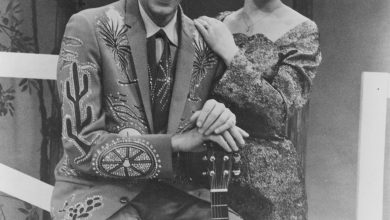
Chris LeDoux’s Last Inheritance: How Ned LeDoux Turned Crossed-Out Lyrics Into a Final Duet


What Chris LeDoux left behind
When Chris LeDoux died on March 9, 2005, in a hospital in Casper, Wyoming, the public record of his life seemed easy to summarize. He was 56. He had been diagnosed with bile duct cancer four months earlier. He left behind a career that stretched across 36 albums, millions of records sold, and a place in country music that felt inseparable from rodeo grit, Western pride, and the working life he sang about.
But the most powerful inheritance in the LeDoux family was not something framed on a wall or counted in sales. It was far more intimate: loose handwritten pages found around the house, fragments of songs, a few lines at a time, some of them crossed out. They were not trophies. They were unfinished thoughts, still warm with the sound of the person who wrote them.
The son in the background steps forward
For years, Ned LeDoux had occupied a familiar place in his father’s orbit: just behind him, on drums, part of the band but not the center of attention. It was a role that kept him close to the music while leaving the spotlight where audiences expected it to be — on Chris, the rodeo champion turned beloved country singer whose songs carried the dust and momentum of the American West.
After Chris died, that arrangement changed. Ned put down the drumsticks and picked up a guitar, moving from support player to songwriter and frontman. It was not a simple career pivot so much as a different way of staying in conversation with his father — not from behind the kit this time, but through melody, phrasing, and the weight of a line that needed finishing.
A house full of fragments
The pages came into Ned’s life gradually. His mother found them around the house: scraps and notes, handwritten ideas, two or three lines long, partial lyrics with edits scratched through them. Anyone who has ever seen a songwriter’s notebook would recognize the scene — inspiration caught in passing, then reworked, doubted, abandoned, or saved for later.
For a son, though, those papers meant more than process. They preserved Chris LeDoux not as a finished legend but as a working writer, still searching for the right word. The crossed-out lines mattered as much as the surviving ones. They showed hesitation, revision, instinct. They showed a man still making the thing he would one day be remembered for.
Some fathers leave fortunes. Chris left crossed-out lines, and the one son who could finish them.
Filling in the blanks on ‘We Ain’t Got It All’
One of those unfinished pieces found a future in 2016, when Ned worked with Mac McAnally to complete a song built from his father’s writing. The result was “We Ain’t Got It All,” a title that carries the kind of plainspoken humility long associated with Chris LeDoux’s best music. It was less an act of excavation than collaboration across time: Chris providing the spark, Ned and McAnally shaping it into a finished recording.
That kind of project can easily collapse under sentimentality, but what gives it force is its incompleteness. The song did not arrive as a sealed artifact from the past. It had to be interpreted, inhabited, and completed by someone who understood not only the language on the page but the life behind it. Ned was not merely preserving his father’s work; he was learning how to answer it.
The vocal that waited twenty-one years
Then came a second discovery, even more startling. Eight years after “We Ain’t Got It All,” a songwriter friend told Ned that something else still existed: a Chris LeDoux vocal recorded in 2003 that had never been released. It was, by all accounts, the last song Chris ever sang in a studio. And it had been sitting unheard, or at least unused, for twenty-one years.
There is something haunting about that image — a final vocal left on a shelf while the years moved on, while careers changed, while grief hardened into memory. Recordings often outlive the people who make them, but they do not usually remain so suspended, so unfinished in public life. This one waited for the son who had inherited the fragments.
Hearing his father again, this time beside him
Ned was out on tour when that old Chris LeDoux vocal was finally dropped into a new recording. The moment he first heard it, the distance between archive and present collapsed. He and his father were suddenly singing together.
That is the emotional center of the story, and it is why the papers matter as much as the recordings. Chris LeDoux’s legacy was never only the catalogue, the championship, or the sales figures. Those are the facts of a career. What endured most was the unfinished material that required trust, memory, and family to complete. In the end, Ned did not simply inherit his father’s songs. He inherited the chance to answer them — and, for one extraordinary moment, to sing back.
Quick Facts
- Chris LeDoux death: March 9, 2005
- Cause of death: Bile duct cancer
- Age at death: 56
- Place of death: Casper, Wyoming
- Albums left behind: 36
- Records sold: 6 million
- Rodeo achievement: World bareback championship, 1976
- Key unfinished song completed later: We Ain’t Got It All
Image credits: Christian Deschênes / Wikimedia Commons / CC BY-SA 3.0; s:fr:Auteur:Charles Baudelaire / Wikimedia Commons / Public domain; Maurice Renard / Wikimedia Commons / Public domain.