My Brother Took $38,000 From Dad’s Retirement and Never Paid It Back, So at 79, Dad Was Still Driving a School Bus
Chapter One: 6:20 A.M.
At 6:20 that morning, the bus barn door rolled up for the last time.
It made the same sound it always made. A long metal groan and a rattle, chains running up through the pulleys, and then cold gray light spilling in across the concrete floor. The smell of diesel and old vinyl seats. The radio in the dispatch office playing the farm report, low.
Eleven yellow buses in a row, nose to the door. Number 7 was third from the left.
My father climbed up into the driver’s seat the way he’d done every school morning for three years. One hand on the grab rail. One foot on the step. A little grunt as he pulled himself up.
I was in the first seat behind him.
Dad didn’t know why I’d taken the morning off.
I’d told him I wanted to ride along. Just once. Before he retired. I told him I’d always wondered what his route looked like.
He looked at me funny when I said it. He knows me. He knows I don’t take days off. I’ve worked at the Sioux County Treasurer’s office in Orange City for nineteen years, and I can count on one hand the sick days I’ve used.
But he didn’t ask questions. He just said, “Bring a coat. Heater’s slow.”
He wore the tan zip-up jacket he’s had since before Mom died.
It’s a Carhartt. Faded almost white at the elbows and the cuffs. One pocket torn and sewed back up with brown thread, crooked, by Mom, the winter before she got sick. He won’t wear anything else. My husband, Kent, bought him a new one two Christmases ago. It’s still in the box in his closet with the tags on.
He had his reading glasses in the chest pocket and a thermos of coffee in the cup holder and his lunch in a brown paper sack. Same as every day.
He put the key in. He checked his mirrors. Left, right, the big convex one over the windshield.
Then he turned around in his seat and looked at me.
“Last one, Jillie,” he said.
“Last one, Dad.”
He turned back around. He started the engine.
My father’s name is Harold DeBoer. Everybody calls him Hal. He was seventy-nine years old that morning. He farmed four hundred acres of corn and beans in Sioux County, Iowa, for fifty-one years, on the same ground his father farmed, and his father before that.
He retired from farming at seventy-three. He sold the land to the neighbor boy. He put the money in the bank. He was going to take Mom to see the Grand Canyon. She’d always wanted to see it.
She got sick that fall. Ovarian cancer. She was gone in fourteen months.
They never went.
He pulled Number 7 out of the barn into the cold morning. The tires crunched on the gravel. The sky was pink in the east over the windbreak.
He reached up and flipped on the radio. The country station out of Sioux Center. George Strait.
Then he drove out the gate and turned north toward Route 7.
He didn’t know what was waiting for him. I’d made sure of that.
I sat in the first seat behind him with my hands in my lap and my heart pounding and didn’t say anything at all.
Chapter Two: The Yellow Legal Pad
To understand why my seventy-nine-year-old father was driving a school bus, you have to know about Neal.
Neal is my older brother. He’s fifty-two. Three years older than me. He has Dad’s height and Mom’s laugh and a way of talking that makes you feel like he’s letting you in on a secret.
He’s a car salesman. A good one. Maybe the best in Sioux County. He could sell a minivan to a man with no kids and make him feel like he got a deal.
In 2019, he opened his own lot. Hollandale Auto Sales, on Highway 75 on the south edge of Hollandale. Used cars and trucks. A little white sales office with a flag on top and balloons tied to the antennas.
It did all right the first two years. Then 2022 came.
Interest rates went up. Way up. Used car prices crashed after the big spike. Neal had financed his inventory on what’s called a floor plan, a line of credit from a bank in Sioux Falls, and when the prices dropped, the cars on his lot were suddenly worth less than he owed on them.
He was upside down by about sixty thousand dollars. The bank wanted it by June. Or they’d pull the floor plan and take his inventory.
He didn’t tell anybody. Not his wife, Shelly. Not me. Not Dad.
He just went to Dad’s house on a Sunday afternoon in March and sat down at the kitchen table.
I wasn’t there. I know because Dad told me later. Much later.
Neal asked to borrow thirty-eight thousand dollars. From Dad’s retirement. From the land money.
Dad had about a hundred and twelve thousand dollars in savings back then. After the land sale and Mom’s medical bills and the funeral. That was it. That was everything. He had Social Security, eighteen hundred a month, and no pension. Farmers don’t get pensions.
Thirty-eight thousand was a third of everything he had in the world.
He said yes before Neal finished asking.
Neal wrote the loan on a yellow legal pad. In 2022.
I’ve seen it. It’s one page. In Neal’s handwriting, blue ink, slanting to the right the way his writing always has.
I, Neal DeBoer, borrow $38,000 from my father, Harold DeBoer, to be repaid in full within two years, by March 31, 2024.
Neal’s signature at the bottom. Dad’s signature next to it.
Two years, it says.
It’s still in Dad’s kitchen drawer with the rubber bands.
The drawer to the left of the sink. Where Mom kept rubber bands and twist ties and birthday candles and the warranty for the dishwasher. Dad never cleaned it out after she died. He just kept putting things in.
The yellow legal pad note is folded in thirds, on top of a tangle of rubber bands. I found it in January, looking for a pen. I unfolded it and read it standing at his kitchen counter.
March 31, 2024. Two years.
It was January 2025.
I asked Dad about it that day. Standing in his kitchen, holding it.
He took it out of my hand. He folded it back up in thirds. He put it back in the drawer, on top of the rubber bands. He shut the drawer.
“Has he paid any of it?” I asked.
Dad didn’t answer.
“Dad. Has Neal paid you back one dime?”
He looked out the window over the sink. At the yard. At the bird feeder Mom put up in 1987.
“He’s had a hard time,” he said.
“That’s not what I asked.”
“No,” Dad said quietly. “He hasn’t.”
Chapter Three: For Something to Do
At seventy-six, Dad went back to driving bus.
He’d driven school bus once before. When I was a kid. In the winters, when the farm was slow, he drove Route 3 for the Hollandale Community School District to make a little extra money. He did it for eight years. He loved it.
In 2022, the summer after he loaned Neal the money, the district put an ad in the Sioux County Index-Reporter. School bus drivers needed. Will train. Must have CDL with passenger and school bus endorsements.
Dad went down to the bus barn and filled out the application.
“For something to do,” he told everyone.
That’s what he said. At church. At the café in Hollandale. At the Casey’s, when the woman at the register asked him why on earth a man his age wanted to drive a school bus.
“For something to do,” he said. “Gets lonely in that house. I like the kids.”
He went to Sioux City and got his commercial driver’s license renewed. He passed the written test. He passed the road test in a borrowed bus. He passed the Department of Transportation physical at the clinic in Orange City, which they make you do every single year after you turn seventy.
The district gave him Route 7. The longest one. Fifty-eight miles of gravel roads, out through the farm country north of Hollandale. Thirty-one stops. Forty-four kids.
I knew it wasn’t for something to do.
I knew because I do the property tax rolls for Sioux County. I see every tax bill in the county. And I saw Dad’s.
In 2023, he paid his property taxes late. In two installments. He’d never paid late in his life. Not once in fifty-one years of farming.
In 2024, he let his car insurance lapse for a month. I only found out because the Iowa DOT sent him a letter and he left it on his kitchen table.
He stopped buying the good coffee. He started buying the store brand in the big red can. He turned the heat down to sixty-two in the winter. He stopped going out to eat with his friends from church on Thursdays.
The district paid him nineteen dollars and forty cents an hour. Two runs a day, morning and afternoon. About twelve hundred dollars a month during the school year.
Kent and I offered to cover the money ourselves.
We sat him down at his own kitchen table in February. Kent and me. We’d talked about it for weeks. We didn’t have thirty-eight thousand dollars lying around. Kent’s a manager at the feed mill in Sioux Center. I work at the treasurer’s office. We’ve got two kids in college and a mortgage.
But we could take a home equity loan. We’d figured it out. We could give Dad the thirty-eight thousand, and he could quit driving that bus, and we’d sort it out with Neal ourselves.
Dad listened. Then he shook his head.
“No,” he said.
“Dad…”
“I won’t take a cent, Jillie,” he said. “Not from you. Not from Kent. You’ve got your own kids to look after.”
“Then let me talk to Neal,” I said.
Dad looked at me across the table. That look. The one he used to give me when I was twelve and wanted to fight a boy at school.
“No,” he said.
“Dad, he owes you thirty-eight thousand dollars. You’re seventy-nine years old and driving a school bus in a blizzard. Somebody has to say something to him.”
“Nobody has to say anything,” Dad said. “It was my money. It was my choice to lend it. And it’s his business to pay it back. Not yours.”
“But…”
“Jill.” He put his hand flat on the table. “Promise me. Promise me you won’t fight your brother over this. I won’t have my kids fighting over money. Not after your mother.”
I sat there for a long time.
“Promise me,” Dad said again.
“I promise,” I said.
It was Dad’s money and Dad’s choice to lend it.
And he made me promise not to fight my brother.
So I didn’t. I didn’t call Neal. I didn’t drive to his car lot. I didn’t say one word to his wife or his kids or anybody at church.
But I couldn’t just sit there either.
All I could do was make sure the county saw what he’d been carrying. Not the money. Him. Three years of five a.m. mornings on gravel roads. Forty-four kids. Thirty-one stops.
Chapter Four: His Hand on the Lever
In January, his hand shook so hard on the door lever it took him two tries.
I saw it. I’d driven out to the bus barn on a Friday afternoon to bring him a casserole. I was sitting in my car in the parking lot when Number 7 came in from the afternoon run.
He pulled into the barn. He set the brake. He reached for the lever that opens the door.
His hand shook. Bad. Like a leaf in the wind. He missed the lever. He reached again. On the second try, he got it.
The door folded open. He came down the steps slowly, one hand on the grab rail. He saw my car and waved.
He didn’t know I’d seen.
I called Dr. Haverkamp at the clinic in Orange City that night. She’s been Dad’s doctor for twenty years.
“I can’t tell you anything about his health, Jill,” she said. “You know that. Privacy rules.”
“I know. I just need to know if he’s safe. Driving forty-four kids around on gravel roads.”
She was quiet for a long time.
“He passed his DOT physical in August,” she said carefully. “He’ll need another one this August. Whether he passes it depends on a lot of things.” She paused. “I’ll tell you what I tell everybody. Seventy-nine is old for that job. Hands get tired.”
In March, he told the district this was his last year.
He didn’t tell me first. I found out from the transportation director, Marv Schuiteman, who goes to our church.
“Your dad came in today,” Marv said after the service, in the narthex. “Said he’s done in May. Last day of school.” He shook his head. “I’ve got nobody to replace him. Nobody wants Route 7. Fifty-eight miles of gravel.”
“Did he say why?”
“Said his hands are tired,” Marv said. “Said he didn’t want to be the old man who put a bus in the ditch with kids on it.”
That night, I sat at my kitchen table in Orange City with a yellow legal pad. Like Neal’s. Like the note in Dad’s drawer.
I made a list.
Not one family on Route 7 knew how old he was. I was sure of it. He never told anybody. When kids asked, he’d say, “Older than dirt and twice as dusty.” When parents asked, he’d change the subject.
They didn’t know he’d farmed for fifty-one years. They didn’t know he’d buried his wife. They didn’t know he drove that bus so he could pay his property taxes.
They just knew him as Mister Hal. The old man in the tan jacket who’d been picking up their kids at the end of the lane every morning for three years.
I called Marv and asked for the route list.
He didn’t want to give it to me. Student privacy. Then I told him what I wanted to do.
He was quiet on the phone for a long time.
“I’ll give you the parents’ names and phone numbers,” he said finally. “That’s all. Don’t tell anybody where you got them.”
“I won’t.”
“And Jill?” Marv said. “Let me know when. I’d like to be there.”
I made thirty-one phone calls.
One for every stop on Route 7. Over two weeks in April. In the evenings, at my kitchen table, after supper. Kent sat next to me and handed me coffee.
I said the same thing every time.
“Hi. My name is Jill Vander Wal. My dad is Hal DeBoer. He drives your kids on Bus 7. He’s retiring at the end of the year.” I’d take a breath. “He’s seventy-nine years old. And I’d like to do something for his last day.”
Fifty-eight miles of gravel.
Thirty-one families. Farmers and teachers and a pastor and a woman who runs a daycare out of her basement. A family of Guatemalan dairy workers who’d been in Sioux County four years. A young couple who just bought the old Hoekstra place. A great-grandmother raising two of her great-grandsons.
Not one family said no.
Not one. Every single one of them said yes before I even finished explaining.
Several of them cried on the phone.
“Seventy-nine?” said the mom at Stop 9. “He’s seventy-nine? He helped my son with his shoe in the snow every morning in January. He got down on one knee in the slush. At seventy-nine?”
“He’s never once been late,” said the dad at Stop 22. “Not in three years. Not one time. Even in the blizzard in December.”
“My daughter calls him Grandpa Bus,” said the mom at Stop 17. “She doesn’t have a grandpa. Hers died before she was born.”
Chapter Five: Stop 1
Stop 1 is a quarter mile from the barn.
The Groen place. A white farmhouse with a red barn and a long gravel lane lined with cedar trees. Dad turned off the county blacktop onto the gravel and slowed down.
The sun was just over the windbreak. Coming up gold and pink through the bare branches of the cottonwoods. Frost on the fields. A meadowlark singing on a fence post.
I sat forward in my seat. My hands were sweating.
At the end of the lane stood a mom in a green fleece with her two kids.
Becky Groen. Thirty-five. She teaches second grade at Hollandale Elementary. Her husband, Mark, farms with his dad.
A girl about six, in braids. Lily. First grade.
A boy about nine. Owen. Fourth grade.
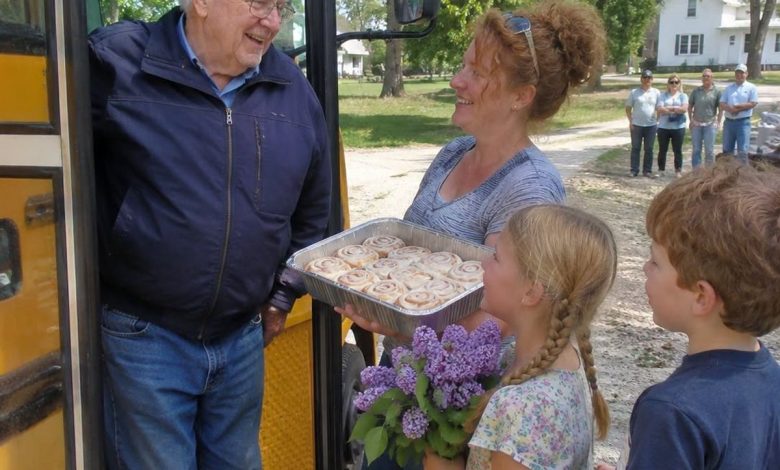
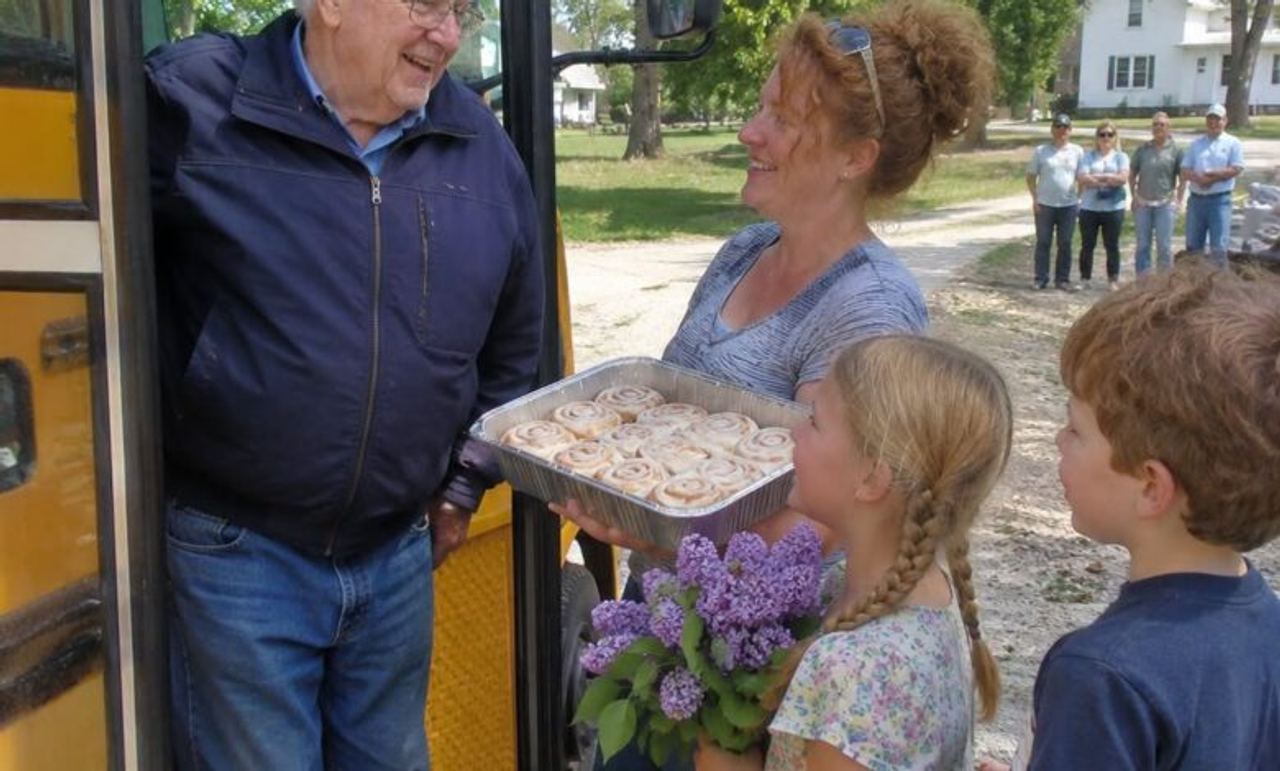
They were holding up a pan of cinnamon rolls and a bunch of lilacs.
The cinnamon rolls were in a glass baking dish, covered in plastic wrap. Becky was holding them with both hands. They were still steaming against the plastic.
The lilacs were in Lily’s arms. A huge bunch. Purple and white. Cut from the big bushes along the Groens’ driveway. They were almost as big as she was. She was holding them up so high I could barely see her face behind them.
Dad saw them as he came up to the lane.
I watched him see them. His foot came off the gas.
Dad put the red stop arm out and opened the door.
He did it the way he always does. Flashers first. Then the stop arm swinging out from the side of the bus with its red light blinking. Then the brake. Then his hand reaching for the door lever.
It didn’t shake. I watched.
The door folded open. Cold air came in. The smell of lilacs.
Dad stepped down onto the bottom step, one hand on the grab rail.
“Well,” he said. “What’s all this?”
Lily stepped forward. She held up the lilacs.
“These are for you, Mister Hal,” the little girl said. “Because it’s your last day.”
Dad stood there on the bottom step of that bus. With one hand on the grab rail and his tan jacket zipped up to his chin.
His eyes were wet.
He reached down and took the lilacs from Lily. Very carefully. Like they might break. He held them against his chest.
“Thank you, sweetheart,” he said. His voice was rough.
Becky held out the cinnamon rolls.
“I’m sorry, Hal,” she said. “I didn’t know. I didn’t know you’d been doing this at seventy-nine. Every morning. In the snow.” She shook her head. “Jill called and told us. I had no idea.”
Dad looked back over his shoulder. At me in the first seat.
He didn’t say anything. But he knew.
He was smiling like I hadn’t seen since Mom.
I mean that. I hadn’t seen him smile like that in five years. Not since before the cancer. Not since the last Christmas, when Mom was still well enough to make her banket and he stood in the kitchen doorway watching her roll out the dough.
That smile. All the way up to his eyes.
He took the cinnamon rolls from Becky and set them on the dash. He set the lilacs next to them. Then he stepped back down and shook Becky’s hand. And Owen’s hand, very seriously. And he picked up Lily and gave her a hug, and she squealed.
“Get on the bus, you two,” he said. “Owen, your shoe’s untied again.”
Owen and Lily climbed on. They sat in their usual seats.
Becky stood at the end of the lane and waved.
Dad got back in the driver’s seat. He pulled in the stop arm. He shut the door.
Then he looked down the gravel road. North. Toward Stop 2.
And he stopped.
Chapter Six: The Next Lane
Another family was waiting at the next lane.
I could see them from Stop 1. A quarter mile up the road. The Kooiman place. A dad and two boys standing at the end of their gravel lane in the gold morning light. The dad was holding something over his head. A sign.
And beyond them, at the next lane, another family.
And the next.
Dad sat there with his hands on the wheel. The engine idling.
The road ran straight north for two miles. Flat Iowa farm country. Gravel road, ditches on both sides, fence lines, fields of black dirt waiting for planting. Cottonwoods and windbreaks around every farmstead.
And at the end of every lane, as far as you could see, there were people. Little clusters of them. Moms and dads and kids and grandparents. Standing in the cold morning, waiting.
Some of them were holding signs. Some of them were holding food. One family had tied yellow balloons to their mailbox.
Dad didn’t say anything for a long time.
Then he put the bus in gear. And he drove.
At Stop 2, the Kooimans had a sign painted on a piece of plywood. THANK YOU MISTER HAL. ROUTE 7 LEGEND.
At Stop 3, the Mulders gave him a thermos of real coffee. “Not the store brand,” Lisa Mulder said. “I heard.”
At Stop 5, the Vermeer kids sang him a song. All four of them, in a row, at the end of the lane. “You Are My Sunshine.” Off-key. Dad stood on the bottom step and listened to the whole thing with his hand over his heart.
At Stop 8, the Lopez family. The Guatemalan dairy workers. Mrs. Lopez handed him a plate wrapped in foil. Tamales. Still warm. “For your lunch,” she said, in careful English. “Gracias, Señor Hal. For taking care of my babies.”
At Stop 11, the young couple from the old Hoekstra place. They’d moved in last August. Their son, Mason, started kindergarten in the fall. He’d been terrified of the bus. He cried every single morning for the first two weeks.
Dad started getting off the bus at their stop. Every morning. He’d come down and kneel at the end of the lane and hold out his hand. And he’d say, “Come on, partner. I’ll save you the best seat.”
By October, Mason ran to the bus.
Now Mason’s mom stood at the end of the lane with tears running down her face. Mason was holding a drawing. A yellow bus with a stick figure driver in a tan jacket.
“That’s you,” Mason said, holding it up. “You’re the bus guy.”
“I’m the bus guy,” Dad agreed. He took the drawing. He held it for a long time.
By then, the bus was filling up. Not just with kids. With stuff.
Cinnamon rolls on the dash. Lilacs. A thermos. Tamales. A loaf of banana bread. Three cards. Mason’s drawing taped to the inside of the windshield where Dad could see it.
And behind us, on the gravel road, cars.
I noticed it around Stop 9. I looked out the back window of the bus.
The Groens’ minivan was behind us. Becky, driving to school. She’d waited at the end of her lane until we pulled away, and then she’d followed.
Behind the Groens, the Kooimans’ pickup.
Behind them, the Mulders.
At every stop, another family pulled out of their lane behind us. And followed.
Chapter Seven: Stop 14
At Stop 14, an eighty-four-year-old widow sat waiting at the end of her lane.
Ruth Hoogeveen. She’s not a parent. She’s a great-grandmother. Her granddaughter died of an overdose in Sioux Falls four years ago, and Ruth took in her two great-grandsons, Tyler and Jace. They were three and five. They’re seven and nine now.
Ruth had been raising those boys alone, at eighty, on a farmstead with no farm. Her husband died in 2015. She sold the land and kept the house. She drives an old Buick to the Fareway in Orange City once a week.
She was sitting in a lawn chair at the end of her gravel lane. A folding aluminum lawn chair with green and white webbing. She had a blanket over her knees. Tyler and Jace stood on either side of her.
When she saw the bus coming, she tried to stand up. She couldn’t. Her knees wouldn’t let her.
Dad saw that.
He put the stop arm out. He opened the door.
Then he did something he’d never done. Not once in three years.
He took off his seat belt. He set the parking brake. He stood up out of the driver’s seat.
And he climbed all the way down. Not just to the bottom step. All the way down, onto the gravel.
He walked over to Ruth’s lawn chair. Slowly. His knees aren’t good either. He bent down.
And he kissed her cheek.
Ruth put her hand on his face. Her old, spotted hand on his old, weathered cheek. They stayed like that for a moment.
“Hal DeBoer,” she said. “I didn’t know you were the same age as my Herman would’ve been.”
“Close enough,” Dad said.
“You get off this bus every morning to help my Jace with his backpack,” Ruth said. “Every morning. Because his arm’s bad. I watch you from the window.”
“He’s a good boy.”
“He is,” Ruth said. “Because men like you show him how to be.”
Ruth handed him something. A small box. Wrapped in old Christmas paper.
Dad opened it right there on the gravel.
Inside was a wooden bus. Hand-carved. Yellow, with black stripes. About six inches long. The wheels turned.
“Herman made it,” Ruth said. “In 1962. For our son. He drove bus too. Route 4. For nine years.” She looked up at Dad. “I want you to have it.”
Dad held that little wooden bus in his hands. He couldn’t speak.
He climbed back up into the driver’s seat. Tyler and Jace climbed on behind him.
He set the wooden bus on the dash, right next to Mason’s drawing.
He reached for the door lever.
His hand never shook on that door lever.
Not once.
Not that whole morning. Thirty-one stops. I watched every single one. His hand was as steady as a fence post.
By Stop 20, half the route was following us to the end.
I counted. Eighteen vehicles. Pickups and minivans and SUVs and Ruth Hoogeveen’s old Buick, which she’d somehow gotten into and driven out of her lane. All in a line on the gravel road behind Bus 7. Their headlights on in the morning light, like a funeral procession. Or a parade.
Dad saw them in the big mirror over the windshield.
He didn’t turn around.
Chapter Eight: You Promised
Without turning around, Dad said, “You did this.”
His voice was quiet. Just loud enough for me to hear over the engine.
I didn’t lie to him. I’ve never been able to lie to my father.
“I made some phone calls,” I said.
He drove for a while. The gravel crunched under the tires. Out the window, the farm country rolled past. Black fields. Red barns. Grain bins shining in the sun.
“You promised me, Jill,” he said.
My stomach dropped.
“I never said one word about the money, Dad,” I said. “Not to anybody. I promise. Not one word.”
He didn’t answer.
“I just told them you were seventy-nine,” I said. “And that it was your last day. That’s all. I didn’t tell them about Neal. I didn’t tell them about the loan. I didn’t tell them about the property taxes or the coffee or anything.”
He drove a mile in silence.
A whole mile. Past Stop 21. Past Stop 22. …
Read more stories
- A 68-Year-Old Woman Adopted a 3-Year-Old Girl After Five Families Rejected Her – Then the Woman’s Adoption Attorney Handed Her a Folder Revealing Why
- Why You Should Never Put Your Crockpot on the Stovetop
- My Ex-Husband Kept Our House and Left Me With His $11,000 Tractor Debt, but I Made Sure Everyone Knew the Truth
- Blake Shelton’s Bizarre Turkey Ingredients, Donna Kelce’s Signature Rolls, and More Celebrity Thanksgiving Recipes That Might Surprise You