The messenger who begged the world to believe him
In 1942, a 28-year-old Polish courier was smuggled into the Warsaw Ghetto disguised as a laborer. What he saw there changed him forever. Children starved in doorways. Bodies lay uncollected in the street. Families waited for a train that, once it came, would carry them only one way. The man who entered the ghetto was Jan Karski, and he left with a burden far heavier than any document: a memory he was meant to carry out to the world.
The Jewish leaders trapped inside the ghetto gave him a simple, desperate task. Memorize everything. The names, the numbers, the methods, the scale. There could be no cameras, no papers hidden in his coat, nothing that might betray him if he were stopped. So Karski carried the truth in his head as he crossed occupied Europe, dodging checkpoints where the wrong answer could mean death. He moved through war-torn countries with one mission: reach the people with the power to stop what was happening.
He finally made it to London and told the Polish government-in-exile and British officials what he had seen. He asked to see Winston Churchill himself, but Churchill said he was too busy. Karski did not stop there. He crossed the Atlantic and tried again at the very top. On July 28, 1943, he sat down in the Oval Office with President Franklin D. Roosevelt.
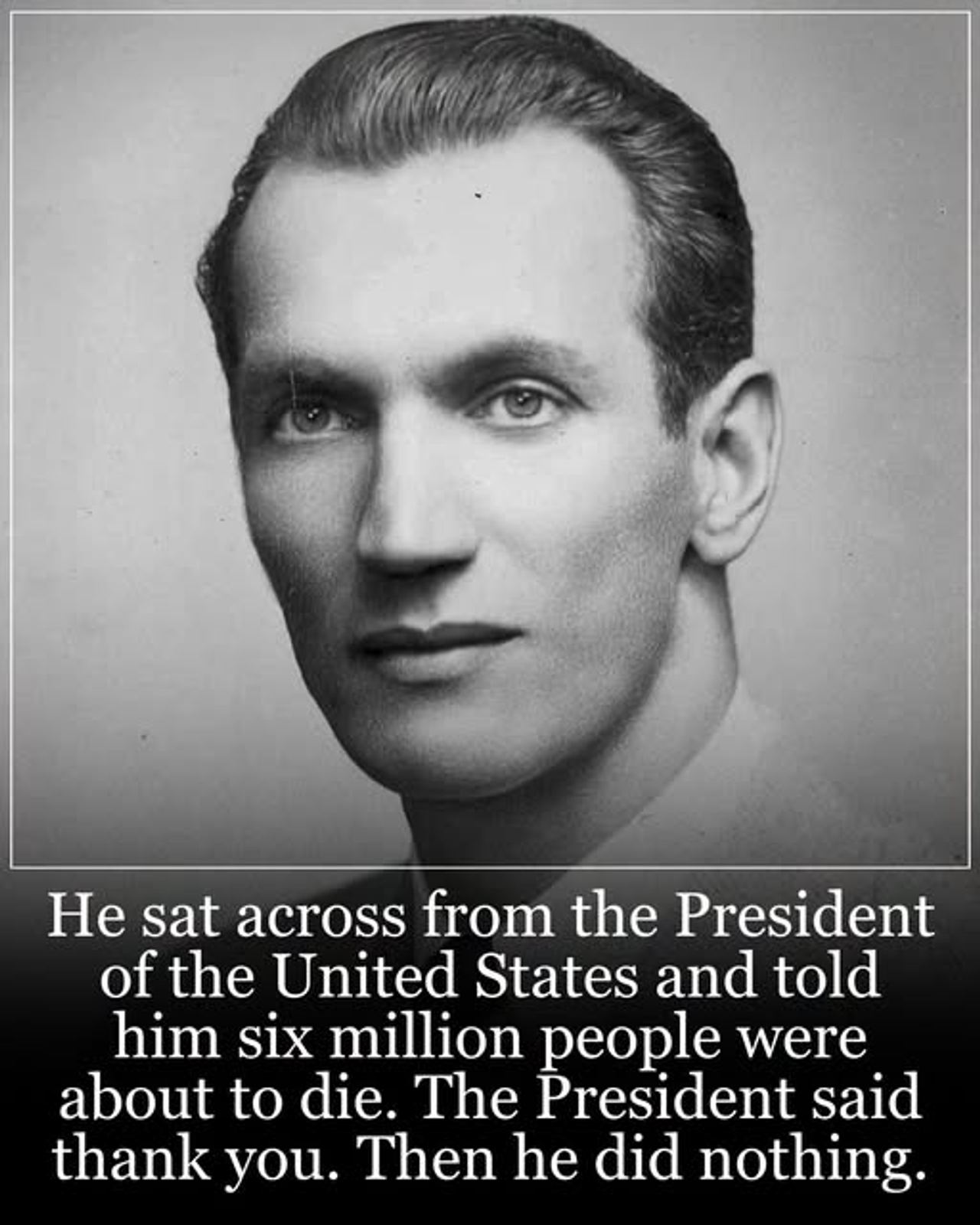
For more than an hour, Karski laid out the reality of the ghettos and camps, the systematic murder already well underway. Roosevelt listened. He asked questions, though by Karski’s own account afterward, not a single one was about the fate of the Jews themselves. The president seemed engaged. Courteous. Interested. Then he thanked Karski, and the meeting ended. No public statement followed. No warning was issued. No rescue plan was launched.
Karski kept going. He testified before Congress. He met with Supreme Court Justice Felix Frankfurter, who heard the same horrifying account and finally said, quietly, “I am unable to believe you.” It was not a claim that Karski was lying. It was something more chilling: an admission that the mind could refuse to accept such cruelty as real. That, again and again, was the barrier Karski faced — not disbelief in his honesty, but disbelief that the world could truly be this terrible.
The war ground on. The killing continued. By the time the Allies finally issued a public warning about the Holocaust, thousands more had already been sent to their deaths. Karski carried the weight of that Oval Office meeting for the rest of his life, along with the knowledge that he had done everything he could to make the world hear him.
He became a professor. He wrote. He taught. He spent decades making sure the story would not disappear with him. In the early 1980s, filmmaker Claude Lanzmann recorded one of the most searing interviews ever made about the Holocaust, and there Karski, older now, broke down as he described what he had witnessed. Even then, the memory remained raw. His life became a solemn reminder that sometimes history is not only made by those who survive it, but by those who try, against overwhelming silence, to warn the rest of us.