The day Rick Hansen refused to let one accident define him
On June 27, 1973, Rick Hansen was a fifteen-year-old with the kind of future that seemed to open in every direction. He lived near Williams Lake, British Columbia, and sports filled his life. He had just been named athlete of the year at his high school. He was already dreaming about trying out for the provincial volleyball team. For Rick, the world still looked wide and waiting.
That day, he and his best friend Don Alder were hitchhiking home from a week-long fishing trip, riding in the back of a pickup truck on a gravel road. Then everything changed in a moment that lasted only a second. The driver lost control. The truck rolled. Don was thrown clear. Rick hit a steel toolbox, and his back broke. His spinal cord was damaged. He would never walk again.
The next seven months were spent in a Vancouver rehabilitation ward, where he had to learn a new version of his own body and a new way of moving through the world. But when he left, the world had not caught up with him. In 1973, there were no ramps, few accessible doorways, and little public understanding of the full life a wheelchair could hold. Too many people would have treated the accident as the end of the story.
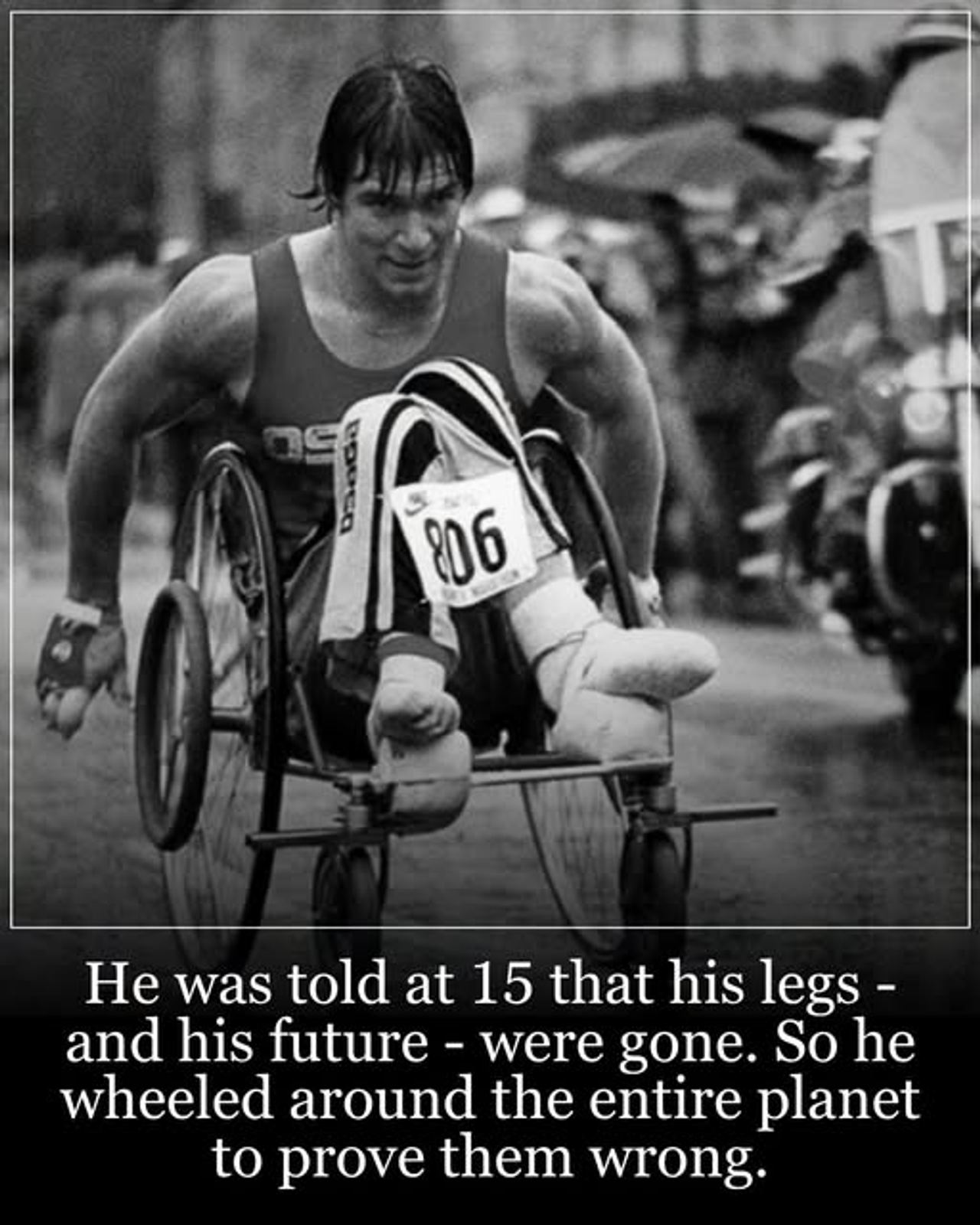
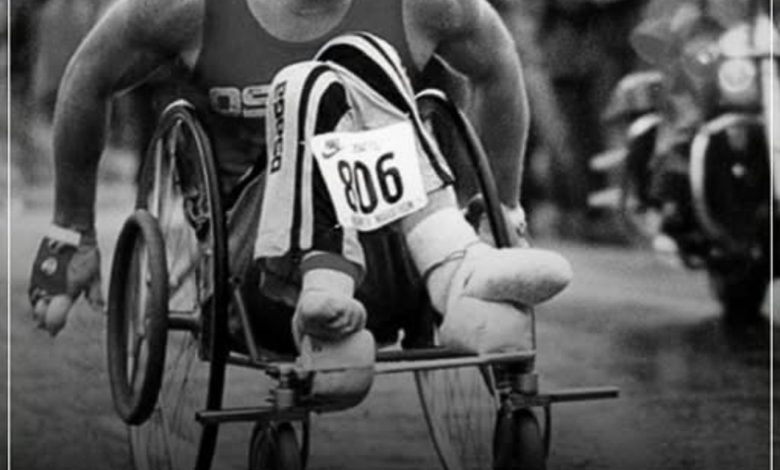
Rick did not accept that ending. Three years later, he enrolled at the University of British Columbia and kept training, because stillness was never really part of who he was. He found wheelchair racing, and he found that he was fast. Between 1979 and 1984, he won nineteen international wheelchair marathons and four world titles. In 1983, he was named Canada’s Outstanding Athlete of the Year, sharing the honor with a young hockey phenom named Wayne Gretzky.
But medals were never enough for Rick Hansen. He wanted something larger, something so ambitious it sounded almost impossible: to wheel around the entire world. On March 21, 1985, a crowd gathered at Oakridge Mall in Vancouver to watch him leave. There were tears, and there was fear, because no one had attempted anything like it before. Rick set off in a manual wheelchair, using only his own arms, across 34 countries and four continents.
Before he left, an old friend handed him a small replica of the statue honoring Terry Fox, whose own run for cancer research had been cut short by illness. Rick had watched that courage up close. He was determined not to let it end there. The road would be punishing. Within two weeks, his wrists were raw, and he was facing Siskiyou Summit, a brutal mountain pass on the Oregon-California border.
What Rick Hansen carried was never just his wheelchair. It was refusal, endurance, and the stubborn belief that a life changed by trauma could still become a life of reach and purpose. His story remains a reminder that the moment everything breaks is not always the moment everything ends.