The man who built worlds from New York’s forgotten objects
He was born in a small town north of New York City, and he would die seventy years later in a modest house barely twenty minutes from where he started. Yet in that small geographic circle, Joseph Cornell made art that seemed to open outward endlessly, as if every box he touched contained a weather system, a memory, and a dream.
His childhood changed abruptly when his father died, when Joseph was thirteen. The family’s comfortable life gave way to financial strain, and the loss shadowed everything that followed. As a teenager, he was sent to boarding school, where he was painfully shy and deeply homesick. When he returned to New York, there was no art school waiting for him, no clear path into a creative life, only the need to work. For the next decade he traveled as a textile salesman, moving from office to office with fabric swatches in hand while carrying an inner life full of ballet, opera, astronomy, old French novels, and silent films.
By the late 1920s, Cornell had settled his mother and his younger brother Robert into a plain wood-frame house on Utopia Parkway in Flushing, Queens. Robert had severe cerebral palsy and needed constant care, and Joseph devoted himself to that responsibility every day. He rarely socialized. He never married. The house became the whole of his world, a place of duty, silence, and private imagining. He had spent years dreaming about Paris, and once talked for an hour with Marcel Duchamp about strolling through the Louvre and the grand boulevards, only to admit, almost apologetically, that he had never actually been there. Duchamp was stunned into silence.
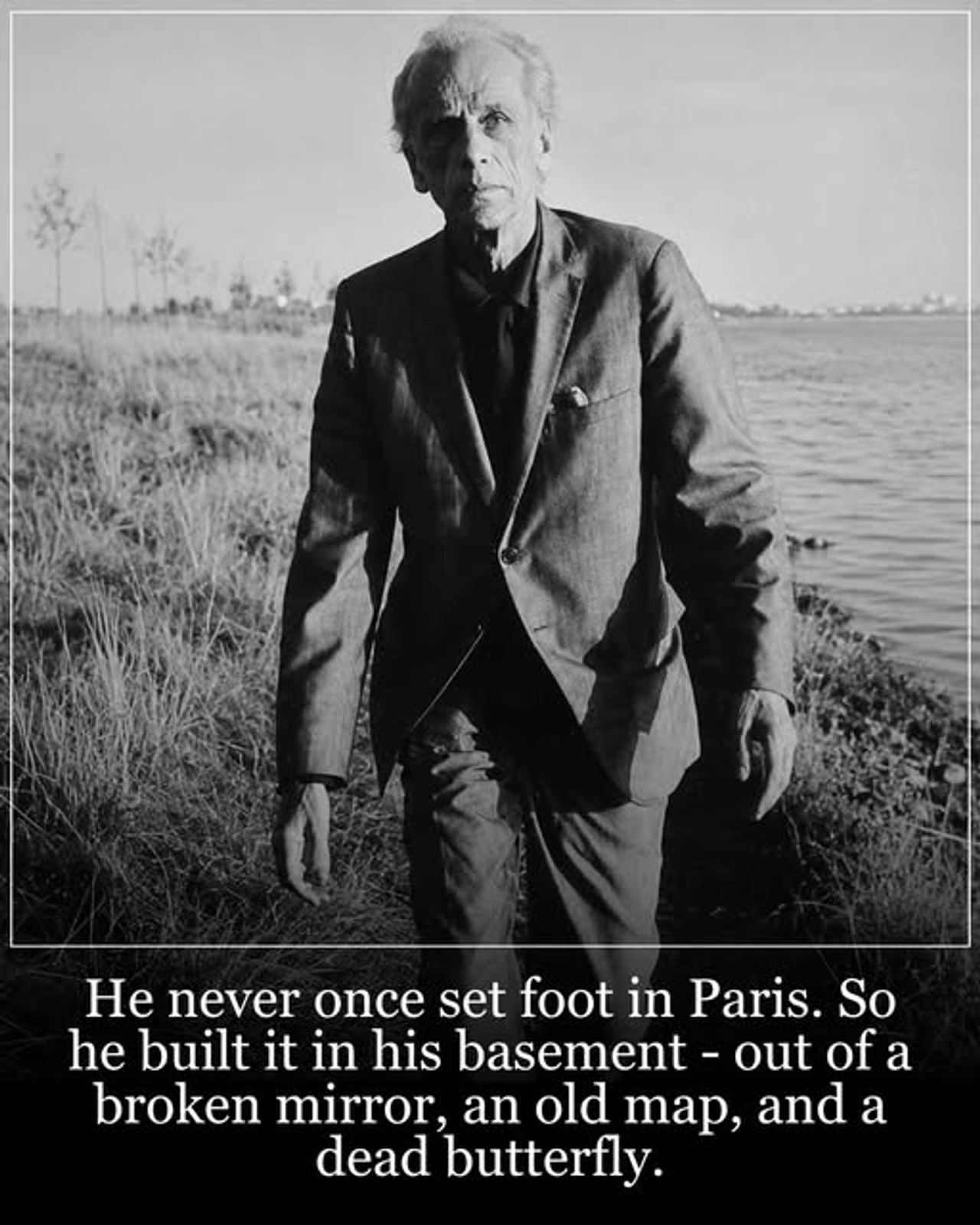
So Cornell turned instead to what was near at hand. He wandered secondhand shops and flea markets in New York, buying for pennies the things other people had discarded: cracked mirrors, old star charts, ballet photographs, dried flowers, clock parts, ticket stubs. At night, after his mother and brother had gone to sleep, he would disappear into the basement and arrange these fragments inside old wooden boxes. In his hands, the abandoned became luminous.
He called them his poetic theaters. Each box held its own atmosphere: one devoted to a forgotten opera singer, one built around the night sky, another filled with a longing so quiet it seemed to hum. They were tiny worlds, but they felt vast. Looking into one could be a brief glance or a long encounter; either way, the eye kept discovering more.
In the early 1930s, the New York gallery owner Julien Levy saw the boxes and immediately understood that something unusual was there. Cornell’s work did not announce itself loudly. It invited a person to lean in, to pause, to remember. What he made from castoffs was not only art, but a form of tenderness — a way of rescuing beauty from neglect.
Cornell never crossed an ocean, but he created places that seemed to travel farther than maps could. In the end, his life remained rooted in Queens, in care, in routine, in solitude. And yet from that narrow stretch of ground, he built quiet miracles that still feel alive: small, haunting reminders that even the most overlooked things can be made to shimmer.